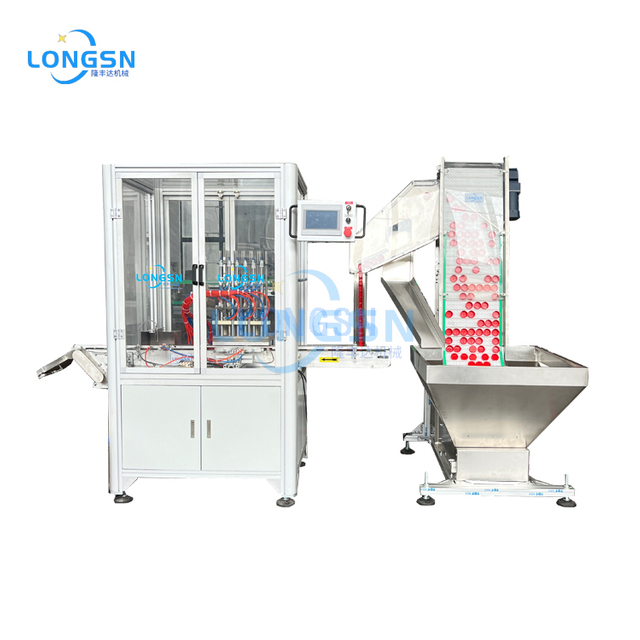
While many manufacturing lines have fully automated their filling and capping stations, liner insertion often remains a hidden bottleneck. This specific stage is frequently left to manual labor or semi-automated systems that struggle to keep pace with high-speed upstream equipment. The result is production variability, where the speed of the entire line is dictated by its slowest, least consistent component. This disconnect creates operational friction and limits the overall efficiency of the packaging floor.
The limitations of manual insertion go beyond simple speed. Human error introduces significant risks, including inconsistent seal pressure, potential contamination, and the possibility of missing liners. In contrast, fully automated systems offer precision engineering designed to eliminate these variables. They ensure that every cap receives the correct liner, seated at the exact depth, every single time.
This guide serves as a strategic resource for production managers and decision-makers evaluating the integration of an Auto Bottle Cap Assembly Liner Inserting Machine. We will move beyond basic definitions to analyze the operational impact, financial return on investment, and compliance advantages of automating this critical packaging step.
Key Takeaways
Efficiency Gains: Automation typically yields a 20–30% increase in throughput compared to manual processes.
Compliance Security: Automated torque and pressure control significantly reduce leak risks and support FDA/GMP traceability.
Material Economy: Precision handling reduces liner waste and raw material costs over time.
ROI Timeline: With proper integration, ROI is often realized within 24–36 months through labor reallocation and waste reduction.
Why Upgrade to an Auto Bottle Cap Assembly Liner Inserting Machine?
The decision to automate is rarely just about going faster. It is about establishing a predictable, controllable manufacturing environment. When you replace manual stations with an advanced auto bottle cap assembly liner inserting machine, you are primarily investing in consistency.
Beyond Speed—True Throughput Consistency
Speed creates headlines, but consistency delivers profit. Manual production rates naturally fluctuate throughout a shift. Operators experience fatigue, breaks are necessary, and focus can drift. This phenomenon, often referred to as the "Monday morning" factor, causes OEE (Overall Equipment Effectiveness) scores to dip unpredictably.
Automated systems eliminate this variance. They provide a continuous flow that allows upstream injection molding machines and downstream capping stations to run at their optimal set points without starvation or accumulation. By stabilizing the heartbeat of the line, you unlock the true capacity of your existing equipment.
Precision and Material Handling
Modern closures require handling delicate materials that human hands often damage. Foil liners, foam wads, and complex vented liners can easily wrinkle or tear if mishandled. Automated systems utilize sophisticated pick-and-place or rotary insertion mechanisms designed for gentle precision.
These mechanisms ensure liners are placed flat and seated firmly at the bottom of the shell. This prevents "double-fills" (where two liners are accidentally inserted) or "missing liners," both of which can cause catastrophic leaks during shipping. For high-speed lines, this mechanical repeatability is the only way to guarantee product integrity.
Workforce Reallocation and Safety
The argument for automation often centers on labor reduction, but the more strategic view is labor elevation. Manual liner insertion is a repetitive, low-value task that carries a high risk of Repetitive Strain Injuries (RSI) like carpal tunnel syndrome. These injuries lead to increased insurance costs and workforce turnover.
By automating this task, you upgrade roles rather than just cutting jobs. Staff can be retrained for high-value positions such as quality control, machine supervision, and line maintenance. This shift not only improves safety metrics but also boosts morale by offering employees more engaging, technical responsibilities.
Elevating Quality Control and Regulatory Compliance
In regulated sectors like pharmaceuticals, food, and beverage, the liner is not just a component; it is the primary barrier protecting consumer health. Automation transforms quality control from a reactive sampling process into a proactive assurance system.
Ensuring the "Perfect Seal"
A liner must be mechanically amalgamated with the cap to function correctly. This often requires a precise combination of pressure and, in some cases, heat, to create a tamper-evident and leak-proof seal. Manual application rarely achieves the uniform pressure required to seat a liner permanently behind the retention beads of a cap.
Automated inserters apply calibrated force to every single unit. This ensures that when the cap is torqued onto a bottle, the liner performs exactly as engineered, preventing oxygen ingress or liquid leakage.
Cleanroom and Hygiene Standards
Hygiene is non-negotiable for ingestible products. Human interaction with liners is a primary vector for biological contamination. Automated machines remove the "human touch" from the equation, significantly lowering bio-burden risks.
Furthermore, advanced machines offer features specifically for cleanroom environments. For example, cold perforation cutting technology is preferred over heat cutting for certain materials. Heat cutting can generate smoke or burnt particles, whereas cold cutting produces a clean, dust-free edge. This capability helps manufacturers meet strict standards such as ISO 14644 and FDA 21 CFR Part 11, ensuring full traceability of the production batch.
Defect Detection Integration
Modern liner inserters are rarely standalone units; they are intelligent systems. They integrate seamlessly with vision inspection cameras. These systems scan every cap immediately after insertion to verify liner presence, position, and orientation.
If a defect is detected—such as an inverted liner or a damaged foil—the machine auto-rejects that specific cap before it exits the system. This prevents defective closures from ever reaching the filling line, saving the cost of the filled product and the bottle itself.
Assessing Flexibility: Single-Format vs. Multi-Format Lines
One of the biggest challenges in selecting machinery is balancing current needs with future flexibility. Manufacturers must decide between "fixed" automation designed for speed and "flexible" automation designed for variety.
The Dilemma of Fixed vs. Flexible Automation
Fixed (or "hard") automation is engineered for high-volume, single-SKU runs. These machines are incredibly fast and efficient but rigid. If you produce millions of the exact same 28mm water bottle cap, this is the cost-effective choice.
However, contract packagers (Co-packers) often face a different reality. They handle multiple bottle sizes, cap diameters, and liner materials in a single week. For these operations, flexible (or "soft") automation is essential. The table below outlines the core differences to help guide your selection:
| Feature | Fixed Automation | Flexible Automation |
|---|
| Target Volume | High Volume, Single SKU | Medium Volume, High Mix |
| Primary Benefit | Maximum Speed & Lower Unit Cost | Versatility & Agility |
| Changeover Time | Hours (Requires tools) | Minutes (Tool-less SMED) |
| Ideal User | Dedicated Brand Manufacturers | Contract Packagers (Co-packers) |
Changeover Efficiency (SMED)
If your production schedule requires frequent switches between products, changeover time becomes a critical KPI. You should evaluate machines based on their "tool-less changeover" capabilities. This concept, derived from SMED (Single-Minute Exchange of Die) principles, allows operators to switch size parts—such as star wheels and guides—by hand, without needing wrenches or complex calibration.
Rapid switching is critical for lines running multiple cap diameters, for example, transitioning from a standard 28mm cap to a 38mm wide-mouth closure. A machine that takes four hours to convert kills productivity; a machine that converts in 20 minutes keeps the line profitable.
Complex Closures Compatibility
Standard flat caps are the industry norm, but shelf differentiation is driving complex designs. Sport caps, Child-Resistant Closures (CRC), and irregular geometric shapes (like squares or ovals) present feeding challenges. Advanced automation can handle these complex geometries using specialized vibratory bowls and orientation tracks, ensuring that even difficult-to-handle caps are lined securely.
Calculating the ROI and Total Cost of Ownership (TCO)
Investing in an Auto Bottle Cap Assembly Liner Inserting Machine requires a higher upfront Capital Expenditure (CapEx) than manual stations. However, the Total Cost of Ownership (TCO) analysis almost always favors automation over the medium to long term.
Hard Cost Savings
The most immediate savings appear in labor and materials. You eliminate the direct salary and benefits costs of manual assemblers. Furthermore, you reduce "training churn"—the hidden cost of constantly hiring and training temporary staff for high-turnover manual positions.
Material savings are equally significant. Manual insertion often results in a higher scrap rate due to damaged liners or dropped caps. Precision automation handles materials gently, reducing waste percentages to near zero. Over millions of cycles, pennies saved per unit compound into substantial figures.
Soft Cost Savings (Risk Mitigation)
Soft costs are often ignored until a crisis hits. Consider the financial impact of a single product recall due to leakage or contamination. The direct costs of logistics, disposal, and refunds are high, but the damage to brand reputation can be irreversible.
Retailers also impose strict chargebacks for non-conforming goods. Consistent quality helps you avoid these penalties and maintains your status as a reliable supplier. These risk mitigation factors essentially act as an insurance policy built into your production line.
Payback Period Benchmarks
Industry standards suggest that for well-utilized automated lines running at least two shifts, the typical payback period is between 24 and 36 months. After this break-even point, the efficiency gains contribute directly to the bottom line, improving margins on every unit produced.
Implementation Risks and Selection Criteria
Successful implementation requires careful planning. Dropping a new machine onto the floor without considering the ecosystem can lead to new bottlenecks.
Integration with Upstream/Downstream Equipment
The liner inserter must talk to the rest of the line. It needs to sync with the output of injection molding machines or the demand of the capping station. If the inserter runs too fast, caps accumulate and jam; if it runs too slow, it starves the filler.
Advanced integration involves using sensors and PLC logic to create a balanced line flow. The machine should automatically ramp speed up or down based on the queue of available parts, ensuring smooth operation.
Space and Layout Constraints
Factory floor space is often premium real estate. When selecting a machine, consider the footprint. Horizontal rotary machines offer high speed but take up more floor area. Vertical layout options might be necessary for tighter spaces. Analyzing the flow of materials—where the raw caps enter and where the lined caps exit—is crucial to prevent cross-traffic and ensure ergonomic operation for staff.
Vendor Support and Maintenance
The best machine is useless if it lacks support. Prioritize vendors who guarantee the availability of spare parts and offer remote diagnostic capabilities. Modern machines often feature IoT connectivity, allowing technicians to troubleshoot PLC logic remotely to solve issues in minutes rather than days. Decision-makers should look for predictive maintenance features that alert operators to wear before a part fails, preventing unplanned downtime.
Conclusion
Integrating an auto bottle cap assembly liner inserting machine is more than a hardware purchase; it is a process transformation. It shifts the production focus from managing labor variability to managing machine precision. By securing the seal, reducing waste, and enabling higher throughput, automation addresses the root causes of production inefficiency.
For high-volume manufacturers or those in high-compliance industries, the cost of not automating—measured in risks, recalls, and labor challenges—now far exceeds the cost of implementation. The technology has matured to a point where reliability is high and ROI is predictable.
To move forward, we recommend conducting a thorough audit of your current production line. Identify your specific bottlenecks and contamination risks. With this data, you can select the machine model that fits your specific volume and regulatory requirements.
FAQ
Q: What production volume justifies investing in an auto liner inserting machine?
A: Typically, production lines running above 20-30 caps per minute or operations running multiple shifts will see a quick ROI. High-volume environments maximize the benefits of speed and labor reduction. Conversely, extremely low-volume or artisan batch runs may not generate enough savings to justify the initial CapEx unless specific quality compliance standards make manual insertion impossible.
Q: Can one machine handle both wadded and induction seal liners?
A: Yes, many machines are designed for versatility. However, handling different liner types often depends on the flexibility of the feeder bowl and the cutting mechanism. You should specifically look for "multi-format" specifications that allow for the handling of both rigid wads and delicate foil induction seals without damaging the materials.
Q: How long does a typical size changeover take?
A: It depends heavily on the machine's design. Modern machines featuring "tool-less" changeover technology can often switch sizes in 15–30 minutes. Older systems or "fixed" automation lines that require manual unbolting and recalibration of parts may take several hours, significantly impacting uptime.
Q: Is it necessary to have a cleanroom environment for these machines?
A: Not always. However, if you are in the food, beverage, or pharmaceutical sectors, the machine itself should be capable of "clean design." This means it should be constructed with stainless steel, have minimal crevices for dust accumulation, and be easy to sanitize. Some machines offer specific cleanroom features like HEPA filters and cold-cutting technology.

 English