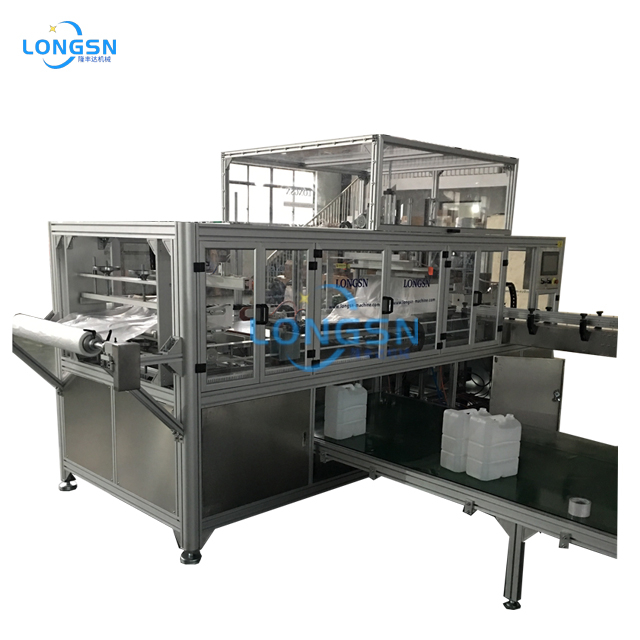
High-speed blow molding lines frequently outpace the capabilities of manual packing crews. When your molders are cycling efficiently but the downstream packing station is clogged with labor shortages or slow manual stacking, your entire plant’s Overall Equipment Effectiveness (OEE) suffers. This bottleneck does not just slow down throughput; it introduces inconsistent stack quality and forces expensive production pauses. For Operations Directors, the disparity between upstream speed and downstream handling is a daily operational headache that eats into margins.
The solution lies in shifting from manual intervention to an Automatic Empty Bottle Bagging Machine. These systems do more than simply replace human labor; they serve as a critical inventory buffering node and a rigorous quality control checkpoint. By automating the collation and bagging process, manufacturers can secure their inventory against contamination while decoupling production speeds from filling schedules. In this guide, we will walk through the essential feature evaluations, integration challenges, hygiene compliance requirements, and the realistic Total Cost of Ownership (TCO) calculations needed to justify this capital investment.
Key Takeaways
Throughput Synchronization: Automation bridges the gap between 24/7 blow molding cycles and intermittent filling schedules.
Hygiene & Compliance: Eliminating manual touchpoints is now a requirement, not a luxury, for food and pharma standards.
Hidden Cost Reduction: Significant savings come from reduced dunnage (trays/strapping) and lower shipping damage rates, not just labor reduction.
Integration Matters: Success depends on how the bagger pairs with upstream conveyors (air vs. belt) and downstream palletizers.
The Business Case: Why Automate Empty Bottle Handling?
The decision to install automated bagging equipment often starts with a labor analysis, but the strategic benefits extend far beyond headcount reduction. For plant managers, the primary value proposition is the stabilization of the production ecosystem.
Decoupling Production from Filling
One of the most persistent challenges in bottle manufacturing is the synchronization between blow molding and filling. Blow molders are most efficient when running continuously 24/7, whereas filling lines often operate on different shifts, require frequent changeovers, or experience unplanned downtime. An Automatic Empty Bottle Bagging Machine functions effectively as an "Intermediate Bottle Storage System" (IBSS).
By bagging bottles into dense, stackable "bricks," you create a buffer. You can continue to run the blow molding equipment at full speed even if the filling line is down for maintenance. This decoupling allows operations to maximize the return on assets for the expensive molding machinery without being throttled by downstream constraints.
Labor Market Resilience
Reliability in staffing is currently a major risk factor for manufacturing. Manual stacking and bagging of empty bottles is repetitive, ergonomically difficult work that often leads to repetitive strain injuries and high turnover. Moving beyond the simple narrative of "cutting costs," automation provides resilience. A machine does not call in sick, does not get fatigued after an eight-hour shift, and does not suffer from the inconsistencies in stack quality that tired operators might introduce. Automating this process stabilizes operations against the volatility of the local labor market.
Hygiene and Contamination Risks
In the food, beverage, and pharmaceutical sectors, the "No-Touch" standard is becoming the baseline expectation. Every time a human operator handles a bottle, there is a risk of contamination, whether from contact with the bottle neck or the introduction of foreign particles. Automated bagging seals bottles immediately after they leave the conveyor.
Unlike open tier sheets used in palletizing, which leave bottles exposed to warehouse dust and moisture, a sealed bag offers a hermetic environment. This protection is critical for long-term warehousing, ensuring that containers remain pristine from the moment they are molded until they enter the filler’s rinsing cycle.
Space and Dunnage Optimization
Warehouse space is a finite and expensive resource. Manual palletizing often relies on loose stacking with dividers, tier sheets, and top frames to maintain stability. This method is inefficient regarding volume. Automated baggers create tight, compressed bundles that maximize cubic utilization.
Furthermore, this approach drastically reduces consumable inventory. You no longer need to purchase, store, and manage the logistics of cardboard trays, tier sheets, or strapping materials. The plastic film used for bagging is significantly cheaper per unit than the cumulative cost of traditional dunnage.
| Comparison Factor | Manual/Tray Packing | Automated Bagging |
|---|
| Consumables | High (Trays, tier sheets, strapping) | Low (LDPE/HDPE Film) |
| Hygiene | Open exposure, manual handling | Sealed, "No-Touch" process |
| Warehouse Density | Low (Air gaps, pallet overhang) | High (Compressed bricks) |
| Labor Dependency | High (1-2 operators per line) | Low (1 operator for multiple lines) |
Evaluating Automatic Empty Bottle Bagging Machines: Critical Features
When soliciting quotes from vendors, the technical specifications can vary wildly. To ensure the equipment matches your specific operational needs, you must evaluate several critical subsystems.
Infeed and Accumulation Logic
The efficiency of the bagger is dictated by how well it accepts bottles from the line. For high-speed lines, a multi-lane configuration is essential to match the Bottles Per Minute (BPM) output without causing back-pressure jams. However, the real challenge lies in handling unstable containers.
Modern lightweight PET bottles are often top-heavy or have non-round footprints. Older machines required upstream dividers to keep these bottles upright, adding complexity and jam points. Advanced systems now utilize sophisticated collation tunnels and low-friction side guides that prevent "shingling" (where bottles overlap like roof shingles) or tipping. If your production mix includes lightweight 500ml water bottles or oval cosmetic containers, prioritize systems with proven stability logic.
Motion Control: Servo vs. Pneumatic
The debate between servo-driven and pneumatic controls is about precision versus initial cost. Pneumatic systems utilize compressed air cylinders to push rows of bottles. While cheaper upfront, they operate with a "bang-bang" motion that can dent delicate, lightweight bottles. They also consume vast amounts of compressed air, which is one of the most expensive utilities in a plant.
Servo-driven pushers offer variable speed and torque control. They can accelerate gently to contact the bottles and then speed up to complete the row transfer, ensuring smooth handling. From a maintenance perspective, servos reduce the TCO by eliminating the chase for air leaks and replacing worn cylinder seals. For any high-speed application, servo technology is the superior choice for long-term reliability.
Bagging Configuration & Changeover
Flexibility is paramount if your line runs multiple SKUs. You need to determine if you require full-enclosure bags (6-sided sealing) for maximum hygiene or if sleeve options (open sides) are sufficient for your supply chain. 6-sided sealing provides the best protection against dust but requires more complex film handling.
Changeover speed is another major differentiator. Look for machines offering tool-less adjustments. Operators should be able to adjust lane guides, pusher heights, and film roll widths using hand cranks or digital presets rather than searching for wrenches. A changeover that takes 4 hours kills efficiency; a well-designed machine should allow a size change in under 30 minutes.
Safety and Guarding Standards
Never compromise on safety architecture. An automated bagger involves high-speed moving parts and heat sealing bars. Essential specifications include:
Guarding: Full polycarbonate guarding that provides visibility while preventing reach-in access.
Interlocks: Doors must feature safety interlocks that immediately halt the machine if opened.
Safety Category: Look for Category 3 or 4 safety architectures (dual-channel monitoring) to comply with modern ISO standards.
Ergonomics: Features like auto-height adjustment for the stacking table prevent operators from bending excessively when managing the discharge.
Upstream and Downstream Integration Challenges
The bagger does not exist in a vacuum. Its performance is entirely dependent on the handoff from the blow molder and the handoff to the warehouse.
The Upstream Handoff: Conveyor Selection
Getting the bottle to the bagger is half the battle. For lightweight PET bottles, air conveyors are practically mandatory. They support the bottle by the neck ring, preventing them from falling over due to air currents or line vibration. Using a standard belt conveyor for light PET often results in mass jams before the bottles ever reach the accumulator.
Conversely, for HDPE jugs or heavier, stable containers with flat bottoms, tabletop chain or mat-top belt conveyors are ideal. They are energy efficient and easier to maintain. The choice relies heavily on the center of gravity of your container.
Bottle Orientation Strategy (Neck-Up vs. Neck-Down)
Orientation affects both hygiene and stack stability. The dairy and food industries frequently prefer a "Neck-Down" orientation. This leverages gravity to ensure that any potential debris or plastic flash falls out of the bottle before it is sealed in the bag. However, "Neck-Up" is often more stable for bottles with small bases. You must analyze your bottle geometry to see which orientation creates a more interlocking, stable pattern inside the bag to prevent the "brick" from collapsing during transit.
Downstream Handoff: Stacking and Palletizing
Once the bag is sealed, it must be palletized. Decisions here range from semi-automatic to fully fully automatic.
Semi-Auto: The bagger pushes the finished bundle onto a table where an operator manually places it on a pallet. This is cost-effective for lower speeds but retains an ergonomic burden.
Fully Auto: A robotic palletizer picks the bag and places it. This is necessary for high-speed lines (above 20 bags per minute).
Crucially, the programming must allow for interlocking stack patterns (rotating layers 90 degrees) to ensure the pallet does not telescope or tip over during truck transport.
Compliance, Verification, and Quality Control
Automated bagging systems are increasingly serving as data points for quality assurance.
Traceability Features
In the event of a product recall, knowing exactly when a bottle was produced is vital. Modern baggers can integrate thermal transfer printers to apply batch codes, timestamps, and line numbers directly onto the film of every bag. This granular traceability protects your brand by limiting the scope of any potential recall to specific batches rather than entire days of production.
Additionally, smart systems feature "Order Rejection" logic. Sensors detect if a bottle has fallen over in the accumulation row or if a row is incomplete. The machine automatically rejects these errors before they are pushed into the bag, ensuring every shipped unit meets the count specification.
Material Compatibility
Sustainability goals are driving changes in film materials. You need a machine capable of running various film thicknesses (mil ratings). While thinner films reduce plastic waste and cost, they are harder to seal and more prone to tearing. The machine's sealing bars must have precise temperature controls (often PID loops) to handle these sensitive materials without burning through or creating weak seals. Compatibility with Post-Consumer Recycled (PCR) content films is also becoming a standard requirement for meeting corporate sustainability mandates.
Calculating ROI and Total Cost of Ownership (TCO)
Justifying the investment requires a holistic look at costs.
Hard Cost Drivers
The most direct savings come from labor reduction. If a manual line requires two people per shift to stack and bag, and you run three shifts, that is six Full-Time Equivalents (FTEs). An automated system typically reduces this to a fractional operator role (someone who oversees the line while doing other tasks). Multiply the average burdened labor rate by the reduced hours to find your primary savings.
Material savings are also significant. Calculate the annual spend on wooden pallets (if moving to slip sheets), cardboard trays, dividers, and strapping. Compare this against the cost of polyethylene film rolls. The difference is often stark enough to shorten the ROI period by several months.
Soft Cost/Risk Drivers
Do not ignore the "hidden" costs. Manual packing results in looser bundles that shift during transport. What is your current scrap rate due to shipping damage? Automated baggers create tight, uniform bundles that survive transit far better. This reduction in customer credits and returns is real money.
Warehousing efficiency also contributes to ROI. If automated bagging allows you to stack pallets three high instead of two high due to better stability, you have effectively increased your warehouse capacity by 33% without building a single square foot of new space.
Implementation Risks
TCO must include the cost of implementation. Installation downtime can disrupt production schedules. Furthermore, there is a training gap. Your maintenance team may be excellent at mechanical repairs, but do they know how to troubleshoot a servo drive or a PLC logic error? Budget for vendor training to ensure your team can keep the high-tech asset running at peak efficiency.
Conclusion
Automated bagging is the strategic bridge between high-efficiency production and flexible logistics. It resolves the fundamental conflict between the continuous nature of blow molding and the intermittent demands of filling and shipping. By stabilizing the process, enhancing hygiene compliance, and optimizing warehouse density, these systems offer a compelling return on investment.
Before soliciting vendor quotes, we encourage you to conduct a comprehensive audit of your current operations. Quantify your "scrap due to handling," analyze your labor turnover rates in the packing department, and review your current dunnage spend. With this data, you will be well-positioned to select an automated solution that transforms your downstream operations from a bottleneck into a competitive advantage.
FAQ
Q: What is the typical speed limit for an automatic empty bottle bagging machine?
A: Speeds generally range from 150 BPM (Bottles Per Minute) on entry-level models to over 600+ BPM on high-speed, multi-lane systems. The actual achievable speed often depends more on the stability of the bottle shape and the type of upstream conveyor than on the mechanical limit of the bagger itself. Lightweight or unstable bottles may require slower accumulation speeds to prevent tipping.
Q: Can these machines handle square or rectangular bottles?
A: Yes, automated baggers can handle square, rectangular, and oval bottles. However, these shapes require specific collation and accumulation tunnel designs. Unlike round bottles which can rotate freely, square bottles must be maintained in a precise orientation to form a neat row. This often involves specialized side guides and turning devices upstream.
Q: How does automated bagging improve hygiene compared to manual packing?
A: Automation creates a "no-touch" environment. Bottles are conveyed directly from the blow molder into the bagger without human contact, reducing the risk of contamination from hands or clothing. Furthermore, the machine seals the bag immediately, protecting the bottles from cardboard dust, moisture, and warehouse debris, which is a common issue with open-tray packing methods.
Q: Do I need a dedicated operator for an auto-bagger?
A: Generally, no. One operator can usually supervise multiple automated bagging lines. Their primary responsibilities shift from physical stacking to process monitoring, replenishing film rolls, and clearing occasional jams. This allows for a significant reduction in labor costs and frees up staff for more value-added tasks within the plant.

 English