Capital expenditure in plastic manufacturing demands strict alignment between machinery capabilities, part geometry, and production scale. Selecting the wrong molding technology permanently bottlenecks production and inflates unit costs. Manufacturers frequently struggle to quantify the trade-offs between tooling costs, cycle times, and dimensional tolerances when deciding between extrusion-based and injection-based systems. Misalignment leads to excessive scrap rates, unacceptable wall thickness variations, or over-engineered tooling for low-volume runs. This guide provides an evidence-based framework for evaluating an Extrusion Blow Moulding Machine against injection molding and injection blow molding (IBM) alternatives. We focus on geometric constraints, capital expenditure, and production scalability to ensure your equipment investment matches your operational requirements.
- Geometry Dictates the Process: An extrusion blow moulding machine is mandatory for large, asymmetrical hollow containers (especially those with handles) and laboratory ware, whereas standard injection molding is required for solid, 3D parts.
- Precision vs. Tooling Costs: Injection blow molding (IBM) offers superior neck and thread precision with zero flash, but requires significantly higher initial tooling capital compared to extrusion blow molding (EBM).
- Volume Thresholds: EBM provides a faster ROI for low-to-medium volume runs due to cheaper molds, while injection processes achieve better economies of scale in ultra-high-volume production of small, precise parts.
- Material Utilization: EBM inherently produces scrap (flash) that requires a regrind system, whereas injection processes are generally scrap-free but demand specific melt-flow characteristics.
Defining the Core Manufacturing Technologies
The Extrusion Blow Moulding Machine (EBM) Mechanics
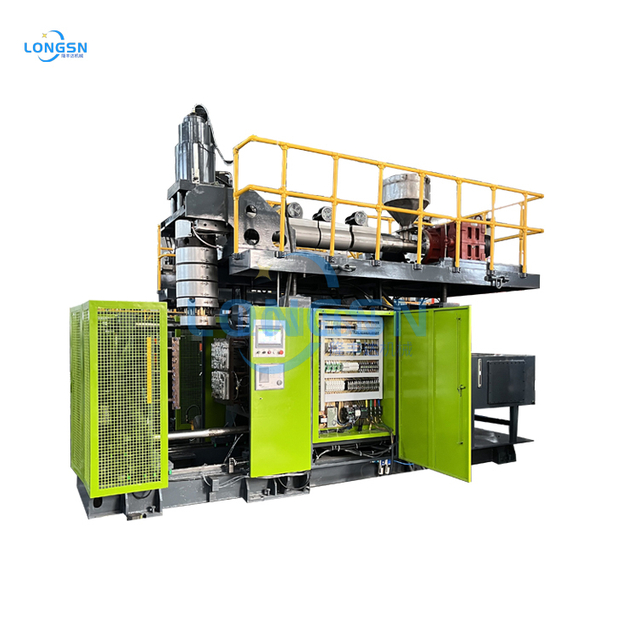
An extrusion blow moulding machine operates by melting plastic resin and forming it into a parison. This hollow tube of melted plastic is produced either continuously or intermittently using an accumulator head. Continuous extrusion is typically used for smaller containers where the extruder runs constantly, and the mold shuttles to capture the parison. Accumulator head machines are reserved for large industrial parts, like 55-gallon drums or automotive fuel tanks, where a large volume of plastic must be pushed out rapidly to prevent the parison from sagging under its own weight before the mold closes.
The process differs significantly from profile extrusion, which creates continuous linear, 2D shapes like pipes or tubing. Extrusion blow molding forms 3D hollow objects by clamping the parison inside a mold and inflating it with compressed air. During the cycle, the mold closes around the extruded parison. The clamping action pinches the top and bottom of the tube, sealing the plastic. Air is then injected through a blow pin, forcing the plastic against the chilled mold walls where it cools and solidifies. This necessary pinch-off action inherently creates flash, which is excess material that must be trimmed away after the part is ejected.
Injection Blow Molding (IBM) vs. Standard Injection Molding
Standard injection molding injects molten resin directly into a solid cavity under high pressure. This process produces solid, complex 3D parts such as caps, closures, structural components, and syringes. The tooling requires massive clamping forces to keep the mold halves shut against the injection pressure. It cannot produce enclosed hollow parts without secondary welding operations, making it unsuitable for bottles or tanks.
Injection blow molding (IBM) combines injection and blowing techniques. It first injects resin over a core pin to create a highly accurate preform. This preform looks similar to a test tube with fully formed neck threads. The preform is then transferred to a blow station and inflated against the final mold cavity. IBM is ideal for small, precision hollow bottles, typically under 500ml. In this guide, we contrast EBM against both IBM for hollow parts and standard injection for solid components to establish clear boundaries for equipment selection.

Part Geometry and Design Constraints (Success Criteria)
Hollow Containers vs. Solid Structures
Physical limitations dictate the choice of machinery. EBM cannot produce solid parts. Conversely, standard injection molding cannot produce enclosed hollow parts without complex secondary processes. The fundamental design of the product determines the required technology. When evaluating a new product design, the presence of an enclosed internal volume immediately points toward a blow molding process.
EBM excels in specific product applications. It is the standard for manufacturing jugs, industrial tanks, automotive ducting, beakers, and complex hollow shapes. If your product requires a large, enclosed internal volume, an extrusion blow moulding machine is typically the most viable solution. Below is a comparison of geometric capabilities across the three primary processes.
| Feature/Requirement | Extrusion Blow Molding (EBM) | Injection Blow Molding (IBM) | Standard Injection Molding |
| Part Structure | Hollow, thin-walled | Hollow, thin-walled | Solid, thick or thin-walled |
| Integrated Handles | Excellent capability | Impossible | N/A (Solid parts only) |
| Asymmetrical Shapes | High capability | Low capability (requires symmetry) | High capability |
| Maximum Part Size | Very Large (up to 1000L+) | Small (typically < 1L) | Varies by machine tonnage |
Neck Precision and Threading Tolerances
Dimensional accuracy varies significantly between processes. IBM utilizes injection-molded preforms, guaranteeing exact neck finishes and thread details. Because the neck is formed in a solid steel cavity under high injection pressure, the dimensions are locked in before the blowing phase even begins. This process holds tight tolerances, making it essential for pharmaceutical, medical, or cosmetic closures where precise sealing is critical.
EBM neck finishes are formed by blowing and mechanical calibration. The blow pin enters the top of the parison, forcing the plastic into the neck threads of the mold. This results in wider tolerances compared to IBM. While suitable for many consumer goods, these wider tolerances can present sealing challenges for highly pressurized contents or aggressive chemicals that require absolute leak-proof closures. Secondary facing operations are sometimes required on EBM parts to ensure a perfectly flat sealing surface.
Complex Shapes, Handles, and Multi-Layer Requirements
EBM demonstrates clear superiority in forming highly asymmetrical, complex hollow shapes. It is the only practical method for creating containers with integrated handles, such as milk jugs, watering cans, and detergent bottles. The ability to manipulate the parison allows for significant design freedom in container geometry. The mold simply pinches off the center section of the handle, creating a solid web of flash that is later punched out.
IBM faces geometric limitations. It requires symmetrical designs because it relies on a preform stretched over a rigid, symmetrical core pin. If the final shape is too asymmetrical, the plastic will not distribute evenly during inflation. Additionally, EBM offers co-extrusion capabilities for multi-layer barriers. This allows manufacturers to incorporate UV protection, oxygen barriers, or recycled cores into the container walls. Co-extrusion die heads can layer up to seven different materials simultaneously, a feature that is highly complex or impossible to achieve with standard IBM.
Production Volume and Cycle Time Realities (Evaluation Dimensions)
Tooling Costs vs. Per-Part Costs
Capital expenditure profiles differ drastically based on the required tooling. EBM molds operate at lower internal pressures, typically between 80 and 150 psi during the blowing phase. This allows manufacturers to use cheaper materials like aircraft-grade aluminum or zinc alloys for the mold cavities. Aluminum is easier to machine and offers superior thermal conductivity, which reduces cooling times. This results in significantly lower initial tooling costs, reducing the financial barrier to entry for new product launches.
IBM and standard injection tooling require high-pressure, hardened steel molds to withstand injection pressures that can exceed 10,000 psi. IBM often requires two complete sets of molds: one for the injection preform and one for the final blow cavity. This drastically increases upfront tooling costs, requiring substantial capital investment before production begins. The steel molds take longer to machine and require complex internal cooling channels to manage the heat load.
Scalability, Volume Thresholds, and Cavitation Limits
Break-even points dictate the financial viability of each process. EBM is highly cost-effective for low-to-medium volumes, typically ranging from 10,000 to 1,000,000 units. It is also the standard for large-scale industrial containers where high cavitation is impractical. When scaling production, manufacturers must evaluate the following steps:
- Assess the annual volume requirements and peak seasonal demand.
- Calculate the maximum cavitation possible based on the machine's platen size and extruder output.
- Determine the cycle time based on wall thickness and cooling capacity.
- Compare the amortized tooling cost per part across EBM and injection alternatives.
Injection processes scale differently. High cavitation molds in IBM and standard injection yield unmatched, ultra-low per-part costs. A single injection mold can feature 64, 96, or even 144 cavities. However, these economies of scale are only realized when production volumes exceed the multi-million mark for small, precise bottles and parts. For lower volumes, the high tooling costs negate the per-part savings.
Material Compatibility and Scrap Management (Implementation Realities)
Resin Types and Melt Strength Requirements
Material behavior is critical for process stability. EBM requires resins with high melt strength, such as High-Density Polyethylene (HDPE) and Polypropylene (PP). High melt strength ensures the extruded parison does not sag or tear under its own weight before the mold clamps shut. Fractional melt index materials are typically specified for EBM to maintain parison integrity during the drop.
Injection processes require different material properties. They need resins with high melt flow indices (MFI) to easily fill complex mold cavities and thin walls under high pressure. Materials like PET and Polycarbonate are commonly used in injection molding but require specific modifications to be processed via EBM. Attempting to run high-flow injection grade resins in an extrusion blow moulding machine will result in uncontrollable parison sag and massive wall thickness variations.
Flash Generation and Regrind Integration
EBM inherently generates scrap. The pinch-off process creates flash at the tail and neck of the container, and in the handle areas. This reality requires manufacturers to manage scrap effectively to maintain profitability. The flash must be removed, ground up, and reintroduced into the process.
Operating an extrusion blow moulding machine requires specific auxiliary equipment. Facilities need granulators, proportional blending valves, and closed-loop regrind systems to recycle the flash back into the production stream. Dust separation systems are also critical to prevent fines from burning in the extruder. In contrast, IBM and standard injection molding are generally scrap-free, utilizing hot runner systems that eliminate sprues and runners. This eliminates the need for downstream trimming equipment and reduces material handling complexities.
Capital Expenditure and Operational Factors
Initial Machine and Mold CapEx
The base cost of machinery varies based on output capacity and technology. When comparing an extrusion blow moulding machine to an injection blow molding machine of equivalent output, the EBM system often presents a lower initial machine cost. The mechanical complexity of an EBM machine is generally lower than a three-station IBM machine. However, a complete financial assessment must include the necessary auxiliary equipment.
EBM requires trimmers, leak testers, and regrind systems. Injection systems, particularly those processing PET, require expensive dehumidifying dryers to prevent moisture-induced degradation during melting. Evaluating the complete production cell is necessary for accurate capital planning. A cheaper base machine might require more expensive downstream automation, altering the final capital requirement.
Operational Costs: Energy, Maintenance, and Labor
Energy consumption impacts long-term profitability. EBM generally requires less clamping force than high-tonnage injection machines. A typical EBM machine might require 20 to 50 tons of clamping force, whereas an injection machine for a similarly sized part might require 300 tons. This lower clamping force can potentially lower energy costs per cycle, especially when utilizing modern servo-hydraulic or all-electric drive systems.
Labor and automation requirements also differ. EBM often requires more downstream automation for deflashing and neck trimming. If automation is not implemented, manual labor is required to trim the flash, increasing operational costs. IBM and standard injection parts are typically finished upon ejection, requiring less secondary handling and potentially reducing labor costs per unit.
Implementation Risks and Mitigation Strategies
Wall Thickness Distribution and Quality Control
The primary risk in EBM is uneven wall thickness, particularly in asymmetrical or highly complex shapes. As the parison inflates, it stretches further to reach the deep corners of the mold, causing the plastic to thin out. Thin spots compromise container integrity, leading to failure during drop testing or stacking. Thick spots waste material and increase cooling time, slowing down the entire production cycle.
To mitigate this risk, specify machinery equipped with advanced Parison Programming, also known as Wall Thickness Distribution Systems (WDS). These systems dynamically adjust the die gap during extrusion, controlling the parison thickness profile. By making the parison thicker in areas that will stretch the most, manufacturers ensure uniform wall distribution in the final part. Ultrasonic thickness testing should be implemented on the production floor to verify distribution.
Changeover Times and Maintenance Realities
Mold changeover complexities impact machine uptime. EBM molds are generally lighter and faster to swap than heavy steel injection molds. A skilled crew can often complete an EBM mold change in under two hours. However, extruder purging and die-head cleaning add significant downtime during material or color changes. Disassembling a complex co-extrusion die head for cleaning can take an entire shift.
Implement Single-Minute Exchange of Die (SMED) principles to streamline mold changes. Pre-stage water manifolds and utilize quick-disconnect fittings. Utilize commercial purge compounds to minimize material transition times and reduce extruder cleaning requirements. Regular maintenance of heater bands and thermocouples is critical to prevent cold spots in the die head, which can cause parison curving and poor part quality.
Conclusion
The choice between an extrusion blow moulding machine and an injection system is dictated by part geometry, required tolerances, and production volume. Select EBM for large hollow parts, containers with integrated handles, multi-layer barriers, and projects where minimizing initial tooling CapEx is critical. Select IBM for small, high-volume hollow containers requiring flawless neck finishes and zero scrap. Select standard Injection Molding for solid, highly detailed 3D components.
- Conduct a formal design for manufacturability (DFM) review based on your specific part geometry to identify potential pinch-off issues or draft angle constraints.
- Request a mold flow analysis to verify material behavior, predict cooling times, and identify potential defects before cutting steel.
- Solicit comprehensive RFQs from machinery OEMs that detail both machine and tooling costs, including all necessary auxiliary equipment.
- Evaluate the required auxiliary equipment for scrap management, material handling, and downstream automation to ensure a complete production cell layout.
FAQ
Q: What is the main difference between extrusion blow molding and injection blow molding?
A: EBM extrudes a continuous tube of plastic (parison) that is clamped and blown, creating flash. IBM injects plastic over a core pin to make a precise preform, which is then blown, creating a flash-free, highly precise part.
Q: Can an extrusion blow moulding machine produce solid plastic parts?
A: No. EBM is exclusively designed for manufacturing hollow objects like bottles, tanks, and ducts. Solid parts require standard injection molding.
Q: Which process has higher tooling costs: EBM or Injection?
A: Injection and IBM have significantly higher tooling costs due to the need for high-pressure, hardened steel molds. EBM uses lower-pressure aluminum molds, making tooling far cheaper.
Q: Why does extrusion blow molding create scrap (flash)?
A: Flash is created when the mold halves clamp shut on the extruded parison, pinching off the top and bottom to seal the hollow shape before inflation.
Q: Is PET commonly used in extrusion blow molding?
A: Standard PET lacks the melt strength for EBM and is typically used in Injection Stretch Blow Molding (ISBM). However, modified PET (PETG) can be used in EBM.
Q: Which molding process is best for making bottles with handles?
A: Extrusion blow molding is the industry standard and most cost-effective method for producing hollow containers with integrated handles, such as milk jugs and detergent containers.

 English