The increasing demand for lightweight, complex hollow plastic components forces manufacturers to re-evaluate production lines for efficiency and design flexibility. Plant managers and procurement teams struggle to determine whether specific part geometries and production volumes justify the capital expenditure of a new molding system compared to alternative methods like injection blow molding or rotational molding. Balancing upfront tooling costs with cycle times and part quality remains a daily challenge on the factory floor. This guide breaks down the technical capabilities, industry-specific applications, and financial trade-offs of investing in an Extrusion Blow Moulding Machine, providing a framework to determine if it is the right technology for your manufacturing requirements.
- Cost-Effective Tooling: Extrusion blow moulding machines operate with significantly lower mold pressures than injection molding, allowing for cheaper, faster-to-produce tooling (often aluminum).
- Versatility in Scale: Machine configurations range from continuous extrusion for high-volume packaging to intermittent (accumulator head) systems capable of producing massive industrial tanks.
- Design Freedom: EBM excels at producing asymmetrical parts, complex automotive ducts, and multi-layer barrier containers that are impossible or cost-prohibitive with other methods.
- The Primary Trade-Off: Unlike injection blow molding, EBM inherently produces "flash" (excess material), requiring robust secondary trimming operations and efficient regrind/recycling systems to maintain profitability.
Core Mechanics of an Extrusion Blow Moulding Machine
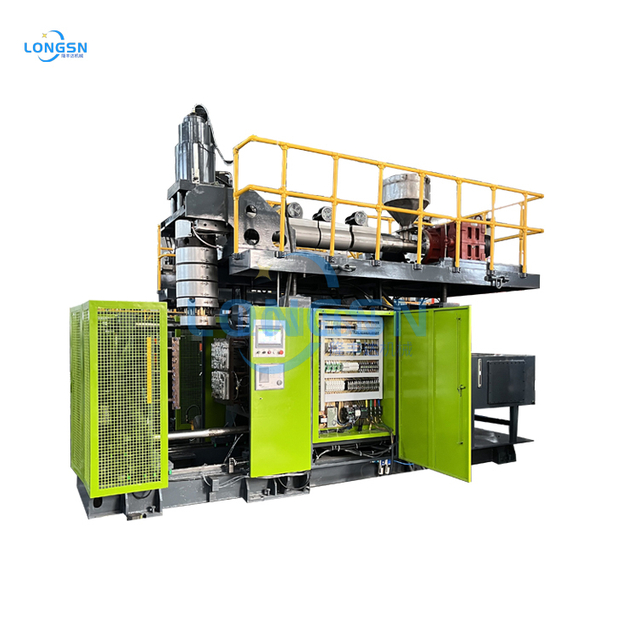
The extrusion blow molding process relies on a sequence of precise thermal and mechanical actions. You start by feeding raw polymer pellets into a heated barrel. A rotating screw melts and mixes the resin, pushing it forward through a specialized die head. This die head shapes the molten plastic into a hollow, hanging tube known as a parison. The mechanics of how this parison is handled dictate the entire production cycle.
Once the parison reaches the target length, the two halves of the mold clamp shut around it. The mold pinches the top and bottom of the tube, welding the plastic together at these extremities. A blow pin or needle then pierces the plastic, injecting compressed air into the cavity. The air pressure forces the soft polymer outward against the chilled walls of the mold. The plastic cools rapidly, taking the exact shape of the mold interior. Finally, the mold opens, and the machine ejects the solidified part for downstream trimming.
To understand the operational flow, we can break down the standard cycle into distinct phases:
- Plastication: The extruder screw melts the polymer using shear friction and external heater bands, ensuring a homogeneous melt temperature.
- Parison Extrusion: The melt flows through the die head, forming the tubular parison. The die gap controls the initial wall thickness.
- Clamping: The mold platens close rapidly, pinching the parison at the neck and base.
- Inflation: Compressed air (typically between 5 and 10 bar) enters the parison, expanding it against the mold cavity.
- Cooling: Chilled water circulates through channels inside the mold, pulling heat out of the plastic until it becomes rigid.
- Ejection and Deflashing: The mold opens, the part drops or is removed by a robot, and excess flash is trimmed away.
Continuous vs. Intermittent Extrusion
Selecting the right extrusion method depends entirely on the size and weight of the part you intend to manufacture. The physics of molten plastic dictate that a heavy parison will stretch and sag under its own weight if it hangs for too long, leading to uneven wall thickness and structural failure.
Continuous extrusion runs the extruder screw constantly. The die head continuously pushes out the parison at a steady rate. Because the plastic never stops flowing, the machine uses a moving carriage. The mold shuttles over to the die head, grabs the parison, cuts it, and moves away to a separate station for blowing and cooling. This setup is highly efficient for small to medium parts like shampoo bottles, milk jugs, and consumer goods where the parison weight is low enough that sagging is negligible.
Intermittent extrusion, specifically using an accumulator head, is mandatory for large, heavy parts like automotive fuel tanks or 55-gallon industrial drums. Instead of pushing the parison out continuously, the extruder feeds molten plastic into a holding chamber (the accumulator). Once the chamber holds the exact volume of plastic needed for one part, a hydraulic or servo-driven ram pushes the entire shot out through the die head in a matter of seconds. This rapid drop prevents the massive parison from sagging before the mold can close around it.
| Feature | Continuous Extrusion | Intermittent (Accumulator) Extrusion |
| Part Size | Small to Medium (up to 20 Liters) | Large to Massive (20 to 2000+ Liters) |
| Extruder Operation | Runs constantly, steady output | Runs constantly, feeds into a holding chamber |
| Parison Delivery | Slow, continuous drop | Rapid, high-pressure push |
| Mold Movement | Shuttles or rotates on a wheel | Stationary under the die head |
| Typical Applications | Beverage bottles, cosmetics, household chemicals | IBC tanks, automotive ducts, large drums |

High-Value Industry Applications for Extrusion Blow Moulding
Packaging and FMCG (Fast-Moving Consumer Goods)
The packaging sector relies heavily on extrusion blow molding for producing bottles, jerrycans, cosmetics containers, and household chemical packaging. High-speed continuous extrusion machines equipped with multi-cavity molds deliver the massive throughput required to keep unit costs fractions of a cent. You will often see dual-station shuttle machines running 8 to 16 cavities simultaneously, dropping finished bottles onto high-speed conveyor lines.
Co-extrusion technology pushes these capabilities further. By utilizing multiple extruders feeding into a single complex die head, manufacturers can create multi-layer containers. This allows the integration of oxygen or UV barriers (like EVOH or Nylon) for food preservation. It also enables packagers to sandwich post-consumer recycled (PCR) resin between layers of virgin plastic. This three-layer (Virgin-PCR-Virgin) approach meets aggressive sustainability targets while ensuring the recycled material never touches the consumable product.
Automotive and Transportation Components
Automotive engineers utilize this technology for complex under-the-hood components like HVAC ducts, windshield washer fluid reservoirs, fuel tanks, and seat backs. These applications typically require 3D blow molding techniques and robust accumulator head machines. 3D blow molding manipulates the parison as it drops, laying it into a complex, winding mold cavity without creating massive amounts of pinch-off flash.
The primary advantage on the assembly line is part consolidation. You can mold complex, asymmetrical, and winding geometries in a single piece rather than welding multiple injection-molded halves together. This consolidation reduces assembly steps, eliminates potential leak points at weld seams, and contributes significantly to overall vehicle lightweighting efforts. Suction blow molding, a variant of 3D EBM, is particularly useful for creating long, winding turbocharger ducts with zero flash.
Medical, Pharmaceutical, and Cleanroom Manufacturing
In the medical sector, the process produces IV fluid bottles, sterile ampoules, medical device housings, and unit-dose packaging. Blow-Fill-Seal (BFS) technology is a specialized variant that integrates extrusion, aseptic filling, and hermetic sealing into a single continuous process. The machine extrudes the parison, blows the bottle, fills it with liquid medication, and seals the top before the plastic even leaves the mold. This closed-loop system drastically minimizes contamination risks.
All-electric machines are practically mandatory in modern cleanroom environments. Traditional hydraulic machines leak oil and generate aerosolized oil mist, which violates strict air quality standards. By eliminating hydraulic fluids entirely and relying on servo motors for clamping and carriage movement, all-electric platforms ensure strict compliance with ISO cleanroom standards and FDA regulations for sterile liquid packaging.
Industrial and Chemical Storage
Heavy-duty accumulator head machines dominate the industrial packaging sector. If you need to manufacture Intermediate Bulk Containers (IBCs), 55-gallon L-Ring drums, or large agricultural tanks, you need massive clamping tonnage and high-capacity accumulator heads. These products demand exceptional durability, as they often hold hazardous chemicals and must survive rigorous drop tests.
These systems are built to handle high-molecular-weight polyethylene (HMW-PE). HMW-PE has an incredibly high melt viscosity, meaning it requires specialized grooved feed extruders and high-torque motors to process. However, processing HMW-PE ensures the final containers possess extreme drop-impact resistance, structural stability under heavy stacking loads, and the chemical inertness required for safely transporting industrial acids and solvents.
Strategic Benefits of Extrusion Blow Moulding
Favorable Tooling Economics
Tooling costs often dictate the viability of a new product launch. EBM molds are generally 30% to 50% less expensive than those used in Injection Blow Molding (IBM) or standard injection molding. The extrusion blow molding process operates at much lower internal cavity pressures (usually under 150 psi) compared to the thousands of psi required to pack out an injection mold.
Because the clamping forces are lower, you do not need to construct molds from expensive, hardened P20 tool steel. Instead, molds are typically CNC machined from aircraft-grade aluminum (like 7075) or softer steel alloys. Aluminum transfers heat much faster than steel, which improves cooling times and shortens the overall cycle. Furthermore, aluminum is significantly faster and cheaper to machine. Quicker mold production accelerates prototyping phases and shortens overall product launch cycles, allowing you to react to market trends faster.
Advanced Parison Programming and Wall Thickness Control
Controlling the distribution of plastic is the most critical skill in blow molding. Modern machines utilize servo-driven parison programming to dynamically adjust the thickness of the plastic tube as it is extruded. The die head features a movable mandrel. As the parison drops, a 100-point controller moves the mandrel up and down, altering the die gap.
This capability prevents thin corners in complex shapes. If a part has a deep draw or a sharp corner, the programmer thickens the parison at that exact spot before the mold closes. It ensures uniform wall thickness across asymmetrical geometries. More importantly, it optimizes part weight through targeted lightweighting. You can thin out the walls in non-structural areas of the bottle, reducing raw material consumption by grams per part. Over a production run of millions of bottles, this translates to massive resin savings without sacrificing structural durability.
Multi-Layer and Co-Extrusion Capabilities
Co-extrusion allows machines to extrude three, four, or even six layers of different polymers simultaneously. You achieve this by arranging multiple extruders around a central, highly complex die head. The melt streams merge just before exiting the die, creating a single parison with distinct, microscopic layers.
This multi-layer approach provides significant functional benefits. You can embed a thick core layer of regrind material while maintaining virgin plastic on the inner and outer contact surfaces. For food packaging, specific barrier properties are integrated directly into the container wall. A thin layer of EVOH (Ethylene Vinyl Alcohol) blocks oxygen ingress, extending the shelf life of ketchups and sauces. A tie-layer of adhesive resin bonds the EVOH to the structural HDPE layers, eliminating the need for secondary coating processes.
Technical Evaluation: Is an Extrusion Blow Moulding Machine Right for Your Line?
Extrusion Blow Molding (EBM) vs. Injection Blow Molding (IBM)
When evaluating EBM against IBM, neck tolerances and part size are the primary deciding factors. IBM is necessary when the container requires extreme, high-precision calibration at the neck. If you are molding leak-free pharmaceutical caps, complex snap-fit closures, or roll-on deodorant bottles, IBM is superior. The IBM process injects plastic into a solid preform mold first, ensuring the neck threads are exact down to the micrometer.
EBM is preferred when standard neck tolerances are acceptable, and the part size or volume is larger. EBM forms the neck by crushing the plastic between the mold halves and driving a blow pin into it. While accurate, it cannot match the injection-molded precision of IBM. However, IBM is typically limited to small, highly standardized containers under one liter due to the massive clamping tonnage required for the preform stage. EBM scales efficiently from 10-milliliter eye dropper bottles to industrial tanks holding thousands of liters.
Extrusion Blow Molding (EBM) vs. Rotational Molding
EBM features significantly faster cycle times and higher throughput compared to rotational molding, making it the better choice for high-volume production runs. A large EBM machine can produce a 55-gallon drum in under two minutes. Rotational molding is a slow, thermal process that bakes plastic powder inside a rotating metal shell. A similar drum might take 30 to 45 minutes to rotomold.
Rotational molding excels at producing heavy-walled, stress-free parts with uniform outer dimensions, and the tooling is incredibly cheap because there is zero internal pressure. However, EBM provides superior structural detail, such as sharp threads and molded-in handles. EBM also allows for thinner, more highly optimized walls through active parison programming. While rotational molding tooling is cost-effective for large, simple hollow parts in low volumes, EBM tooling offers better long-term scalability and vastly lower per-part costs at higher production volumes.
Material Compatibility and Processing
EBM processes a wide range of standard thermoplastic resins. The most common materials include High-Density Polyethylene (HDPE), Polypropylene (PP), Polyvinyl Chloride (PVC), Polyethylene Terephthalate Glycol (PETG), and Polycarbonate (PC). Each material requires specific screw geometries and temperature profiles.
When selecting a machine, you must evaluate the screw design, L/D (Length to Diameter) ratio, and extruder torque. The system must handle specific melt flow indexes (MFI). For blow molding, you generally need fractional melt resins (MFI less than 1.0). These resins have high melt strength, which is the physical ability of the molten plastic to hang from the die head without tearing or stretching uncontrollably under its own weight. Processing PC or PETG requires specialized barrier screws and higher heater band capacities compared to standard HDPE.
| Resin Type | Typical Applications | Processing Characteristics |
| HDPE | Milk jugs, detergent bottles, industrial drums | Excellent melt strength, easy to process, high impact resistance. |
| Polypropylene (PP) | Medical bottles, hot-fill containers, cosmetics | Higher clarity than HDPE, good heat resistance, prone to sagging if too hot. |
| PVC | Clear household chemical bottles, blister packs | Requires specialized corrosion-resistant screws, sensitive to thermal degradation. |
| PETG | Premium cosmetics, clear display packaging | Excellent clarity, requires precise temperature control, lower melt strength. |
Implementation Risks and Trade-Offs
Scrap Generation and Flash Management
EBM inherently produces flash at the top (neck) and bottom (pinch-off) of the part. Because the mold closes on a continuous tube, the excess plastic outside the cavity is crushed and welded off. Depending on the part geometry, this flash can account for 20% to 40% of the initial parison weight. If you do not manage this effectively, your material costs will destroy your profit margins.
To mitigate this, you must evaluate machines with automated in-line deflashing capabilities. The machine should punch out the neck and tail flash automatically before the part leaves the machine envelope. Furthermore, you must integrate a closed-loop regrind system. This system catches the falling flash, grinds it into uniform flakes, blends it with virgin pellets at a set ratio (e.g., 30% regrind to 70% virgin), and feeds it immediately back into the extruder hopper. This makes the process near zero-waste.
Secondary Operations and Automation
Hidden labor costs often arise from necessary secondary operations. If you rely on operators to manually trim flash, flame treat bottles for label adhesion, perform leak testing, and pack boxes, your line efficiency will suffer. Manual labor introduces human error, inconsistent trimming, and bottlenecks.
Specify machines with integrated downstream automation. Robotic part removal ensures the bottles are extracted without scratching. Automated leak testers pressurize every single bottle on the conveyor line and automatically reject any that fail to hold pressure. Integrated conveyor systems and automatic palletizers streamline the process, reduce headcount requirements, and ensure consistent quality control across shifts.
Energy Consumption: Hydraulic vs. Hybrid vs. All-Electric
Legacy hydraulic systems incur high ongoing utility costs. They rely on massive electric motors running constantly to pump hydraulic oil, even when the machine is idle. They also require significant maintenance for oil leaks, filter changes, and pump wear. Relying solely on older hydraulic technology impacts long-term profitability due to high energy bills and cooling water requirements for the hydraulic heat exchangers.
Calculate the return on investment for hybrid or all-electric machines. All-electric platforms use servo motors for every movement (extruder rotation, clamping, carriage shuttle). These motors only draw power when they move. These modern systems offer 30% to 50% energy savings, quieter operation, and lower maintenance requirements over a typical 10-year lifecycle. While the initial capital expenditure is higher, the reduction in kilowatt-hours usually pays for the upgrade within the first three years of continuous operation.
Conclusion
To move forward with upgrading your production capabilities, execute the following steps:
- Conduct a mold flow analysis on your heaviest or most complex part design to verify parison behavior and cooling requirements.
- Request a pilot run with an equipment manufacturer using your exact resin grade to validate cycle times and flash ratios.
- Audit your facility's floor space and power infrastructure to ensure you can integrate automated regrind systems and handle the electrical load of hybrid or all-electric platforms.
- Map out your downstream automation needs, specifically detailing where robotic part removal and automated leak testing will replace manual labor.
FAQ
Q: What is the difference between continuous and intermittent extrusion blow molding?
A: Continuous extrusion runs constantly and is ideal for small, fast-cycle parts like bottles. Intermittent extrusion uses an accumulator head to rapidly push out a large volume of plastic, preventing heavy parisons from sagging before the mold closes, making it necessary for large industrial parts.
Q: How does an extrusion blow moulding machine differ from injection blow molding?
A: EBM extrudes a hollow tube of plastic directly into a mold, while IBM first injects plastic over a core rod to form a preform before blowing it. IBM offers tighter neck tolerances, while EBM offers lower tooling costs and handles much larger part sizes.
Q: What materials can be processed in an extrusion blow moulding machine?
A: Common materials include HDPE, PP, PVC, PETG, and PC. The chosen resin must possess sufficient melt strength to maintain the parison's shape as it hangs from the die head before the mold closes.
Q: How is wall thickness controlled in extrusion blow molding?
A: Wall thickness is managed using dynamic parison programming. A servo-driven mechanism adjusts the die gap during extrusion, precisely controlling the amount of plastic distributed along the length of the parison to optimize part strength and weight.
Q: Does extrusion blow molding produce a lot of waste?
A: EBM inherently produces flash at the pinch-off points. However, modern operations utilize closed-loop regrind systems that immediately grind this excess material and mix it back into the virgin resin, making the process highly efficient and near zero-waste.
Q: What is the typical lifespan of an extrusion blow mold?
A: Because EBM operates at lower clamping pressures, molds experience less wear. Aluminum molds can last for hundreds of thousands of cycles, while steel or beryllium copper molds can easily exceed several million cycles with proper maintenance.

 English