Acquiring a PET Bottle Blow Moulding Machine represents a high-stakes capital expenditure where the wrong choice inevitably leads to severe production bottlenecks, excessive energy consumption, or compromised container quality. Facility managers and production engineers face the constant challenge of balancing initial equipment specifications with long-term operational efficiency. This decision becomes increasingly complex when navigating variables like required production volume measured in bottles per hour (BPH), intricate bottle designs, and the industry-wide shift toward sustainable materials like recycled PET (rPET).
Relying solely on manufacturer specification sheets often obscures the practical realities of daily operation. A structured evaluation framework is necessary to assess machine architectures, process types, and operational efficiency based on specific production environments. Understanding how different systems handle preform heating, stretch ratios, and high-pressure air recovery will directly impact your facility's output capabilities and overall equipment effectiveness (OEE).
- Process Alignment: Single-stage machines offer superior quality control for complex, blemish-free containers, while two-stage machines dominate high-volume, standardized beverage production.
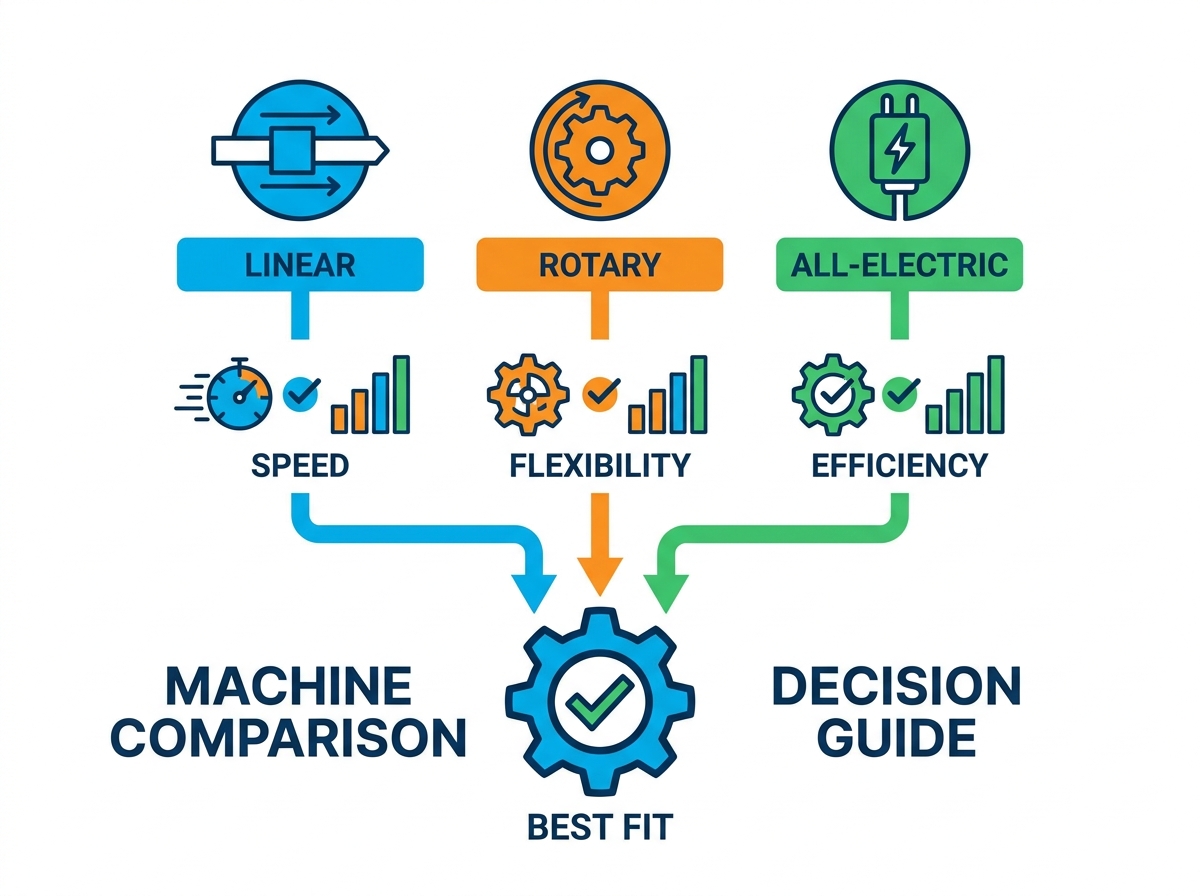
- Architecture Economics: Linear machines provide cost-effective flexibility for low-to-medium output (up to ~14,000 BPH), whereas rotary systems are mandatory for continuous, ultra-high-speed lines.
- Material Versatility: Modern machines must adapt to shifting material profiles, including rPET, refPET, and Polypropylene (PP), which demand precise heating controls.
- Energy and TCO: High-pressure air consumption and heating elements account for the bulk of operational costs; modern air recovery systems are a critical evaluation metric for long-term profitability.
- Integration Readiness: Successful deployment requires assessing facility constraints, upstream injection molding synergy, downstream equipment compatibility, and operator technical competency before procurement.
Defining Your Production Success Criteria
Volume Thresholds and Speed (BPH) Targets
Defining exact production requirements dictates the entire machine categorization process. Output is universally measured in Bottles Per Hour (BPH). Facilities must calculate their peak seasonal demand and baseline daily requirements to determine the necessary machine capacity. Selecting a machine based purely on its theoretical maximum speed often leads to operational shortfalls. Manufacturers list peak speeds achieved under optimal conditions with standard bottle designs. In practice, realistic sustained operational speeds factor in Overall Equipment Effectiveness (OEE) and are typically lower.
Operational realities such as mold changeovers, routine maintenance, preform jamming, and downstream accumulation all reduce the actual daily yield. When evaluating a system, engineers must account for a 15 to 20 percent buffer between the machine's rated capacity and the facility's actual production targets. A machine rated for 12,000 BPH might reliably deliver 10,000 BPH during a standard shift when accounting for operator interventions and material handling delays. You must build this buffer into your procurement specifications to avoid starving downstream fillers.
Technology Classification: Stretch Blow Molding (ISBM) vs. EBM and IBM
Understanding the distinction between PET-specific processes and other plastic molding technologies is fundamental. Injection Stretch Blow Molding (ISBM) is the standard for PET containers. This process involves stretching the heated preform both axially using a stretch rod and radially using high-pressure air. This biaxial orientation aligns the polymer chains, giving PET bottles their characteristic high tensile strength, impact resistance, and glass-like clarity.
In contrast, Extrusion Blow Molding (EBM) is typically reserved for materials like High-Density Polyethylene (HDPE) used in milk jugs or detergent bottles. EBM extrudes a continuous parison of molten plastic, which is then captured by a mold and blown. Standard Injection Blow Molding (IBM) is used for small, precise containers like pharmaceutical pill bottles but lacks the stretching phase, making it unsuitable for the structural demands of carbonated beverage or water bottles. PET inherently requires the stretch-blowing phase to achieve its necessary physical properties.
| Technology | Material Compatibility | Process Characteristics | Primary Applications |
| ISBM (Injection Stretch Blow Molding) | PET, rPET, PP | Biaxial stretching (axial and radial), high pressure | Beverage bottles, water, cosmetics, custom PET shapes |
| EBM (Extrusion Blow Molding) | HDPE, LDPE, PVC | Continuous extruded parison, captured and blown | Milk jugs, detergent bottles, industrial containers |
| IBM (Injection Blow Molding) | HDPE, PP, PET (limited) | Injection molded preform, blown without stretch rod | Small pharmaceutical bottles, medical vials |
Bottle Specifications, Neck Sizes, and Material Variables
The physical dimensions of the target container heavily influence machine selection. Bottle volume dictates the required mold size, the stroke length of the stretch rods, and the necessary clamping force to keep the mold closed during high-pressure blowing. Larger bottles require significantly more high-pressure air and longer cooling times, which naturally reduces the overall BPH output. A machine running 500ml bottles will not achieve the same cycle time when switched to 2L containers.
Neck finish is another critical variable. The machine's preform handling system, including the unscrambler, infeed rails, and heating mandrels, must perfectly match the neck diameter and thread profile. Processing parameters also shift dramatically based on the polymer. Virgin PET behaves predictably, but recycled PET (rPET) and refillable PET (refPET) have different thermal absorption rates. Darker or heavily crystallized rPET absorbs infrared heat faster, requiring highly precise oven controls to prevent overheating the exterior while ensuring the interior remains pliable. Polypropylene (PP) requires entirely different heating profiles and stretch ratios due to its distinct melt flow index.
Facility Constraints and Utility Requirements
Deploying a blow molding system requires substantial supporting infrastructure. The machine itself is only one component of a larger work cell. High-pressure air compressors capable of delivering clean, dry air at up to 40 bar are mandatory. Industrial chillers are required to circulate cold water through the mold halves, ensuring the plastic sets rapidly before ejection. A stable, high-amperage power supply is necessary to drive the infrared heating ovens and heavy-duty servo motors.
Facility layout must accommodate the machine's footprint, the preform hopper, and the unscrambler system. Ceiling height is often overlooked; preform tippers and overhead conveyors require significant vertical clearance. Engineers must map out the material flow, ensuring forklifts or automated guided vehicles have clear access to load preform gaylords and remove finished pallets without disrupting other production lines. Failure to plan utility routing results in messy, unsafe factory floors.
Single-Stage vs. Two-Stage PET Bottle Blow Moulding Machines
Single-Stage Process: Integrated Precision
The single-stage process integrates both the injection molding of the preform and the blow molding of the final bottle into one continuous machine cycle. Plastic resin pellets are melted, injected into a preform cavity, conditioned to the exact blowing temperature, stretched, blown, and ejected as a finished bottle without ever leaving the machine. This continuous handling prevents the preforms from touching each other or being exposed to environmental contaminants.
This architecture is ideal for industries demanding flawless aesthetic quality, such as luxury cosmetics, pharmaceuticals, and custom-shaped containers. Because the preform is never bulk-stored or tumbled in a hopper, the final bottles exhibit zero surface scratches. The single-stage process also allows for precise thread alignment and the production of non-round or highly asymmetrical shapes. The trade-offs include lower overall production speeds compared to two-stage systems, higher initial tooling complexity, and the inability to stockpile preforms for future use.
Two-Stage Process: High-Volume Scalability
The two-stage process separates preform manufacturing from bottle blowing. Preforms are either manufactured on a dedicated injection molding machine elsewhere in the facility or purchased from a third-party supplier. These cold preforms are loaded into a hopper, unscrambled, fed into the blow molding machine's infrared oven, reheated to their glass transition temperature, and then blown into bottles.
This method dominates the production of carbonated soft drinks (CSD), bottled water, and edible oils, where massive scale and high-speed output are required. Two-stage machines can achieve extraordinary speeds, significantly lowering the per-unit production cost at scale. While it requires managing a separate preform supply chain, the flexibility to run the blow molding machine independently of the injection molding process allows facilities to optimize scheduling and maximize throughput.
Upstream Economics: In-House PET Preform Injection Moulding vs. Sourcing
Facilities utilizing two-stage systems face a critical operational decision: whether to invest in dedicated PET preform injection molding equipment or source preforms from external vendors. Sourcing preforms reduces initial capital requirements, minimizes floor space usage, and eliminates the need for specialized injection molding technicians. It allows a facility to focus entirely on the blowing and filling processes.
Bringing preform injection in-house provides absolute control over supply chain logistics, resin quality, and preform design. It eliminates the transportation costs associated with shipping empty preforms. The transition point usually occurs when production volumes reach a scale where the freight savings and reduced piece-price of raw resin justify the substantial investment in injection machines, molds, resin drying systems, and the associated electrical infrastructure.
- Calculate monthly preform consumption volume.
- Analyze freight costs for shipping empty preforms versus raw resin pellets.
- Assess available floor space for injection machines and resin silos.
- Evaluate local availability of injection molding technicians.
Evaluating Machine Architectures: Linear vs. Rotary Systems
Linear Blow Moulding Machines
Linear machines transport preforms through the heating and blowing stations in an intermittent, straight-line motion. The preforms index forward, stop for heating, index again, and finally stop inside the clamping unit where the mold closes around them for the blowing phase. This start-and-stop kinematic motion is mechanically simpler than continuous rotary systems.
Linear systems offer significant flexibility and faster mold changeovers, making them ideal for facilities managing diverse product portfolios with frequent shape or size variations. Maintenance is generally straightforward due to accessible components. Modern servo-driven linear machines have pushed the boundaries of this architecture, achieving outputs up to approximately 14,000 BPH. However, the intermittent motion inherently limits maximum speed, and the heating profile can be slightly less consistent than in continuous systems.
Rotary Blow Moulding Machines
Rotary machines operate on a continuous circular motion. Preforms enter a rotating heating carousel, pass through the infrared ovens without stopping, and are seamlessly transferred to a rotating blowing wheel. The molds open and close as the wheel spins, stretching and blowing the bottles in continuous motion before discharging them onto an air conveyor.
This architecture is mandatory for ultra-high-speed production, capable of exceeding 80,000 BPH on large configurations. The continuous motion provides highly consistent heating profiles, as the preforms are constantly rotating in front of the lamps without indexing pauses. Rotary machines also offer a smaller physical footprint relative to their massive output. The drawbacks include significant upfront complexity, the need for specialized maintenance technicians, and longer mold changeover times, rendering them inefficient for short production runs.
| Feature | Linear Machines | Rotary Machines |
| Motion Type | Intermittent (Start/Stop) | Continuous Circular |
| Max Speed (BPH) | Up to ~14,000 | 80,000+ |
| Changeover Time | Fast (Ideal for short runs) | Slow (Ideal for long runs) |
| Maintenance Complexity | Low to Medium | High (Requires specialized techs) |
| Heating Consistency | Good | Excellent |
Core Evaluation Dimensions: Features to Operational Outcomes
Preform Heating and Conditioning Efficiency
The infrared (IR) heating oven is the heart of the blow molding process. Oven design directly impacts both bottle quality and energy consumption. A critical metric is oven pitch—the distance between preforms as they travel through the heating zone. A smaller pitch allows more preforms to be heated simultaneously using fewer lamps, drastically improving energy efficiency. Advanced ovens utilize ceramic reflectors and adjustable lamp positioning to target heat exactly where it is needed on the preform body.
Closed-loop temperature control systems are essential. These systems use pyrometers to measure the actual temperature of the preforms exiting the oven and automatically adjust lamp intensity to compensate for ambient temperature changes or voltage fluctuations. This precision is non-negotiable when processing rPET and refPET, which are highly sensitive to thermal variations and prone to crystallization or uneven wall distribution if improperly heated.
Automation, Servo-Drives, and Changeover Speed
The transition from fully pneumatic systems to servo-driven architectures has revolutionized machine performance. Servo motors provide precise, repeatable control over mold clamping, stretch rod deployment, and preform transfer. Unlike pneumatic cylinders, which are subject to variations in air pressure and wear, servo drives execute movements with millimeter accuracy. This precision reduces mechanical wear, lowers vibration, and significantly decreases energy consumption.
Operational downtime between product runs severely impacts OEE. Evaluating a machine's quick-change capabilities is vital. Features like tool-less mold locking mechanisms, quick-connect cooling water manifolds, and automated recipe management via the Human-Machine Interface (HMI) allow operators to switch bottle formats rapidly. Automated parameter loading ensures the heating profile and blowing pressures are instantly optimized for the new bottle, eliminating hours of manual trial and error on the factory floor.
Air Recovery and Energy Management
High-pressure blowing air is the single largest utility expense in PET bottle production. Compressing air to 35 or 40 bar requires massive electrical input. During the blowing cycle, this high-pressure air fills the bottle and is then exhausted into the atmosphere when the mold opens. Managing this exhaust is critical for operational efficiency.
Modern machines incorporate air recovery systems that capture the exhausted high-pressure air and recycle it. This recovered air can be routed to supply the low-pressure pre-blow phase, used to drive the machine's internal pneumatic cylinders, or fed back into the facility's general low-pressure air network. Implementing robust air recovery significantly reduces the load on the high-pressure compressors, directly lowering daily utility consumption and improving the sustainability of the production line.
Implementation Risks and Mitigation Strategies
Operator Skill Gaps and Training
Deploying advanced servo-driven or high-speed rotary machines introduces substantial technical complexity to the factory floor. The primary risk is an operator skill gap; personnel accustomed to older, mechanical systems may struggle to troubleshoot PLC faults, optimize servo parameters, or interpret complex HMI diagnostics. This leads to extended downtime during minor faults and suboptimal machine tuning.
Mitigation requires mandating comprehensive vendor training programs prior to machine commissioning. Facilities should select machines equipped with intuitive, diagnostic-heavy HMIs that provide clear, visual troubleshooting steps rather than cryptic error codes. Establishing standard operating procedures (SOPs) for routine maintenance and parameter adjustments ensures operators can confidently manage the equipment without constantly relying on external engineering support.
Downstream Integration Bottlenecks
A high-performance blow molding machine is only effective if the rest of the production line can handle its output. A common implementation risk is creating downstream bottlenecks where the blowing machine outpaces the filling, capping, or labeling equipment. This mismatch causes severe accumulation issues, forcing the blow molder to frequently stop and start, which destabilizes oven temperatures and increases scrap rates.
To mitigate this, engineers must conduct a full line audit before installation. Ensure air conveyors have sufficient buffering capacity to absorb minor downstream stoppages. Upgrading filler valves, optimizing labeler speeds, and implementing centralized line control systems ensures synchronized speed modulation across the entire packaging line, allowing the blow molding machine to run continuously at its optimal steady state.
Conclusion
- Audit your facility's high-pressure compressor capacity and chiller tonnage before finalizing any machine specifications.
- Calculate your required BPH using realistic OEE metrics rather than relying on theoretical maximum speeds.
- Specify closed-loop heating controls and servo-driven stretching mechanisms if you plan to process rPET or complex bottle geometries.
- Require comprehensive air recovery capabilities on all new equipment to reduce the utility load of high-pressure blowing.
- Synchronize your blow molding machine's output with downstream filling lines to prevent accumulation bottlenecks.
FAQ
Q: What is the main difference between single-stage and two-stage blow molding?
A: Single-stage machines inject the preform and blow the bottle in one continuous cycle within the same machine, ideal for high-quality, blemish-free containers. Two-stage machines require pre-made preforms that are reheated and blown, offering much higher production speeds and scalability for standard beverage bottles.
Q: Why is servo-driven technology preferred over pneumatic systems?
A: Servo motors provide precise, repeatable control over mechanical movements, reducing vibration and wear. They consume significantly less energy than pneumatic cylinders and allow for exact positioning of stretch rods and mold clamps, resulting in more consistent bottle quality and faster cycle times.
Q: How does processing rPET differ from virgin PET?
A: Recycled PET (rPET) often has a darker tint and different thermal absorption properties compared to virgin PET. It absorbs infrared heat faster, requiring highly precise, closed-loop oven controls to prevent surface overheating while ensuring the core of the preform reaches the correct stretch temperature.
Q: What is an air recovery system in blow molding?
A: An air recovery system captures the high-pressure air exhausted from the bottle after the blowing phase. Instead of venting it to the atmosphere, the system recycles this air to be used for the low-pressure pre-blow phase or to operate the machine's pneumatic cylinders, drastically reducing compressor workload.
Q: When should a facility choose a rotary machine over a linear machine?
A: A rotary machine is necessary when production demands continuous, ultra-high-speed output, typically exceeding 14,000 to 20,000 bottles per hour. Linear machines are better suited for lower volumes and facilities that require frequent, fast mold changeovers for diverse product lines.

 English