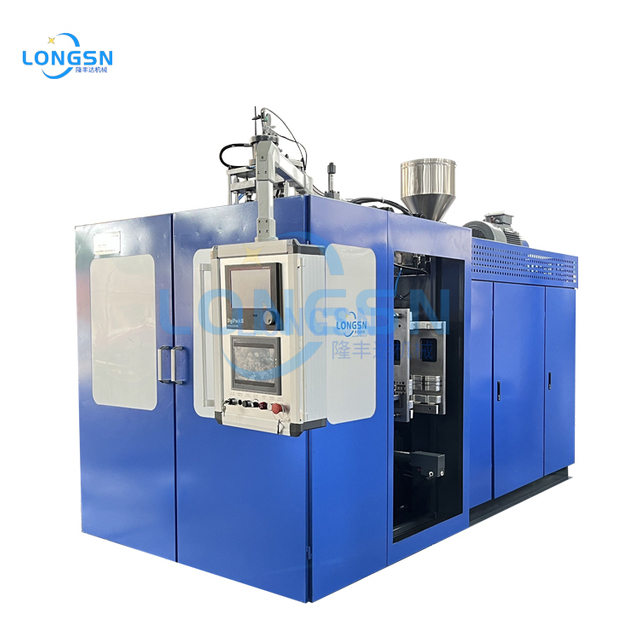
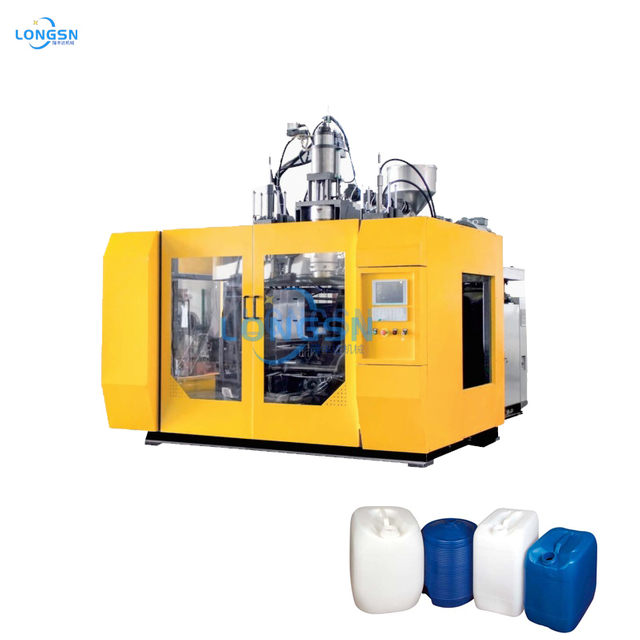
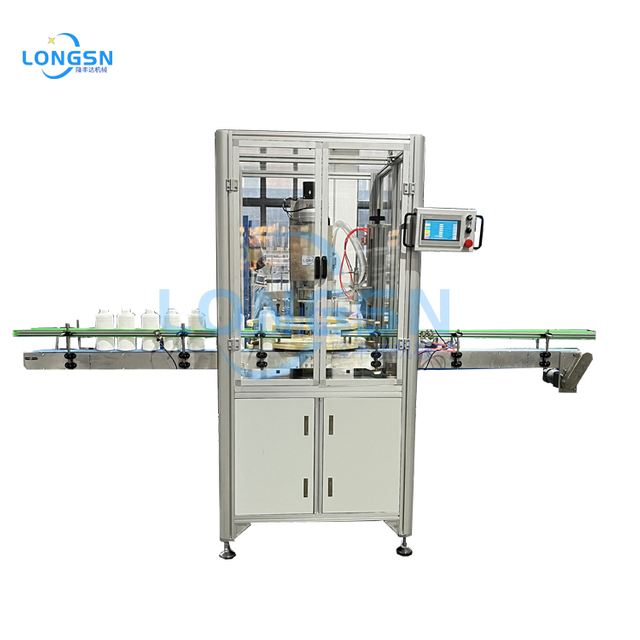
Capital equipment procurement in plastics manufacturing carries incredibly high stakes. A single poor investment can bottleneck production for a decade. Manufacturers face a core challenge today. You must select machinery balancing immediate production requirements and long-term scalability. You need equipment guaranteeing robust operational efficiency. This article provides a realistic, specification-driven framework for evaluating your options. We will help you mitigate implementation risks effectively. You will learn how to match clamping force, head systems, and material specs to your exact needs. We guide you through shortlisting reliable vendors based on true lifecycle value. By the end, you will understand how a high-quality Extrusion Blow Molding Machine impacts both daily output and long-term profitability. Making an informed decision ensures your manufacturing lines remain competitive. Proper evaluation safeguards your investment against unexpected technical limitations.
Key Takeaways
- Process Fit: Extrusion blow molding (EBM) is ideal for hollow, lightweight containers but requires precise parison control to ensure wall thickness consistency and minimize resin waste.
- Specification Alignment: Selecting the right extrusion blow molding machine depends on matching clamping force, extruder capacity, and head type (continuous vs. accumulator) to the target part size and material.
- Hidden Costs: True ROI depends heavily on secondary factors like deflashing automation, regrind integration efficiency, and cooling system requirements.
- Vendor Evaluation: Shortlisting should prioritize aftermarket support, spare part availability, and verifiable machine reliability over initial capital expenditure.
The Business Case for an Extrusion Blow Molding Machine
Investing in new manufacturing equipment requires a solid business case. You must move beyond theoretical machine capacities. We need to evaluate how the equipment performs under actual floor conditions. Success relies on setting strict performance baselines early in the procurement phase.
Defining the Success Criteria
You cannot evaluate a machine without defining exact production expectations. Setting baseline metrics prevents vendor over-promising. We recommend establishing the following clear parameters before reviewing any technical catalogs:
- Target Throughput: Calculate required bottles or parts per hour. Account for standard maintenance downtime.
- Target Part Weight: Define acceptable minimum and maximum part weights. This metric directly impacts resin consumption.
- Allowable Scrap Rates: Set strict limits on reject rates. Plan how much flash you can realistically regrind and reprocess.
EBM vs. Alternative Processes
We often see manufacturers confusing the ideal applications for different blow molding techniques. Extrusion blow molding (EBM) competes directly against Injection Blow Molding (IBM) and Stretch Blow Molding (SBM). Each process offers distinct advantages. EBM stands out primarily for its low tooling costs. You can produce complex, asymmetrical shapes easily. For example, handled detergent bottles rely almost exclusively on EBM technology.
EBM also leads the market in multi-layer capabilities. You can extrude barrier layers to protect food or chemicals. However, you must transparently acknowledge the limitations. EBM cycle times remain generally slower than injection molding. Post-mold trimming, known as deflashing, is mandatory. You must incorporate deflashing stations into your production line.
Process Comparison: EBM vs. Alternative Molding Methods
| Process Feature | Extrusion Blow Molding (EBM) | Injection Blow Molding (IBM) | Stretch Blow Molding (SBM) |
| Best Application | Complex shapes, handled containers, large drums | Small medical or cosmetic bottles, tight neck tolerances | High-clarity beverage bottles (PET) |
| Tooling Cost | Relatively Low | High (requires two sets of molds) | Moderate to High |
| Cycle Time | Moderate | Fast | Extremely Fast |
| Scrap (Flash) | High (requires deflashing and regrind) | None (scrap-free process) | None (preform-based process) |
Core Machine Specifications: Matching Capacity to Production Needs
Choosing the right specifications prevents costly bottlenecks. You must align the machine capabilities with your exact product dimensions. Over-specifying wastes capital. Under-specifying ruins product quality.
Clamping Force and Platen Size
Clamping force dictates whether your mold stays closed during the blowing phase. If pressure exceeds the clamping force, the mold separates. This creates severe flashing or blown-out parts. You calculate required tonnage by multiplying the projected area of the part by the blowing pressure. We recommend adding a 20% safety margin to this calculation.
Platen size determines your cavitation options. A larger platen holds bigger molds. It also allows multi-cavity configurations for smaller parts. You must verify the distance between tie bars. This ensures your molds actually fit inside the machine.
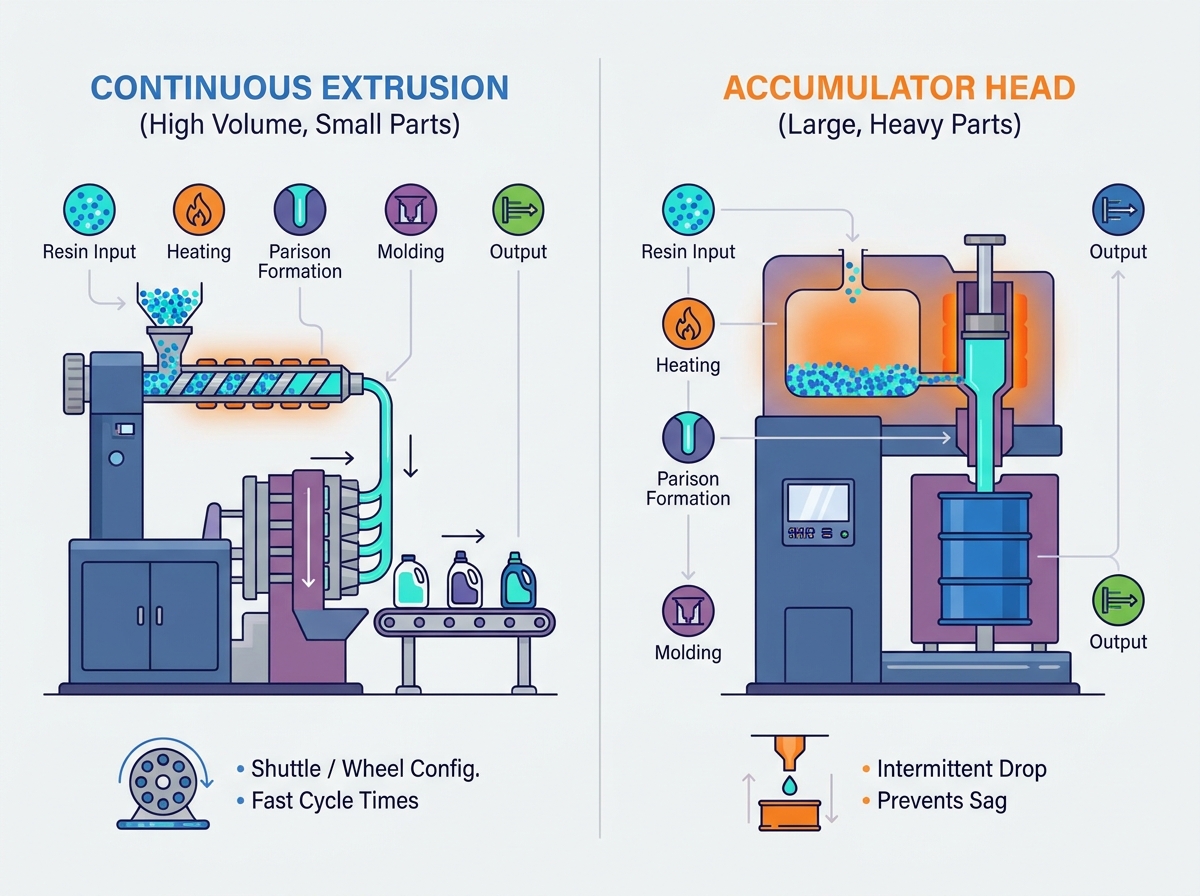
Continuous Extrusion vs. Accumulator Head Systems
The choice of head system depends entirely on your product size. They operate using fundamentally different mechanics.
Continuous Extrusion: This system extrudes a continuous tube of plastic (the parison). It works best for high-volume, smaller parts under 5 liters. You typically see shuttle or rotary wheel configurations here. Shuttle machines move the mold to the parison. Rotary wheels spin multiple molds past a continuous parison flow. They excel at high-speed packaging production.
Accumulator Head: Large parts require a different approach. If you extrude a 50-liter drum continuously, the heavy plastic sags under its own weight. This stretches the parison and ruins wall thickness. Accumulator heads solve this. They gather a large volume of melted resin. They push it out rapidly in one intermittent drop. This process prevents parison sag. It is strictly necessary for large industrial containers and automotive panels.
Parison Programming and Control Systems
Gravity pulls the extruded plastic downward. The top of the parison stretches thinner than the bottom. Parison programming solves this critical issue. High-end systems utilize 100-point (or more) profile controls. The machine dynamically adjusts the die gap as the plastic drops.
This dynamic adjustment ensures uniform wall thickness across the finished part. Precise control drastically impacts material savings. We call this lightweighting. Shaving just two grams off a high-volume bottle transforms bottom-line profitability over a year. Modern controllers integrate these profiles seamlessly. They provide operators with intuitive visual graphs for fine-tuning.
Material Compatibility and Application Constraints
Your choice of resin dictates machine hardware requirements. You cannot process every plastic through a standard setup. Extruder screw designs and heating profiles must match the specific polymer chemistry.
Standard Resin Processing
Most facilities process HDPE, PP, LDPE, or PVC. Each material melts differently. HDPE handles easily and provides excellent moisture barriers. Polypropylene (PP) offers higher clarity but requires precise temperature control. PVC is heat-sensitive. It degrades rapidly if left in the barrel too long. You must evaluate the machine's screw design. Barrier screws or mixing tips ensure a homogenous melt. Ensure the barrel heating profiles offer adequate zoning to prevent resin degradation.
Multi-Layer Co-Extrusion (Barrier Applications)
Modern packaging often requires multiple layers. Food packaging needs oxygen barriers to prevent spoilage. Agricultural chemicals require solvent barriers. You achieve this through multi-layer co-extrusion. Evaluating machines capable of 3-to-6 layer co-extrusion is complex.
The machine uses multiple extruders feeding into a single die head. Extruder synchronization is critical. The control system must perfectly distribute the tie layers and barrier layers (like EVOH). If synchronization fails, the barrier layer breaks. This ruins the product's protective qualities. You must demand verifiable layer distribution tests from the vendor.
Post-Consumer Recycled (PCR) Integration
Sustainability mandates require integrating Post-Consumer Recycled (PCR) plastics. PCR behaves unpredictably. It has variable viscosity and occasionally contains microscopic impurities. Processing PCR without compromising structural integrity is challenging.
Your machine requires robust melt filtration systems. Screen changers remove impurities before they reach the die head. You might also need specialized screw designs to mix virgin material and regrind effectively. Poorly mixed PCR results in weak seams and terrible surface finishes. Your equipment must handle these material variations seamlessly.
Operational Risks and Implementation Realities
Theoretical output means nothing if the machine cannot run reliably on your floor. You must plan for operational realities. Utility demands and secondary automation often dictate your actual production speed.
Energy Consumption and Drive Systems
Drive systems heavily influence utility bills. You have three primary choices: hydraulic, hybrid, or all-electric. Traditional hydraulic machines offer massive initial force. They remain reliable and familiar to older maintenance teams. However, they consume immense amounts of power. They also risk oil leaks.
All-electric machines use servo motors. They draw power only when moving. This drastically lowers energy consumption. Electric machines run cleaner, making them ideal for medical cleanrooms. Hybrid machines blend both technologies. They use hydraulics for high-force clamping and servos for extrusion. You must weigh the higher upfront cost of electric systems against their long-term utility savings.
Cooling Infrastructure Requirements
Cooling dictates your cycle time. The plastic must solidify before the mold opens. If you open early, the part warps. EBM cooling typically accounts for over 60% of the total cycle time.
You must assess your facility's chilled water capacity. A new machine might overwhelm your existing chillers. Evaluate the machine's internal mold cooling efficiency. Advanced molds utilize conformal cooling channels. They wrap closely around the part's geometry. Poor cooling infrastructure ruins the ROI of even the fastest extruder.
Scrap Management and Automation
EBM generates unavoidable scrap. Flash occurs at the top (neck) and bottom (tail) of every molded container. Manual deflashing requires intense labor. It slows down production entirely.
You must evaluate integrated auto-deflashing stations. These punch away the excess plastic automatically. Furthermore, you need closed-loop regrind conveyors. These systems catch the flash, grind it immediately, and feed it back into the hopper. Automating this loop minimizes labor costs. It eliminates resin contamination and reduces material waste.
Shortlisting Vendors: A Buyer’s Decision Framework
Selecting a vendor goes far beyond reviewing a spec sheet. You are entering a decade-long partnership. The procurement phase requires strict vetting protocols. You must separate reliable manufacturers from those offering cheap, unsupported hardware.
Evaluating Value Beyond the Sticker Price
Do not fixate solely on the initial capital expenditure. Cheap machines often hide massive future expenses. You must factor in energy efficiency over a ten-year lifespan. Calculate standard maintenance intervals. Project the costs of expected downtime. A machine costing 15% more upfront might save you thousands annually in electricity and reduced scrap. Base your decisions on comprehensive financial impacts rather than just the initial invoice.
Aftermarket and Technical Support
Machine breakdowns are inevitable. When they happen, every hour costs you money. Aftermarket support is critical. Prioritize vendors offering local service technicians. Flying a technician internationally creates unacceptable delays.
Furthermore, demand standard component usage. Avoid proprietary control systems. If a PLC fails, you want to buy a replacement from a local supplier. Standard platforms like Allen-Bradley, Siemens, or Beckhoff ensure immediate spare parts availability. Proprietary boards lock you into the vendor's pricing and lead times.
Proof of Concept (Factory Acceptance Testing)
Never sign off on a machine without a Factory Acceptance Test (FAT). Theoretical output claims require physical validation. Demand transparent dry-cycle speed tests. More importantly, require actual mold-run validations using your specific resin.
Run the machine for several hours during the FAT. Check the parts for uniform wall thickness. Verify the deflashing station operates flawlessly. Ensure the machine maintains continuous temperatures without overheating. Only release final payment after a successful FAT.
Next-Step Actions
Structure your Request for Proposal (RFP) to force vendor accountability. Follow these steps when drafting your RFP:
- Provide exact 3D models and part weights for the intended products.
- Demand guaranteed output rates (parts per hour) documented in writing.
- Request specific power consumption metrics (kW per kg of processed resin).
- Require a detailed list of non-proprietary electrical and hydraulic components.
- Establish firm penalties for missing delivery or FAT performance metrics.
Conclusion
Selecting the correct extrusion blow molding machine bridges the gap between material science and mechanical reliability. You cannot treat this purchase as a simple hardware transaction. Successful adoption requires looking far beyond theoretical output capabilities. You must plan meticulously for cooling demands, trimming automation, and long-term maintenance realities. By evaluating clamping force, accumulator needs, and material compatibility, you protect your production line.
Prioritize vendors who offer transparent testing and rely on standard, non-proprietary components. Your next step should be actionable. We recommend gathering your specific part drawings and resin data. Schedule a technical consultation with reputable manufacturers. Request a customized production analysis. This proactive approach guarantees your new machinery delivers immediate efficiency and lasting value.
FAQ
Q: What is the typical lead time for a custom extrusion blow molding machine?
A: Standard manufacturing timelines usually run from 4 to 8 months. This timeline depends heavily on the level of customization required. Complex accumulator heads or multi-layer co-extrusion setups take longer to engineer. Additionally, scheduling comprehensive factory acceptance testing (FAT) and shipping logistics will impact final delivery dates.
Q: How does parison programming reduce material costs?
A: Parison programming uses dynamic die gap adjustments as the plastic drops. This prevents the plastic from over-thickening in non-stress areas of the container. By ensuring uniform walls and preventing excess plastic accumulation, it directly reduces the overall resin weight per part. This process saves substantial material costs over time.
Q: Can an existing machine be upgraded for multi-layer co-extrusion?
A: Yes, but it involves significant technical hurdles. You must add satellite extruders and completely replace the existing die head. You also need to upgrade the control systems to handle synchronization. Often, retrofitting an older machine is less cost-effective and more risky than purchasing a new, purpose-built multi-layer machine.
Q: What is the average lifespan of an industrial EBM machine?
A: With strict preventative maintenance, tier-1 industrial EBM machines typically operate reliably for 15 to 20 years or more. The heavy mechanical components are built to last. However, electronic control systems, like PLCs and servo drives, usually require retrofitting or upgrading around the 10-year mark due to software obsolescence.

 English