Acquiring a PET Bottle Blow Moulding Machine represents a major capital expenditure for any production facility. This crucial equipment directly dictates your overall production yield, individual unit cost, and final product quality. If you choose poorly, you risk facing constant production bottlenecks and excessively high utility bills. The right system perfectly balances upfront capital expenses against long-term operational costs. Specifically, it minimizes daily energy consumption and drastically reduces unplanned maintenance downtime.
We designed this guide to move beyond basic industry definitions. Instead, we focus on practical, real-world evaluation. Procurement and engineering teams will learn how to accurately align specific machine capabilities with actual facility infrastructure. You will discover the distinct advantages of different processing methods, understand critical automation configurations, and identify the hidden mechanical features driving real operational efficiency.
Key Takeaways
- Process Split: Machine selection fundamentally begins with choosing between single-stage (best for specialty/cosmetics) and two-stage (best for high-volume beverage) processes.
- Scalability: Rotary machines dominate high-speed mass production, while linear machines offer flexibility for medium-scale, multi-SKU operations.
- OpEx Drivers: Advanced features like servo-driven toggles and high-pressure air recovery systems are critical for reducing long-term energy costs.
- Facility Readiness: True ROI depends heavily on ancillary equipment, specifically the sizing and quality of high-pressure air compressors.
Single-Stage vs. Two-Stage PET Bottle Blow Moulding Machines
The first major decision gate involves the core manufacturing process. You must determine whether to integrate preform injection and final blowing into one single unit or separate them entirely. This choice fundamentally impacts your floor plan, supply chain, and daily operations.
Single-Stage Machines (ISBM - Injection Stretch Blow Moulding)
A single-stage machine executes the entire process internally. It melts the raw PET resin first. Then, it injects this molten material to form the preform. Finally, it stretches and blows the bottle in one continuous cycle without allowing the plastic to cool down.
These systems excel in highly specific manufacturing environments. They represent the ideal use case for specialty shapes, premium cosmetic bottles, and strictly regulated pharmaceuticals. Because the preform never leaves the machine, it avoids contact with external surfaces.
This process offers distinct advantages and notable drawbacks. It eliminates the need for massive preform storage areas. It also completely prevents surface scratches, ensuring pristine optical clarity for premium packaging. However, single-stage equipment generally delivers a significantly lower production rate. Furthermore, the initial tooling costs remain notably higher due to the complex, unified mold designs.
Two-Stage Machines (Reheat Stretch Blow Moulding)
The two-stage approach divides the manufacturing process into completely separate operations. The machine utilizes pre-manufactured preforms. These preforms are injection-molded elsewhere, cooled, and stored in large bins. The machine feeds these preforms onto a track, reheats them via precise infrared lamps, and subsequently stretches and blows them into the final bottle shape.
Facilities rely on two-stage systems for high-volume production. They handle massive runs of bottled water, carbonated soft drinks (CSD), and edible oil bottles. These applications demand relentless speed and structural consistency.
Two-stage machines deliver extremely high output speeds, measured in Bottles Per Hour (BPH). This speed ensures a dramatically lower per-unit cost. However, operating this equipment requires strict, meticulous inventory management of preforms. You must maintain stable storage conditions to prevent moisture absorption and physical damage before the blowing phase.
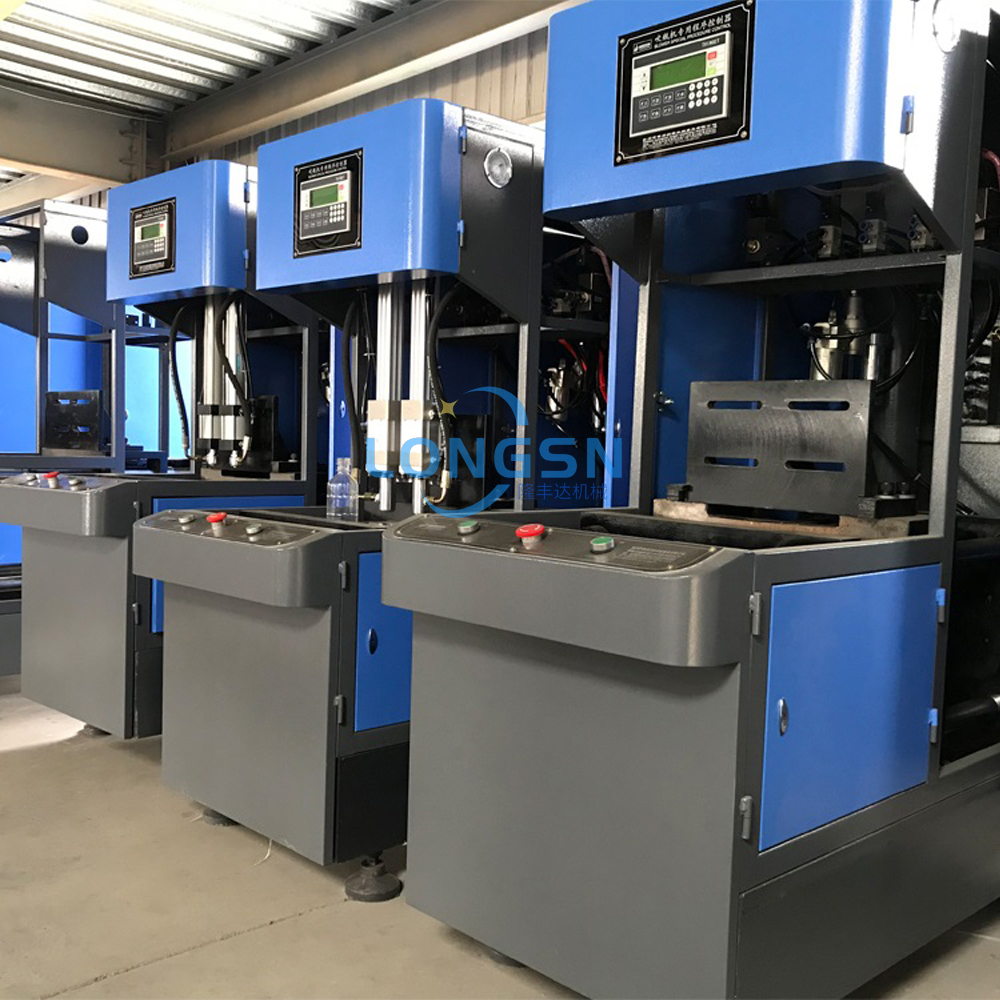
Automation and Configuration: Linear vs. Rotary Types
Once you select your core process, you must match the machine configuration to your facility. You need to align the structural design with your required throughput and your available floor space. The choice typically comes down to linear or rotary architectures.
Linear Blow Moulding Machines
Linear machines operate exactly as the name suggests. The preforms move in a straight, sequential line through the heating ovens and directly into the blowing stations. The clamping mechanisms usually open and close along a single axis.
These machines serve specific production volumes perfectly. They remain optimal for throughputs typically ranging from 1,000 to 10,000 BPH. They provide exceptionally high flexibility for operations requiring frequent mold changes across various shifts.
In implementation reality, linear models offer a significantly smaller physical footprint. They grant operators easier maintenance access, as components are arranged logically along the track. However, they are generally capped in their maximum theoretical speed. The start-and-stop nature of some linear transfer systems naturally limits extreme high-speed scaling.
Rotary Blow Moulding Machines
Rotary systems utilize continuous circular motion. They feature a massive spinning carousel that handles multiple molds simultaneously. Preforms enter the heating wheel and seamlessly transfer into the blowing wheel without ever breaking momentum.
Engineers design these systems strictly for mass production. They routinely exceed 30,000 BPH. Rotary designs also allow for seamless integration with downstream filling blocks. You often see them configured as Combi-blocks, where blowing, filling, and capping happen inside one unified enclosure.
Implementing a rotary system demands serious infrastructure. It requires a significantly larger footprint and a substantially higher initial capital investment. Changeover times take much longer due to the sheer number of individual molds on the carousel. Therefore, they remain best suited for dedicated, single-SKU lines running 24/7.
Table 1: Automation Configuration Comparison Chart | Feature | Linear Configuration | Rotary Configuration |
| Motion Path | Straight line, often intermittent | Continuous circular carousel |
| Typical Speed (BPH) | 1,000 - 10,000 | 10,000 - 80,000+ |
| Footprint Requirement | Compact to moderate | Extensive, requires heavy foundations |
| Mold Changeover | Fast, highly flexible | Slow, labor-intensive |
Core Features to Evaluate for OpEx Reduction and Yield
You must move beyond basic speed specifications when evaluating modern equipment. You need to closely evaluate the internal features that drive long-term cost efficiency and mechanical reliability. Over a ten-year lifespan, utility and maintenance expenses dwarf the initial purchase price.
Servo-Motor Driven Systems vs. Pneumatic Cylinders
Older generation machines rely heavily on pneumatic cylinders to drive the stretching rods and mold clamps. Modern systems replace these air-driven mechanisms with fully electric servo-motor systems.
This shift delivers massive business impact. Servos offer hyper-precise control over the stretching rod speed and position. This precision reduces material waste by ensuring perfect material distribution across the bottle wall. Servos also operate much quieter, significantly lowering ambient noise levels on the factory floor. Most importantly, they decrease overall energy consumption by eliminating the machine's heavy dependence on compressed air for basic mechanical movements.
High-Pressure Air Recovery Systems
Blowing a PET bottle requires immense air pressure, often exceeding 35 bar. Historically, machines vented this pressurized air directly into the atmosphere after each cycle. A high-pressure air recovery system fundamentally changes this wasteful dynamic.
This technology captures the exhausted air immediately after the high-pressure blowing phase. The system then routes this captured air through a specialized manifold. It recycles it for low-pressure machine functions, such as the initial pre-blowing phase or operating auxiliary pneumatic cylinders.
Implementing air recovery drastically impacts your bottom line. It can easily reduce total compressor energy consumption by 20% to 40%. This efficiency significantly lowers your monthly operational utility costs.
- Best Practice: Always verify the recovery system's filtration quality. Recycled air must remain free of oil and moisture.
- Common Mistake: Failing to maintain recovery valves. Leaking valves negate the energy-saving benefits entirely.
Quick Mold Changeover (QMC) Technology
Evaluating how a machine swaps bottle molds is critical for operational flexibility. QMC technology replaces traditional bolt-heavy installations with sliding tracks, quick-release fluid couplings, and tool-less locking mechanisms.
This feature proves absolutely crucial for contract packagers or facilities handling multiple products. It minimizes costly machine downtime during frequent SKU transitions. When you can switch from a 500ml water bottle to a 1L juice bottle in 30 minutes instead of three hours, your Overall Equipment Effectiveness (OEE) skyrockates.
Implementation Risks and Facility Requirements
Procurement teams often focus solely on the machine itself. However, hidden external dependencies frequently derail machine adoption and block expected returns. You must guarantee your facility is entirely ready to support the new equipment.
High-Pressure Air Compressor Sizing
Every standard PET Bottle Blow Moulding Machine requires a massive, stable volume of high-pressure air. Typical beverage applications demand pressures between 30 and 40 bar.
Undersizing your compressor introduces severe production risks. If the pressure drops even slightly during a cycle, it leads to defective, poorly formed bottles. In worst-case scenarios, continuous pressure drops cause the machine to stall completely, ruining entire batches of heated preforms.
You must take actionable steps before installation. Audit your existing compressor capacity thoroughly. Factor in the specific CFM (Cubic Feet per Minute) requirements of the targeted machine at maximum speed. Always build in a 15% safety margin to account for standard pneumatic line losses and future wear.
Chiller and Cooling Water Infrastructure
The molding process generates intense heat. The molds themselves require constant, aggressive cooling to solidify the stretched plastic instantly. If you fail to remove this heat quickly, your production suffers.
Inadequate cooling directly extends cycle times, forcing you to run the machine slower. Worse, hot molds cause bottle deformation, sticking, and uneven shrinkage after ejection.
You must ensure your facility can supply consistent, temperature-controlled water directly to the mold bases. Evaluate your industrial chillers. Check your local ambient humidity as well, since excessively cold water in a humid factory causes condensation on the molds, which ruins bottle surface finish.
- Inspect existing water piping for scale buildup.
- Calculate the required heat dissipation load (in kW or Tons of cooling).
- Install dedicated flow meters on the cooling lines feeding the blow moulder.
Shortlisting Framework for Procurement Teams
Evaluating multiple manufacturers can quickly become overwhelming. We recommend using a logical, step-by-step framework to narrow down your vendor options effectively and objectively.
Step 1: Define Production Targets
Do not approach vendors with vague requirements. Establish exact BPH requirements based on your peak seasonal demand, not just your yearly average. Clearly define your bottle volume ranges. A machine optimized for 500ml formats will struggle or fail to produce 5L large-format containers. Map out the maximum neck finish diameter you plan to run, as this dictates the machine's primary handling mandate.
Step 2: Evaluate Operational Energy Consumption
Look past the initial purchase price and focus on long-term operational expenses (OpEx). Request that vendors provide certified energy consumption data calculated per 1,000 bottles produced. Do not rely merely on the machine's nominal installed power rating. Nominal power indicates maximum electrical draw, not the steady-state running average. Factor in the efficiency gains from integrated servo motors and air recovery systems to find the true daily running cost.
Step 3: Assess Service and Parts Availability
A mechanically superior machine becomes a massive liability if you cannot fix it quickly. Evaluate the vendor's local support network thoroughly. Ask where their closest service technicians are stationed. Request a list of standard wear parts and check their inventory levels in your region. A cheaper machine costs you far more if proprietary spare parts carry a mandatory six-week international lead time.
Conclusion
Selecting the optimal PET Bottle Blow Moulding Machine requires a careful balancing act. You must align the core process type—whether single-stage or two-stage—with your specific product portfolio. You must choose a linear or rotary configuration that matches your volume demands and floor space. Finally, you must prioritize modern energy-saving features to protect your long-term profit margins.
Your next steps should involve looking inward. Conduct a thorough facility audit covering high-pressure air, chilled water, and electrical power stability. Once you verify your infrastructure, request highly specific, data-backed proposals from manufacturers. Ensure these proposals are based on your actual preform weights and exact bottle designs to guarantee realistic performance guarantees.
FAQ
Q: What is the average lifespan of an industrial PET blow moulding machine?
A: Industrial systems generally last 10 to 15 years. Proper preventative maintenance dictates this lifespan. You must routinely replace common wear parts like pneumatic seals, valves, and stretch rods. Upgrading older control systems also extends operational viability. Regular, documented servicing prevents catastrophic mechanical failures.
Q: Can one machine blow different sizes and shapes of bottles?
A: Yes, they routinely handle various shapes and sizes. You simply change the internal molds. However, strict physical limitations exist. The machine's neck handling system heavily restricts flexibility. You cannot run a 38mm neck preform on a transfer setup designed purely for 28mm finishes without extensive, costly modifications.
Q: How much energy does a two-stage blow moulding machine consume?
A: Energy consumption varies significantly based on configuration. Do not look only at nominal installed power. Focus on actual steady-state running power. Modern machines often consume 40% to 60% of their nominal rating during operation. Integrated high-pressure air recovery systems further reduce this baseline. Always measure consumption per 1,000 bottles.
Q: What is the typical changeover time for a linear vs. rotary machine?
A: Linear machines usually utilize quick mold changeover technologies. Experienced operators can often complete a full swap in under 45 minutes. Rotary machines carry distinct mechanical complexities. They contain dozens of individual mold stations. A full rotary changeover typically takes four to eight hours, depending on the carousel size.

 English