Purchasing an Extrusion Blow Moulding Machine is a highly critical production decision. It directly dictates your manufacturing efficiency and scrap rates for the next decade. Manufacturers currently face rapidly evolving sustainability mandates. Integrating post-consumer recycled materials changes how you must evaluate equipment. Energy usage restrictions and new automation shifts also play massive roles. You need to clearly understand how these elements impact daily floor operations. Choosing poorly often leads to heavy scrap generation and severe operational bottlenecks.
This guide provides a purely objective, engineering-focused evaluation framework. We will help you assess your exact facility requirements accurately. You will learn how to seamlessly match machine specifications to specific product geometries. We also cover compliance standards, automation protocols, and hidden implementation risks. Finalizing your product criteria early prevents mismatched equipment purchases. Keep reading to systematically shortlist the perfect machine architecture for your facility.
Key Takeaways
- Match machine specifications (clamping force, die head type) directly to your product’s volume, resin, and structural requirements (e.g., handles, multi-layering).
- Continuous extrusion suits high-volume, smaller containers, while accumulator head machines are mandatory for large, heavy-walled industrial parts.
- A transparent Factory Acceptance Test (FAT) and guaranteed local service SLAs are just as critical as the machine's technical specs.
1. Defining Your Production Baseline (Success Criteria)
You cannot select reliable equipment without first establishing a strict production baseline. Your baseline serves as the foundational blueprint. It prevents you from over-specifying or under-sizing your hardware. You must precisely define container specifications, material strategies, and output demands.
Container Specifications
Start by outlining your absolute maximum container volume. Document this in milliliters or liters. Next, record the exact dimensions including length, width, and neck size. Wall thickness tolerances require special attention. Heavy industrial containers demand incredibly uniform wall distribution. Small cosmetic bottles often require much tighter neck tolerances. You should map these geometric constraints before looking at hardware.
Material Strategy
Your target resin dictates essential extruder designs. Identify whether you will process HDPE, PP, PVC, or PETG. Each polymer requires distinct screw geometries to prevent degradation. Post-Consumer Recycled (PCR) regrind integration presents another crucial variable. Define the exact percentage of PCR you plan to incorporate. High PCR percentages demand specialized melt filtration systems. They also require advanced die head configurations to maintain structural integrity.
Output Requirements
Determine your required parts per hour (PPH). Compare this number against realistic cycle time limits. Cooling times dominate the overall cycle for heavy-walled parts. You must calculate the exact cooling duration required for your specific polymer. Do not base your PPH solely on mechanical dry cycle speeds.
Structural Complexity
Modern product designs often involve high structural complexity. Ask yourself several critical questions about the final part.
- Does the product require in-mold labeling (IML)?
- Are transparent view stripes necessary for liquid level tracking?
- Does the container need multi-layer co-extrusion for chemical barriers?
- Will the design incorporate asymmetrical or pass-through handles?
Best Practices: Finalize your 3D product models before engaging vendors. Clear 3D data ensures precise mold stroke calculations.
2. Confirming Extrusion Blow Moulding (EBM) is the Right Technology
Many manufacturers mistakenly choose the wrong underlying forming technology. You must verify EBM perfectly aligns your geometric goals. We will compare EBM against competing processes below.
EBM vs. Injection Blow Moulding (IBM)
EBM handles complex shapes and asymmetrical handles beautifully. It accommodates massive formats using lower tooling complexities. Tooling changeovers happen much faster on EBM platforms. Conversely, IBM excels at pharmaceutical-grade neck calibration. IBM produces zero-scrap small bottles natively. However, IBM struggles significantly when forming integrated handles.
EBM vs. Injection Stretch Blow Moulding (ISBM)
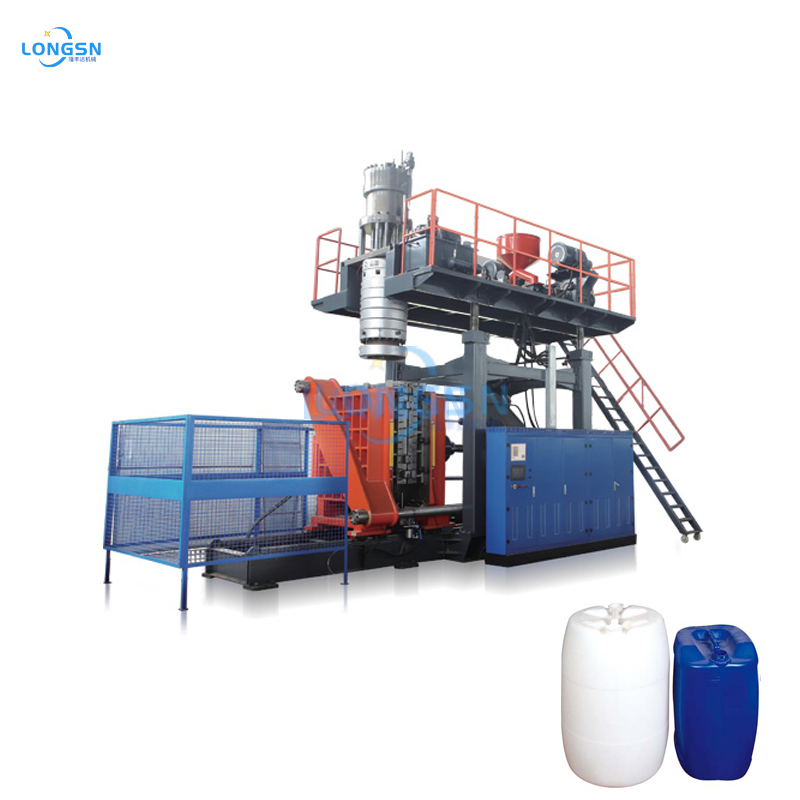
ISBM remains the undisputed champion for high-clarity PET. Water bottles and clear carbonated beverage containers rely on ISBM. The biaxial stretching creates immense structural strength. EBM stands as the industry standard for opaque and highly durable containers. Jerrycans, automotive fluid tanks, and chemical drums require EBM. EBM also easily handles multi-layer co-extrusion requirements.
Decision Checkpoint
You should proceed configuring an Extrusion Blow Moulding Machine under specific conditions. Prioritize EBM if tooling flexibility matters most. Choose EBM for extreme container size versatility. Select EBM when processing polyolefins like HDPE and PP daily.
Technology Comparison Chart
| Process Type | Ideal Applications | Tooling Complexity | Compatible Materials |
| EBM | Jerrycans, handles, automotive parts | Moderate | HDPE, PP, PVC, PETG |
| IBM | Pharma bottles, zero-scrap containers | High | PE, PP |
| ISBM | High-clarity water/beverage bottles | Very High | PET |
3. Core Machine Architecture: Features to Outcomes
Translating your product requirements into mechanical specifications requires absolute precision. We evaluate die heads, clamping forces, and drive systems below.
Die Head Configuration
Die heads determine how the molten plastic parison forms. The choice between continuous and accumulator heads changes everything.
- Continuous Extrusion: Best suited for bottles under twenty liters. The parison drops continuously from the tooling head. This method requires highly synchronized, high-speed carriage movement. The mold must capture the moving parison perfectly.
- Accumulator Head: Essential for heavy industrial parts. Large drums and automotive tanks use this configuration exclusively. The head stores molten plastic internally. It then rapidly pushes the parison out via a hydraulic ram. This prevents heavy plastic tubes from sagging under gravity.
Clamping Force & Carriage Stroke
Clamping force holds the mold shut against internal blowing pressure. Sizing the clamp tonnage correctly prevents unsightly flashing. Proper tonnage ensures clean pinch-off performance on thick handles. You calculate this using the projected surface area of the container. Next, multiply it by the resin blowing pressure. Always add a generous safety margin. Additionally, you must match the carriage stroke to your mold dimensions. Insufficient daylight prevents proper mold opening and part ejection.
Extruder Capacity & Screw Design
Your extruder capacity dictates the entire throughput limit. Match the Length/Diameter (L/D) ratio to your specific polymer family. HDPE often prefers an L/D ratio around 24:1 or 28:1. Proper screw geometry ensures a homogenous melt quality. Aggressive screw designs degrade heat-sensitive plastics like PVC. You must prioritize smooth mixing over raw speed.
Drive Systems (Hydraulic vs. All-Electric)
Drive systems power the carriage and clamp movements. Traditional hydraulic systems offer massive, raw power. However, all-electric servo-driven machines provide superior cycle precision. Electric drives run significantly cleaner. Medical and food-grade operations often mandate all-electric platforms. Servo-hybrid machines combine hydraulic force alongside precise electric carriage controls.
Common Mistake: Over-specifying clamp tonnage unnecessarily. Excess tonnage slows down dry cycle speeds and wastes energy.
4. Addressing 2026 Mandates: Automation & Compliance Integration
Modern production facilities require advanced connectivity and compliance capabilities. Preparing for future mandates ensures long-term operational viability.
Handling Recycled Materials (PCR)
Regulations increasingly demand higher PCR integration percentages. Processing PCR introduces severe melt inconsistencies. You must assess the machine's melt filtration capabilities thoroughly. Continuous screen changers prevent impurities from reaching the die head. Grooved feed sections provide more consistent solid conveying. Consider utilizing multi-layer die heads featuring an A-B-A configuration. This setup hides the inconsistent PCR resin inside the core layer. Virgin material covers the inner and outer visible surfaces perfectly.
Deflashing & Downstream Automation
Manual deflashing introduces extreme variability and high labor dependency. Fully automated downstream equipment eliminates these production bottlenecks. You should integrate automated punch-outs for neck and handle flash. Inline leak testing prevents defective containers from reaching customers. Robotic part-handling systems organize finished goods neatly. Conveyor integration moves parts away from the clamp area instantly. This allows the primary machine to maintain maximum cycle speeds.
Controls & Industry 4.0
Older relay logic panels severely limit modern production optimization. You need sophisticated Programmable Logic Controllers (PLCs). Brands like B&R or Beckhoff offer exceptional processing speeds. Real-time Wall Thickness Distribution System (WDS) programming is mandatory today. WDS profiles the parison using up to 300 distinct data points. Predictive maintenance alerts notify operators before catastrophic bearing failures occur. Remote diagnostic access allows factory engineers to troubleshoot software globally. This drastically reduces unnecessary downtime and travel delays.
5. Implementation Risks & Operational Efficiency
Overlooking basic implementation parameters derails many new production lines. You must audit energy metrics and infrastructure requirements carefully.
Energy Consumption Metrics
Do not simply read nominal power ratings on brochures. Nominal ratings rarely reflect real-world operational loads. Instead, calculate the actual kilowatt-hours required per kilogram of processed plastic. Servo-hydraulic pumps significantly reduce idle energy draw. Barrel insulation jackets keep heat inside the extruder. These small upgrades optimize the kWh/kg ratio drastically. Efficient machines reduce grid strain during peak operational hours.
Scrap & Regrind Loops
EBM inherently produces pinch-off flash around necks and tails. You need highly efficient closed-loop scrap recovery systems. Granulators must chop the flash immediately beside the press. Proportional valves blend this regrind back into the virgin feed hopper. Poorly designed regrind loops generate excessive dust. Dust clogs feed throats and ruins melt homogeneity.
Hidden Implementation Risks
Infrastructure constraints often halt installations unexpectedly. Verify your facility foundation requirements immediately. Accumulator head machines sometimes require reinforced concrete pads. Chilled water capacity presents another frequent oversight. Faster cycle times demand significantly colder, high-volume water flow. Ensure your cooling towers and chillers meet the newly added thermal load. Finally, factor in operator learning curves. Transitioning staff to advanced parison control screens requires dedicated training weeks.
Tooling Changeover Time
High-mix, low-volume manufacturers suffer greatly from slow mold changes. Assess the availability of Quick Mold Change (QMC) systems. Magnetic platens or hydraulic clamping systems slash setup times. Investigate die-head cleaning procedures thoroughly. Switching from black to natural resin often takes hours. Highly polished flow channels purge old colors much faster.
6. Shortlisting Manufacturers and Next Steps
Vetting machine builders requires strict auditing of their supply chain and support network. A beautiful machine fails quickly without proper backing.
Component Sourcing
Examine the exact brand of internal components used. The manufacturer must use standardized, globally available parts. Rexroth valves, Festo pneumatics, and Siemens PLCs are universally supported. Avoid builders utilizing proprietary, locked-in control boards. Proprietary boards leave you stranded if the vendor goes offline. Standardized parts allow your local maintenance team to source replacements instantly.
Factory Acceptance Testing (FAT)
Never authorize final shipment without a rigorous FAT. Demand the builder run your specific molds during this test. They must also use your exact resin grades. A dry-cycle test proves nothing about actual product quality. Run the machine for several continuous hours. Check for hydraulic leaks, overheating zones, and consistent part weights. Document every parameter before signing the release paperwork.
Service Level Agreements (SLA)
Post-installation support separates average builders from exceptional partners. Evaluate the vendor’s domestic spare parts inventory carefully. Verify their remote troubleshooting capabilities. Ask for guaranteed technician deployment times in writing. A 24-hour remote response SLA keeps lines running during night shifts. Ask current customers about their real-world experiences dealing with the service team.
Conclusion
Selecting an extrusion blow moulding machine demands careful geometric and material analysis. You must balance current product designs against future material flexibility requirements. PCR integration requires specialized A-B-A die heads and superior melt filtration. Avoid over-specifying clamp tonnage simply for perceived safety. Excess tonnage drastically harms your cycle speed and footprint. Focus intensely on operational efficiency metrics like your kWh/kg ratio. Heavily weight the reliability of the manufacturer's after-sales support ecosystem. Always finalize your product 3D drawings and target output numbers first. Establish your facility's cooling capacity limits immediately. Take these completed baselines to your shortlisted machine engineers to guarantee a successful deployment.
FAQ
Q: What is the best plastic for an extrusion blow moulding machine?
A: High-Density Polyethylene (HDPE) remains the industry standard. It offers excellent melt strength and rigidity for complex shapes. Polypropylene (PP) and PETG are also highly common. PP provides better heat resistance, while PETG offers glass-like clarity. Your choice depends entirely on required flexibility, clarity, and barrier properties.
Q: How do I calculate the required clamping force for my product?
A: Clamping force relies on the projected surface area of your container. You multiply this area by the specific blow pressure of your chosen resin. Finally, you add a safety margin (typically 10-20%). This ensures clean pinch-offs on thick handles and prevents mold flashing.
Q: What is the expected lifespan of a commercial EBM machine?
A: High-quality EBM machines routinely operate for 15 to 20 years. This requires strict adherence to preventative maintenance schedules. Heavy structural frames rarely fail. Future upgrades typically focus on retrofitting modern PLCs and installing new extrusion screws.
Q: Can an EBM machine produce multi-layer containers?
A: Yes, they utilize advanced co-extrusion technology. This requires a machine equipped with multiple separate extruders. These extruders feed into a specialized multi-layer die head. You can configure 2 to 6 layers to integrate UV barriers, chemical resistance, or hidden PCR cores.

 English