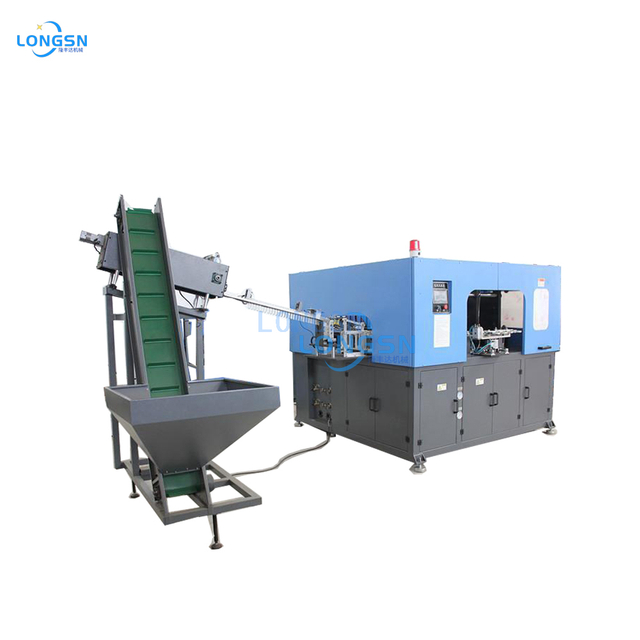
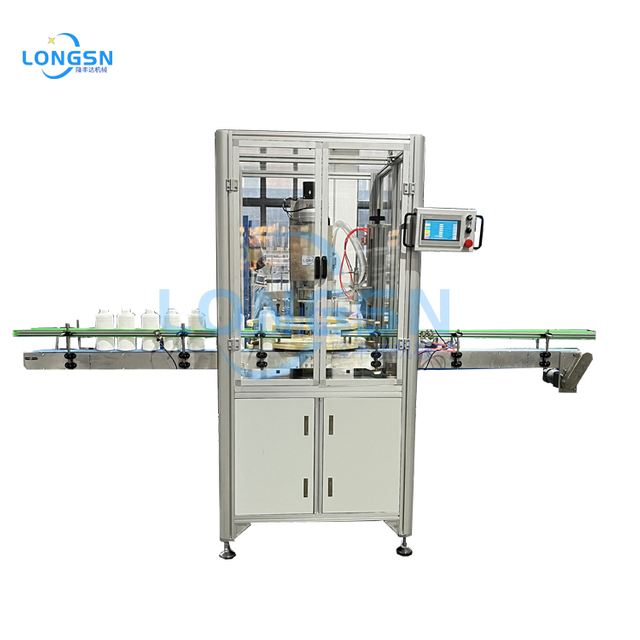
Packaging costs represent a massive line item for beverage and consumer goods brands. This ongoing financial pressure drives many companies to evaluate in-house PET manufacturing. They carefully weigh internal production against continued outsourcing. Transitioning to a dedicated production model requires substantial initial capital expenditure. Your ultimate success relies heavily on precise unit economics and highly predictable demand. You must also select the right equipment to ensure smooth operations.
This comprehensive guide breaks down essential financial modeling and complex operational realities. It also highlights vital vendor evaluation criteria. We will help you determine if investing in a pet bottle making machine makes sound financial sense for your specific business goals. You will discover exactly how to balance upfront costs against long-term profitability. By following these frameworks, you can confidently navigate the transition from purchasing empty bottles to producing them on your own factory floor.
Key Takeaways
- **Volume dictates viability:** Profitability hinges on maintaining high equipment utilization rates; idle capacity rapidly erodes return on investment (ROI).
- **Opex outpaces Capex:** While the initial cost of a pet bottle making machine is high, long-term profitability is largely determined by energy efficiency, raw material (PET resin/preforms) costs, and scrap rates.
- **Automation level defines margins:** The choice between semi-automatic and fully automatic systems directly impacts labor overhead, production consistency, and scalability.
- **Hidden costs exist:** Accurate financial modeling must account for auxiliary equipment (high-pressure compressors, chillers), mold acquisition, and facility power upgrades.
Evaluating the Business Case: When Does In-House Manufacturing Make Financial Sense?
Defining your break-even volume remains the most critical first step. You must establish a clear monthly bottle consumption threshold. Above this specific volume, the amortized cost of your machinery drops below the cost of buying wholesale empty bottles. We often call this the tipping point. Calculating this requires you to divide your total fixed costs by the savings generated per unit produced. Once your demand confidently exceeds this threshold, bringing production in-house becomes a highly viable strategy.
Next, you must evaluate supply chain control versus capital risk. Outsourcing means you constantly pay to ship "empty air." High freight costs erode your profit margins quickly. Eliminating supplier lead times grants you immense operational flexibility. However, bringing manufacturing inside your four walls introduces new liabilities. You take on direct responsibility for equipment maintenance, skilled labor acquisition, and stringent quality control. You must analyze this specific trade-off carefully before committing capital.
Finally, establish strict success criteria for your project. Setting clear financial benchmarks prevents poor investments and aligns stakeholder expectations.
- Define a strict target cost-per-bottle based on your current wholesale pricing.
- Set an acceptable payback period. Successful industrial rollouts typically target 18 to 36 months for complete capital recovery.
- Establish a minimum required gross margin to justify the operational shift and the added manufacturing complexity.
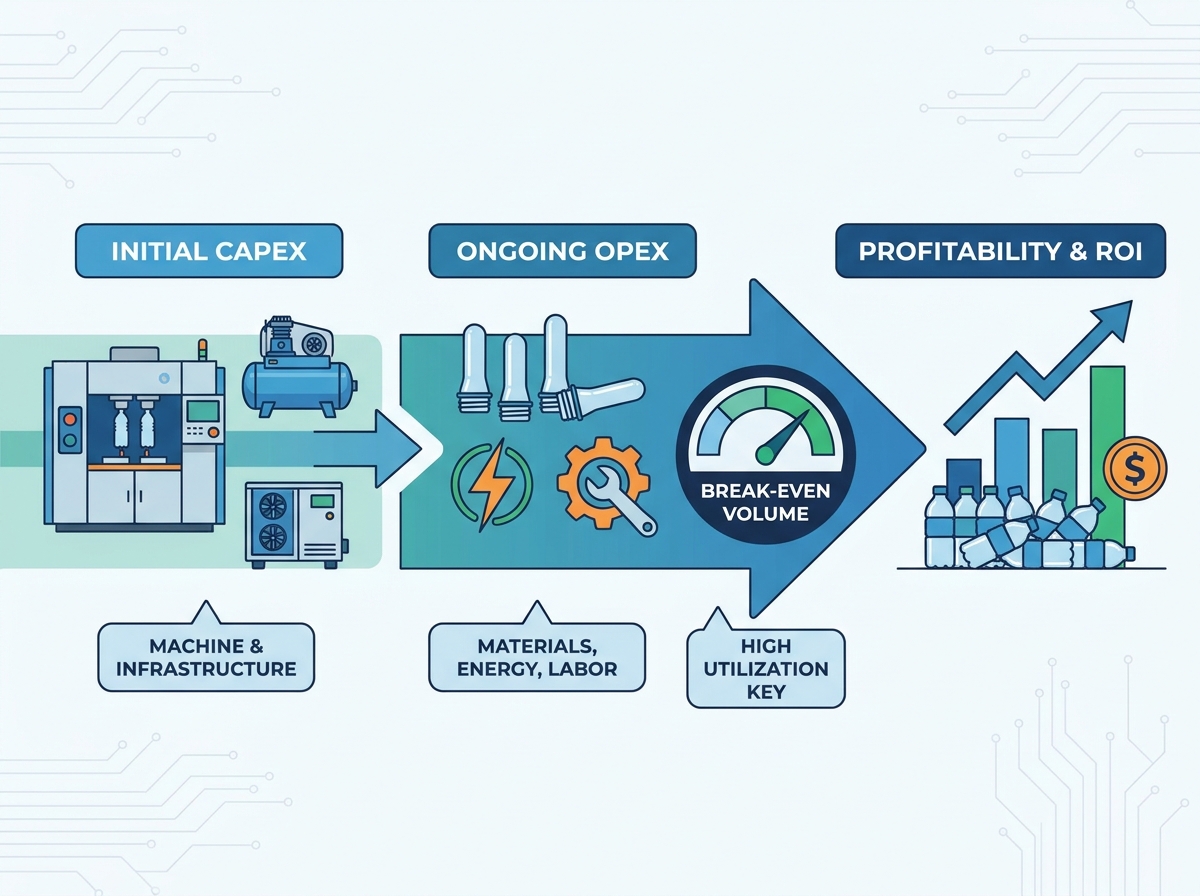
Capex vs. Opex: Structuring Your Cost Analysis
Initial Capital Expenditures (Capex) require careful and comprehensive planning. The core equipment represents your largest upfront purchase. However, it never operates alone in a vacuum. You must budget heavily for required auxiliary infrastructure to support the blow molding process. This includes high-pressure air compressors, heavy-duty water chillers, air dryers, and industrial cooling towers. Custom mold fabrication adds further upfront expenses depending on your bottle designs. Facility modifications also consume capital rapidly. You might need food-grade compliance upgrades, reinforced concrete flooring, or heavy-duty electrical drops to handle the load.
Ongoing Operational Expenses (Opex) dictate your long-term success. Raw materials take the biggest share of this ongoing budget. You will buy PET preforms or raw resin constantly to feed the line. Global petrochemical price volatility impacts these raw material margins directly. Energy consumption also drives up Opex significantly. Blow molding requires massive electrical inputs. Heating the preforms and generating high-pressure air inflates your monthly utility bill quickly. Finally, budget appropriately for ongoing labor and maintenance. You need skilled operators to run the lines efficiently. You also need funds for routine preventative maintenance and spare parts, including valves, mechanical seals, and infrared heating lamps.
Capex vs. Opex Breakdown for PET Bottle Production
| Expense Category | Type | Key Components | Financial Impact |
| Core Machinery | Capex | Blow molding unit, control panels | High initial cost, depreciates over 7-10 years. |
| Auxiliary Equipment | Capex | Compressors, chillers, dryers, molds | Moderate to high initial cost, critical for operation. |
| Raw Materials | Opex | PET preforms, raw PET resin | Highest ongoing cost, subject to market volatility. |
| Energy Consumption | Opex | Electricity for heating and high-pressure air | High ongoing cost, requires efficiency tracking. |
| Labor & Maintenance | Opex | Operator wages, spare parts, servicing | Predictable ongoing cost, essential for minimizing downtime. |
Selecting the Right Pet Bottle Making Machine to Maximize Margins
Throughput must align perfectly with your projected consumer demand. You should always match the equipment's Bottles Per Hour (BPH) rating directly to your actual sales forecasts. Never over-specify your machinery just to have extra capacity. Excess capacity leads to unrecoverable Capex and destroys your ROI timeline. Conversely, under-specifying leads to missed sales and forces you into expensive outsourcing patches.
You must carefully choose between different automation levels to match your labor strategy.
- Semi-Automatic Systems: They offer a significantly lower initial cost. They provide high flexibility for small batches or frequent shape changeovers. However, they remain highly labor-intensive and depend heavily on operator speed. You often see slightly inconsistent quality due to human intervention during the transfer process.
- Fully Automatic Systems: These require substantial Capex upfront. They deliver a much lower unit cost when operated at scale. You gain precise, repeatable quality control across millions of units. They do require strict preventative maintenance protocols to prevent complex mechanical jams.
Briefly consider single-stage versus two-stage processes as well. Single-stage systems convert raw plastic resin directly into a finished bottle in one continuous loop. They work best for niche cosmetic or custom pharmaceutical packaging where pristine, scratch-free surfaces matter most. Two-stage processes convert a pre-manufactured preform into a final bottle. This method remains the unquestioned industry standard for high-volume beverage production due to its sheer speed and efficiency.
Navigating Implementation Realities and Adoption Risks
Real-world constraints often challenge new industrial installations. Facility and utility limitations represent a highly common roadblock for growing businesses. Many standard commercial warehouses lack adequate industrial power supply to support heavy machinery. Upgrading facility transformers costs a significant amount of money and requires long permitting lead times. You must handle massive compressor startup surges safely without tripping main breakers. Ensure your flooring can handle the heavy vibration generated by high-pressure air systems.
Downtime destroys manufacturing profitability faster than any other factor. Machine unreliability halts production lines rapidly, causing missed delivery windows. A lack of local spare parts compounds these daily financial losses. You must secure reliable maintenance channels and keep critical wear parts in stock. The financial cost of a line sitting idle often exceeds the price of the spare parts tenfold.
Operator expertise matters immensely in this specialized field. Acknowledge the steep learning curve your team will face. A pet bottle making machine only hits its rated efficiency under expert guidance. Properly trained operators know how to optimize complex heating profiles for different preform weights. They adjust blowing pressure settings precisely to prevent weak bottle bases. This hard-earned expertise minimizes scrap and keeps rejected bottles out of your final counts.
Shortlisting Vendors and Finalizing Your ROI Model
Vendor evaluation criteria must extend far beyond the initial sticker price. You should evaluate manufacturing vendors based heavily on their local service technician availability. Review their warranty terms carefully to understand what exact parts they cover. Demand transparent energy-consumption data before signing any purchase agreements. Cheap machinery often consumes excess electricity, wiping out your upfront savings over the first few years of operation.
Standardizing the quote protects your final budget. Ensure you compare "apples to apples" during the vendor selection phase. Verify if every single quote includes the necessary custom molds and essential auxiliaries. Check for hidden installation fees, freight surcharges, and commissioning costs. Some vendors quote bare machines, while others quote turnkey, ready-to-run solutions.
Take clear, decisive next-step actions to secure your investment. We highly recommend conducting a localized feasibility study first to verify your utility capacities. Lock in your preform supplier contracts early to secure favorable raw material pricing. Finally, request a highly detailed financial projection from your shortlisted machinery manufacturers. This comprehensive projection helps solidify your overarching profitability model and secures internal stakeholder buy-in.
Conclusion
Profitability in the PET packaging business goes far beyond simply buying the cheapest equipment available. It remains a strict function of high utilization rates, tight operational efficiency, and highly accurate cost forecasting. If you leave your machinery idle, your investment will struggle to generate positive returns.
A well-selected manufacturing setup transforms your packaging strategy completely. It converts a highly unpredictable outsourced expense into a firmly controlled, margin-generating asset. You regain control over your supply chain and eliminate the wasted costs of shipping empty bottles across the country.
Audit your current annual packaging spend immediately. Identify your precise monthly bottle consumption. Request spec-matched capability documents from Tier 1 and Tier 2 machinery providers. You can then confidently build a highly customized ROI model that dictates your next strategic move.
FAQ
Q: How long does it typically take to see an ROI on a pet bottle making machine?
A: Depending on your daily production volume, local energy costs, and specific machine type, standard payback periods range from 18 to 36 months. Highly utilized, fully automatic lines running multiple shifts often achieve faster returns.
Q: What is the largest ongoing operational expense in a PET bottle plant?
A: Raw materials account for the vast majority of ongoing operational costs. PET preforms often represent 60-70% of the total per-bottle cost. Electrical consumption for heating and high-pressure air follows closely behind.
Q: Can a single machine produce multiple bottle sizes and shapes?
A: Yes, they offer excellent versatility. However, it requires purchasing separate custom molds. You must also factor in the labor and downtime required to swap these molds physically and recalibrate the heating parameters.
Q: Do I need specialized infrastructure to install this equipment?
A: Yes. Beyond the primary machine footprint, facilities require industrial-grade electrical panels to handle power surges. You also need reinforced concrete flooring for heavy compressors and dedicated cooling water loops to maintain temperature stability.

 English