Procuring industrial packaging equipment carries exceptionally high financial stakes for any manufacturing facility. A single misstep in machinery selection disrupts production lines, frustrates supply chains, and inflates operational budgets for years. Modern packaging facilities face a complex balancing act when expanding their physical capabilities. They must carefully weigh upfront capital expenditure against ongoing operational expenses, expected yield rates, and long-term production scalability. Relying on surface-level metrics often leads to costly bottlenecks down the line.
This guide provides an evidence-based framework to help you navigate these high-pressure choices. We will compare various equipment configurations directly against your actual production demands. You will learn how to demystify critical feature sets and avoid common procurement traps. We also provide actionable strategies to evaluate long-term financial impacts accurately. By following these steps, you ensure you select the optimal solution for your specific factory floor.
Key Takeaways
- Production Alignment: Choosing between semi-automatic and fully automatic systems depends strictly on your required Bottles Per Hour (BPH) and labor availability, not just initial budget.
- Process Clarity: A PET bottle making machine (stretch blow molding) is distinct from a PET preform machine (injection molding); integrating both requires significant capital and infrastructure.
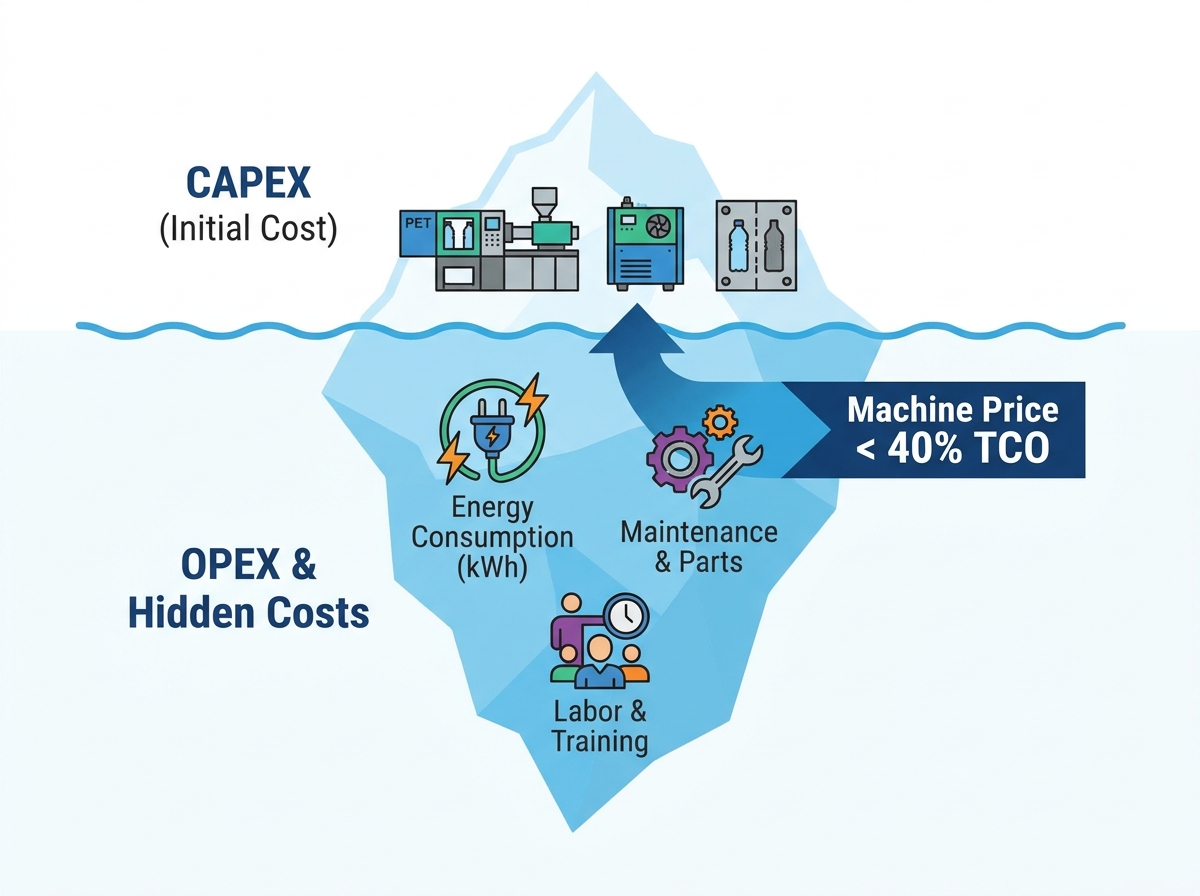
- Cost Realities: The sticker price of the machine often accounts for less than 40% of its TCO; high-pressure air compressors, cooling systems, and energy consumption drive long-term costs.
- Evaluation Criteria: Vendor shortlisting must prioritize mold changeover speed, servo-motor precision, and Factory Acceptance Testing (FAT) terms over marketing claims of maximum speed.
Framing the Business Problem: Defining Your Production Parameters
Auditing your current demand requires absolute precision. You must calculate your required Bottles Per Hour (BPH) accurately. Look beyond the blowing station itself. You should identify existing bottlenecks in your downstream filling and capping lines first. If your filler processes 8,000 BPH, purchasing a 15,000 BPH blower creates unwanted inventory backlogs. You need balanced synchronization across the entire packaging floor.
Procurement teams often confuse preform manufacturing and bottle blowing. We must address this distinction clearly. A stretch blow molding system shapes existing plastic tubes into finished containers. In contrast, an injection molding machine melts raw resin to create those initial tubes. Many buyers search for a pet bottle making machine expecting it to do both. You must decide your strategy early on. Will you buy ready-made preforms from a regional supplier? Or will you manufacture them in-house? Combining both processes requires massive capital and complex infrastructure.
Establish your baseline success criteria before contacting any vendors. Define your acceptable defect rates strictly. Set a target energy consumption metric per finished bottle. Determine the maximum allowable downtime for your mold changeovers. These predefined metrics will guide your final purchasing decision.
Core Categories of PET Bottle Making Machines
Fully Automatic Stretch Blow Molding Machines
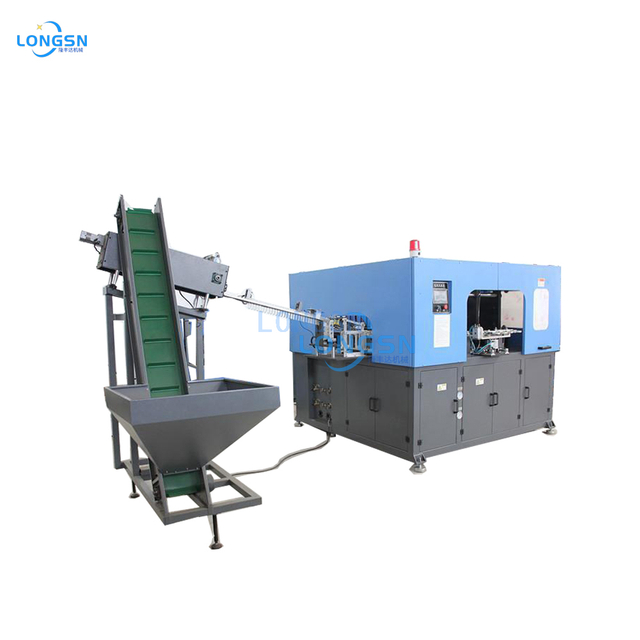
Fully automatic systems serve high-volume, continuous production facilities perfectly. They handle outputs ranging from 4,000 to well over 24,000 BPH. They require minimal labor intervention during standard operation. This automation ensures high consistency across massive production runs. A fully automatic pet bottle making machine integrates seamlessly into existing automated filling lines. The primary drawback remains the high initial capital expenditure. Additionally, these systems require highly skilled technicians for routine maintenance. They are generally less economical for short, custom product runs.
Semi-Automatic Blow Molding Machines
Semi-automatic models fit startups and small-batch production facilities best. They also excel at manufacturing specialized large containers, such as 3-gallon or 5-gallon water jugs. They offer a very low initial investment threshold. You gain high flexibility for frequent mold changes. Their simpler mechanical design makes routine maintenance much easier. However, they carry a high labor dependency. Operators must manually load preforms into the heating ovens. This human intervention often causes inconsistent heating and blowing. Consequently, you face a much lower overall throughput.
Rotary vs. Linear Configurations
Equipment design typically falls into two main physical configurations. Linear machines offer cost-effective solutions for mid-range speeds. They feature straightforward mechanical pathways. This layout makes them much easier to maintain and troubleshoot. Rotary machines, conversely, tackle ultra-high speeds and massive production scale. They utilize a spinning carousel design. This setup requires a significantly larger factory footprint. It also demands complex mechanical synchronization, driving up maintenance complexity.
Equipment Comparison Chart
| Machine Type | Target Volume | Labor Requirement | Initial Investment | Best Application |
| Fully Automatic (Linear) | Medium to High (4,000 - 10,000 BPH) | Low | Moderate to High | Standard beverage lines |
| Fully Automatic (Rotary) | Ultra-High (10,000 - 24,000+ BPH) | Low (requires skilled techs) | Very High | Massive scale water/soda |
| Semi-Automatic | Low (Under 2,000 BPH) | High | Low | Startups, 5-gallon jugs |
Key Features to Evaluate for ROI and Reliability
Comparing technical specifications requires looking past marketing brochures. You must evaluate internal components critically. Several core features dictate long-term performance and reliability.
- Heating Efficiency and Energy Recovery: Assess the infrared (IR) oven configurations carefully. You should look for closed-loop heating systems. These systems monitor and adjust temperatures dynamically. Prioritize high-pressure air recovery features. These recovery valves capture exhaust air from the blowing process. They recycle this air back into the system. This innovation can reduce your compressor energy usage by up to 30%.
- Drive Systems (Pneumatic vs. Servo-Driven): Traditional machines use pneumatic cylinders for movement. Modern equipment utilizes servo-driven stretching and mold clamping. Servos offer vastly higher precision. They enable faster cycle times. They also produce significantly lower defect rates compared to standard pneumatic systems.
- Mold Compatibility and Changeover Speed: Evaluate physical changeover procedures deeply. Determine how quickly the machine switches between different neck finishes. Changing from a 28mm water neck to a 38mm juice neck often requires extensive adjustments. Tool-less quick-change mold systems save hours of weekly downtime.
- Control Systems and HMI: The Human-Machine Interface (HMI) controls your daily operations. Prioritize machines featuring standardized, globally supported Programmable Logic Controllers (PLCs). Brands like Siemens or Allen-Bradley guarantee long-term parts availability. They also make troubleshooting much easier for your local electricians.
Cost Breakdown: CAPEX, OPEX, and Hidden Expenses
Understanding the true financial commitment requires splitting expenses into capital and operational buckets. Do not fall into the trap of only budgeting for the main unit.
Initial Capital Expenditure (CAPEX)
- Base Machine Price: The core cost of the blowing unit itself.
- Auxiliary Equipment: This often surprises first-time buyers. You must purchase high-pressure air compressors (usually 30 to 40 bar). You also need industrial chillers, air dryers, and cooling towers.
- Custom Mold Tooling: Every unique bottle shape requires a custom aluminum or steel mold. These tooling costs scale quickly if you produce multiple SKUs.
Operational Expenditure (OPEX)
- Energy Consumption: Calculate kilowatt-hours per 1,000 bottles. Compressors and heating ovens consume massive amounts of electricity.
- Routine Maintenance Parts: Budget for consumable components. High-pressure valves, pneumatic seals, and infrared heating lamps degrade predictably.
- Labor Costs: Account for daily operators and specialized maintenance engineers. Complex machines require higher-paid technicians.
Calculating ROI
Map your estimated cost per bottle aggressively. Compare this against local preform prices and your regional industrial energy rates. Factor in your expected reduced defect margins. A servo-driven machine might cost 20% more upfront. However, if it reduces scrap by 2% and cuts energy by 15%, you reach your break-even timeline much faster.
Implementation Realities and Rollout Risks
Installing industrial blowing equipment disrupts normal factory operations. You must acknowledge the physical footprint needed. The machine itself takes up significant space. However, you also need ample room for auxiliary equipment. You must route robust electrical supplies. You also need to install specialized high-pressure piping safely.
Compliance and safety remain non-negotiable. Ensure the equipment meets regional safety standards strictly. Look for CE, UL, or OSHA certifications depending on your location. Evaluate the machine's safety enclosures closely. Blow molding generates significant acoustic noise. A poorly enclosed machine might violate local workplace hearing protection laws.
Supply chain vulnerabilities pose another major risk. If you rely on external preform suppliers, calculate lead times carefully. Plan your warehouse storage requirements accurately. Preforms absorb moisture from the air. They require climate-controlled storage prior to blowing. If you blow moisture-laden preforms, the final bottles turn cloudy and brittle.
Shortlisting Logic and Next Steps
Vendor vetting separates successful projects from costly failures. Evaluate manufacturers based on their post-sale support infrastructure. Check the availability of local service technicians in your region. Ask about their spare parts lead times. A cheap machine becomes incredibly expensive if you wait three weeks for a replacement valve from overseas.
Never skip the Factory Acceptance Testing (FAT). Mandate a live production run at the vendor's facility before releasing final payment. You must use your specific preforms and molds during this test. Running a vendor's optimized demo materials will not reveal true operational quirks.
Your actionable next step involves drafting a standardized Request for Proposal (RFP). Detail your required BPH and exact bottle sizes clearly. List your facility's utility constraints regarding power and space. Define your long-term operational expense limits. Send this comprehensive RFP to a shortlisted group of qualified manufacturers. This forces them to quote apples-to-apples solutions.
Conclusion
- The best blowing equipment is rarely the cheapest or the fastest on paper. It is the one aligning perfectly with your actual utility capacity and labor model.
- Prioritize energy efficiency and robust auxiliary equipment during your budgeting phase.
- Demand total transparency from vendors regarding spare parts availability and local technician support.
- Execute a strict Factory Acceptance Test using your own materials before accepting delivery.
- Calculate your expected cost per bottle over a five-year horizon rather than focusing solely on the upfront sticker price.
FAQ
Q: What is the difference between a PET preform machine and a PET bottle making machine?
A: A preform machine uses injection molding to melt raw plastic resin into small, test-tube-like shapes called preforms. A bottle making machine uses stretch blow molding. It heats those existing preforms and injects high-pressure air to stretch them into final bottle shapes.
Q: How much compressed air does a fully automatic PET blow molding machine require?
A: It requires two distinct air supplies. Low-pressure air (around 8-10 bar) drives the mechanical movements and pneumatic cylinders. High-pressure air (typically 30-40 bar) handles the actual bottle blowing process. Precise volume requirements depend strictly on your target BPH.
Q: Can one machine produce both water bottles and hot-fill juice bottles?
A: Generally, no. Hot-fill bottles require specialized heat-resistant molds and distinct oven heating profiles to prevent the plastic from shrinking when filled with hot liquid. Standard water bottle machines lack these specific thermal conditioning capabilities.
Q: What is the average lifespan of a high-speed stretch blow molding machine?
A: A high-quality machine typically lasts between 10 and 15 years. This lifespan assumes strict adherence to preventative maintenance schedules. Neglecting routine valve replacements or running contaminated compressor air can cut this operational lifespan in half.
Q: How do I calculate the energy cost per bottle for these machines?
A: You must measure the combined kilowatt-hour (kWh) draw of the blowing machine, the high-pressure compressor, and the chiller. Divide this total energy consumption by your actual production yield (usable bottles) per hour. Multiply that figure by your local electricity rate.

 English