Transitioning from conceptual packaging design to specifying production line machinery is a critical milestone. Every buyer faces the intense pressure of turning brilliant 3D renderings into tangible, flawless bottles on the factory floor. Misaligning machine capabilities with industry-specific application requirements leads directly to operational bottlenecks. Manufacturers often face high defect rates and poor returns when they select mismatched equipment. You must carefully navigate complex variables like output speed, cosmetic demands, and facility footprint limitations. We will map specific industry applications to the correct equipment configurations to help you make informed decisions. You will discover the vital operational differences between single-stage and two-stage systems. Finally, we provide a robust vendor evaluation framework to ensure a seamless production rollout. Choosing the right technology ensures your packaging lines run efficiently, reliably, and profitably from day one.
Key Takeaways
- Beverage & Food: Require high-speed, two-stage systems prioritized for high throughput (BPH) and lightweighting.
- Cosmetics & Pharma: Favor single-stage systems to guarantee blemish-free finishes and precise neck dimensions.
- Process Selection: The choice between single-stage and two-stage production is dictated by product volume, bottle complexity, and facility footprint.
Evaluating Output Needs: The Business Case for Machine Selection
Defining your production goals before evaluating machinery specifications saves time and capital. Many manufacturers skip this step, jumping straight into equipment catalogs. You must first decide whether your operation demands high-volume uniformity or low-volume complexity. High-volume uniformity involves running millions of identical bottles continuously. Low-volume complexity requires frequent mold changes to accommodate diverse, intricate bottle designs. Establishing this baseline dictates the fundamental architecture of your future packaging line.
Your success criteria must balance capital expenditure (CapEx) against operational expenditure (OpEx). Buying a cheaper machine upfront often results in devastating daily running costs. You should focus heavily on energy consumption per bottle. Heating preforms and compressing air consume massive amounts of electricity. Tracking theoretical scrap rates is equally crucial. A machine generating a 3% scrap rate quickly destroys profit margins compared to one holding a 0.5% rate. Prioritize equipment delivering consistent thermal stability to keep defect rates near zero.
Material considerations also play a massive role in modern machine selection. Sustainability mandates push brands toward recycled PET (rPET). Processing rPET introduces unique thermal challenges. Recycled resins absorb heat differently than virgin PET. You must assess how easily a machine adapts to these material variations. Look for highly configurable infrared heating arrays. Adaptive cooling systems also help operators stabilize rPET production runs, ensuring you meet compliance targets without sacrificing bottle clarity.
Best Practice: Always finalize your exact bottle weight and neck finish specifications before requesting machine quotes. Vague parameters lead to undersized or oversized equipment recommendations.
Beverage and Edible Oil Packaging: Scaling High-Volume Production
Bottled water, carbonated soft drinks (CSD), and edible oils require massive daily output. Margins in this sector remain razor-thin. Producers survive by maximizing volume while ruthlessly cutting per-unit packaging costs. This environment demands extreme reliability and blistering speeds. You cannot afford unplanned downtime during peak seasonal production windows.
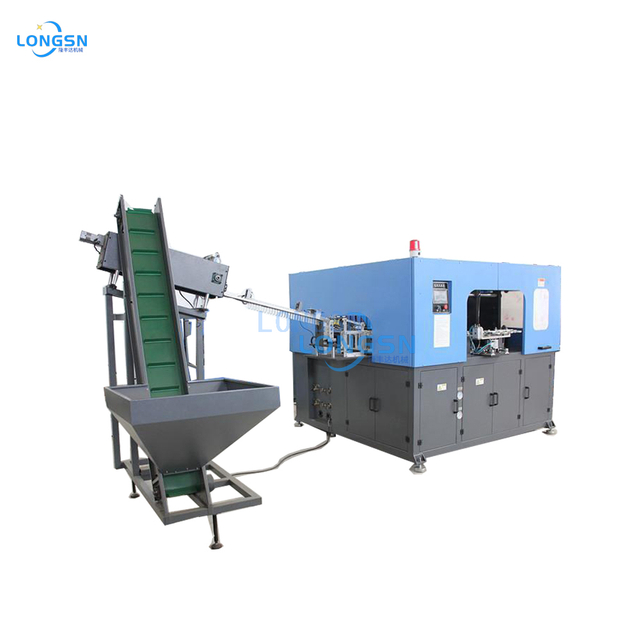
The standard solution for this sector is the two-stage process. Installing a high-speed pet bottle blow molding machine separates preform manufacturing from the final bottle blowing. You can either purchase preforms from a third-party supplier or mold them on a separate high-cavitation injection machine. This separation allows the blowing equipment to run at astonishing speeds, often exceeding tens of thousands of bottles per hour.
Key Evaluation Dimensions
- Speed & Cavitation: Evaluate output capacity carefully. Bottling speed is measured in bottles per hour (BPH). You must weigh the BPH capabilities against the required floor space. Rotary machines offer the highest cavitation and speed, but they require substantial square footage. Linear machines fit better into narrow factory footprints but generally offer lower maximum output.
- Lightweighting Capability: Beverage brands constantly reduce bottle weights to save resin costs. Processing ultra-thin preforms requires incredible precision. The machine must deliver targeted heating and highly controlled stretching. This ensures the final bottle maintains adequate top-load capacity and burst strength, especially critical for pressurized CSD applications.
- Energy Efficiency: Focus intensely on the infrared oven layouts. Narrow oven pitches reduce heating times and save electricity. Furthermore, investigate air-recovery systems. These systems capture exhausted high-pressure blowing air and recycle it to drive low-pressure mechanical movements within the machine. This dramatically reduces the burden on your factory air compressors.
Cosmetics, Personal Care, and Pharma: Ensuring Precision and Aesthetics
Applications like hand sanitizers, luxury lotions, premium cosmetics, and pharmaceutical syrups operate under different rules. Here, massive volume takes a back seat to absolute visual perfection. Consumers associate packaging clarity and zero blemishes with product quality. Pharmaceutical products also demand strict hygienic standards and absolute dimensional consistency to ensure consumer safety.
The ideal solution for these requirements is the single-stage PET bottle blow molding machine. Often called Injection Stretch Blow Molding (ISBM), this technology combines preform injection and bottle blowing into one continuous cycle on a single frame. The preform never leaves the machine. It moves directly from the injection cavity to the conditioning station, and then to the blow mold.
Key Evaluation Dimensions
- Surface Finish: Single-stage machines eliminate preform transport damage. In two-stage systems, preforms tumble into massive bins and rub against each other during transit. This friction creates microscopic scratches. ISBM prevents this completely. The result is scratch-free production, delivering the glass-like clarity demanded by premium cosmetic brands.
- Neck Accuracy: Pump dispensers and pharmaceutical spray closures require guaranteed thread precision. Any deviation causes leaks during shipping. Single-stage machines inject the neck finish and hold it securely with a core rod throughout the entire blowing process. The neck never undergoes reheating, ensuring perfect, leak-proof dimensions every single time.
- Mold Flexibility: Cosmetic product portfolios feature diverse, asymmetrical, and complex bottle shapes. You will likely face frequent, low-volume changeovers. Single-stage machines handle complex geometries beautifully. Their tooling allows you to manipulate material distribution meticulously, achieving sharp edges and unique contours that two-stage machines struggle to replicate.
Common Mistake: Choosing a high-speed two-stage machine for premium cosmetics often results in unacceptable cosmetic defect rates due to preform scuffing. Always prioritize the aesthetic requirement over raw speed for luxury goods.
Single-Stage vs. Two-Stage: Which Fits Your Facility?
Understanding the mechanical and logistical differences between these two methodologies is critical. You must align your facility capabilities, product mix, and quality expectations with the right technology. Making the wrong choice severely limits your future production flexibility.
The two-stage process (Reheat Stretch Blow Molding) maximizes output. It separates the injection of the preform from the blowing of the bottle. You gain immense flexibility in your supply chain because you can easily purchase preforms on the open market. This drives down the per-unit cost at scale. However, it requires a larger overall facility footprint to store bulk preforms. Furthermore, the handling process introduces a higher risk of cosmetic blemishes.
The single-stage process (Injection Stretch Blow Molding) offers a wonderfully compact footprint. You transform raw plastic resin pellets into finished bottles in one machine. This guarantees superior cosmetic quality and gives you complete control over the entire molding process. The downsides include higher initial tooling costs for the injection and blow molds. Cycle times are also inherently slower, making it less efficient for massive, standardized beverage runs.
Process Comparison: Single-Stage vs. Two-Stage Systems
| Process Type | Primary Advantage | Key Limitation | Best For |
| Two-Stage (Reheat) | Maximum output speed and scalability. | Higher risk of preform scuffing. | Beverages, water, edible oils. |
| Single-Stage (ISBM) | Flawless aesthetics and exact neck precision. | Higher tooling costs and slower cycles. | Cosmetics, pharma, personal care. |
Implementation Realities and Rollout Risks
Procuring the primary blow molding machine represents only the first step. The reality of factory implementation often catches buyers off guard. The peripheral equipment, facility requirements, and human elements introduce significant rollout risks. You must evaluate the entire production cell comprehensively.
Auxiliary equipment dependency is a massive factor. Blow molding requires substantial supporting infrastructure. You must accurately factor in the sizing and cost of high-pressure air compressors. These compressors generate the 30 to 40 bar of pressure required to stretch the PET. You also need industrial chillers to cool the molds rapidly, and precise mold temperature controllers to maintain stable process parameters. Undersizing these auxiliaries guarantees machine underperformance.
Mold changeover economics directly impact your daily output. Evaluate the realistic downtime required to swap molds. How long does it take to change the mechanical parts? More importantly, how long does it take the operator to load new heating profiles and stabilize the oven temperatures between product runs? Quick-change tooling systems significantly mitigate this risk.
Operator expertise remains a highly underestimated variable. Assess the learning curve for the machine's PLC controls. Tuning infrared heating lamps for complex bottle geometries requires skill. Adjusting stretch rod speeds to compensate for rPET material variances requires deep process knowledge. Ensure your chosen vendor provides comprehensive, on-site training for your technical team.
You must rigorously validate your facility infrastructure using the following checklist:
- Power Requirements: Verify your electrical grid can handle the massive initial draw of the infrared heating ovens and high-pressure compressors.
- Structural Flooring: Ensure the concrete foundation can withstand the high-frequency vibration generated by rapid mold clamping mechanisms.
- Ambient Climate Control: Maintain stable factory temperatures. Wild swings in ambient heat or humidity drastically alter PET thermal absorption, causing sudden spikes in defect rates.
Shortlisting Logic: How to Evaluate a Machine Manufacturer
The vendor you choose becomes a long-term partner. Evaluating manufacturers requires moving past glossy brochures and examining their engineering rigor and post-sale support infrastructure. A rigorous shortlisting process protects your capital investment.
Demand a comprehensive Factory Acceptance Testing (FAT) protocol. Never accept a machine based on a video using generic preforms. You must demand verifiable FAT using your specific preforms, your specific molds, and your designated bottle weights before authorizing shipment. This real-world test exposes heating issues, stretching limitations, and mechanical faults while the machine still sits on the vendor's floor.
Audit parts and service availability meticulously. A broken machine halts your entire supply chain. Investigate the vendor's regional technical support network. Can they dispatch a technician within 24 hours? Look closely at their reliance on proprietary versus off-the-shelf components. Machines built with standard, universally available pneumatic valves, sensors, and PLC brands (like Siemens or Allen-Bradley) ensure you never suffer prolonged downtime waiting for a proprietary part from overseas.
Ensure strict compliance and documentation. The equipment must meet regional safety standards, including CE or UL certifications, depending on your location. Furthermore, evaluate the machine's software capabilities. Modern production demands transparent Overall Equipment Effectiveness (OEE) reporting. The PLC should automatically track uptime, cycle speeds, and fault codes, exporting this data seamlessly to your factory management software.
Conclusion
Navigating the complexities of packaging machinery requires a clear understanding of your specific production environment. The best equipment is always dictated by your exact end-product application, cosmetic requirements, and daily production volume. High-speed beverage lines demand the raw output of two-stage systems, while precision cosmetic packaging relies on the flawless clarity of single-stage technologies.
Before you engage with manufacturers, finalize your bottle design. Lock down your material choices, neck finishes, and realistic volume projections. Presenting precise data during the RFQ process ensures vendors provide accurate machine sizing and realistic tooling quotes. Take the time to audit auxiliary requirements and vendor support infrastructure. By aligning your operational reality with the correct machine architecture, you guarantee a smooth installation, minimal scrap rates, and highly efficient daily production.
FAQ
Q: What is the typical lifespan of an industrial PET bottle blow molding machine?
A: A well-maintained industrial blow molding machine typically operates effectively for 10 to 15 years. Baseline operating hours often exceed 6,000 hours annually. Adhering to standard maintenance intervals ensures longevity. Factors that aggressively accelerate mechanical wear include inadequate lubrication, poor compressed air quality (moisture in the lines), and operating the equipment beyond its rated capacity.
Q: Can a standard blow molding machine process 100% rPET (recycled PET)?
A: Yes, but it requires careful processing adjustments. Recycled PET possesses different thermal absorption properties and darker tinting compared to virgin resin. It absorbs infrared heat much faster. Therefore, you must utilize specialized heating profiles, lower oven temperatures, and highly responsive PLC controls to prevent material crystallization and maintain optimal bottle clarity.
Q: How much does mold tooling cost for a new bottle design?
A: Mold tooling costs vary wildly based on process and complexity. A simple single-cavity blow mold for a two-stage machine might cost a few thousand dollars. However, complex multi-cavity injection-blow mold sets for a single-stage machine can range from $20,000 to over $80,000. Intricate shapes, engravings, and custom bases increase machining time and final costs.
Q: What are the hidden costs in operating a PET stretch blow molding machine?
A: The most significant hidden costs revolve around auxiliary utilities and maintenance. Generating high-pressure compressed air demands massive electricity usage. Industrial chillers also run continuously, adding to the power bill. Additionally, operators must budget for the routine replacement of critical wear parts, including pneumatic seals, stretch rods, and infrared heating lamps.

 English