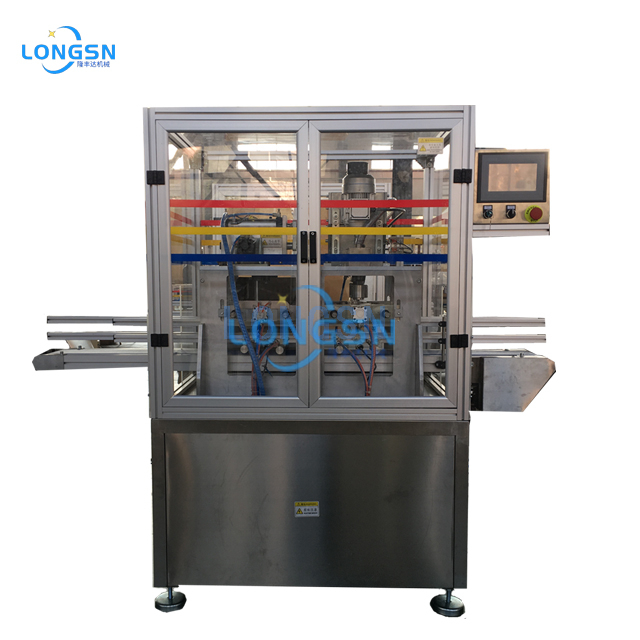
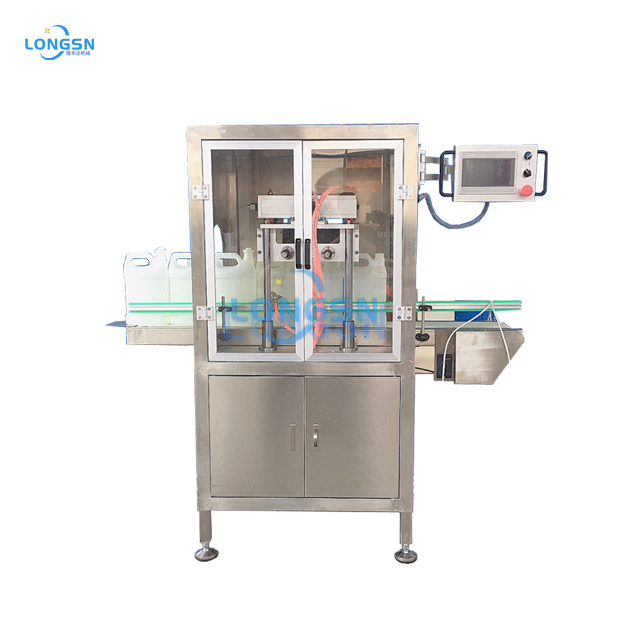
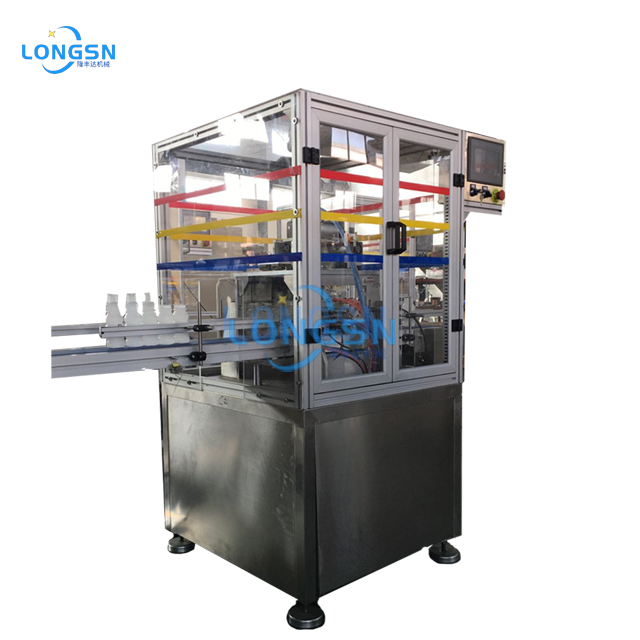
The increasing demand for localized plastic recycling and upcycling has shifted PET bottle processing from manual, labor-intensive tasks to mechanized, efficient workflows. Buyers frequently face a fragmented market where search results confuse glass scoring tools and industrial bottle-making machinery with actual plastic shearing or shredding equipment. Selecting the wrong machine results in bottlenecked throughput, rapid blade degradation, or unusable output. You might end up with uneven PET strips instead of uniform recyclable flakes. This guide evaluates the top plastic bottle cutting machine categories. These range from open-source desktop filament creators to commercial-grade shredders. We compare their technical specifications and operational realities to help you make an evidence-based purchasing decision for your recycling or upcycling operation.
- Intent Dictates Architecture: Desktop manual cutters are strictly for producing continuous PET filament (upcycling/3D printing), while motorized granulators are required for producing standardized plastic flakes (commercial recycling).
- The SERP Trap: Over 80% of search results for "bottle cutters" lead to glass scoring kits. True plastic bottle cutting requires high-shear blades or motorized pulling mechanisms, not score-and-heat thermal shock.
- Blade Metallurgy is the Primary Cost Driver: High-carbon steel or tungsten carbide blades significantly increase upfront costs but reduce machine downtime and maintenance overhead.
- Safety and Compliance Scalability: Commercial machines must be evaluated on their dust extraction capabilities, emergency stop mechanisms, and OSHA/CE compliance, which budget models often lack.
Success Criteria: How to Evaluate a Plastic Bottle Cutting Machine
Choosing the right equipment requires understanding the fundamental differences in material processing. You must define your end goal before evaluating specific models. The mechanics of shearing polymers differ vastly from other material processing methods, meaning your equipment selection must align perfectly with your operational workflow.
Addressing the SERP Confusion
Search engines often mix different types of equipment under the same broad terms. You must distinguish between glass tools, plastic cutters, and production machinery to avoid purchasing useless equipment.
Glass scoring kits use a completely different physical principle than plastic cutters. Tools designed for glass create a shallow score line on the surface. You then apply thermal shock using alternating hot and cold water to snap the glass along that stress line. Plastic requires continuous physical shearing. A plastic bottle cutting machine uses sharp blades and high-torque motors to physically slice or tear the polymer bonds. You cannot use a glass cutter on a PET bottle, as the material will simply flex and absorb the scoring wheel's pressure.
Furthermore, commercial listings for "plastic bottle machines" often refer to blow-molding fabrication equipment. These machines heat plastic preforms and blow high-pressure air into them to create new bottles. A cutting machine is strictly for downstream size-reduction and recycling. It destroys the bottle rather than creating it, requiring heavy-duty shredding chambers rather than heating elements and air compressors.
Output Requirements: Filament vs. Flake
Your success metric depends entirely on the end product you need. Different machines produce vastly different outputs, and you cannot easily modify a machine designed for one output to produce the other.
- Continuous PET Strips: Used for 3D printer filament extrusion or crafting. This requires precision slicing mechanisms that cut the bottle in a continuous spiral, maintaining a strict width tolerance of 1.5mm to 3mm.
- Uniform Flakes: Used for injection molding and commercial recycling. This requires heavy-duty shredding chambers that reduce whole bottles into standardized 10mm or 12mm pieces, utilizing a sizing screen to ensure consistency.
- Rough Shreds: Used for volume reduction before transport. This output does not require a sizing screen, resulting in irregular pieces that simply take up less space in a shipping container.
Throughput and Volume Capacity
You must establish baseline metrics to differentiate between hobbyist, small-business, and industrial needs. Measure your expected volume in kilograms per hour or bottles processed per shift. A desktop unit might process five bottles an hour, requiring constant operator intervention. An industrial granulator can process thousands of bottles in the same timeframe, utilizing automated conveyors and hopper feeds. Match the machine's duty cycle to your operational workflow to prevent premature motor burnout and excessive downtime.
Material Compatibility
Assess the machine's ability to handle varying thicknesses and types of plastic. Standard PET water bottles are relatively thin and easy to cut. High-density polyethylene (HDPE) milk jugs and polypropylene (PP) bottle caps present different challenges. Thicker plastics require higher motor torque and more robust blade configurations to prevent jamming during the cutting cycle.
| Plastic Type | Common Source | Cutting Difficulty | Required Machine Feature |
| PET (Type 1) | Water/Soda Bottles | Low to Medium | Sharp shearing blades, tight blade gap |
| HDPE (Type 2) | Milk Jugs, Detergent | Medium to High | High torque motor, aggressive hook blades |
| PP (Type 5) | Bottle Caps, Syrups | High (Rigid) | Heavy-duty rotor, impact-resistant metallurgy |
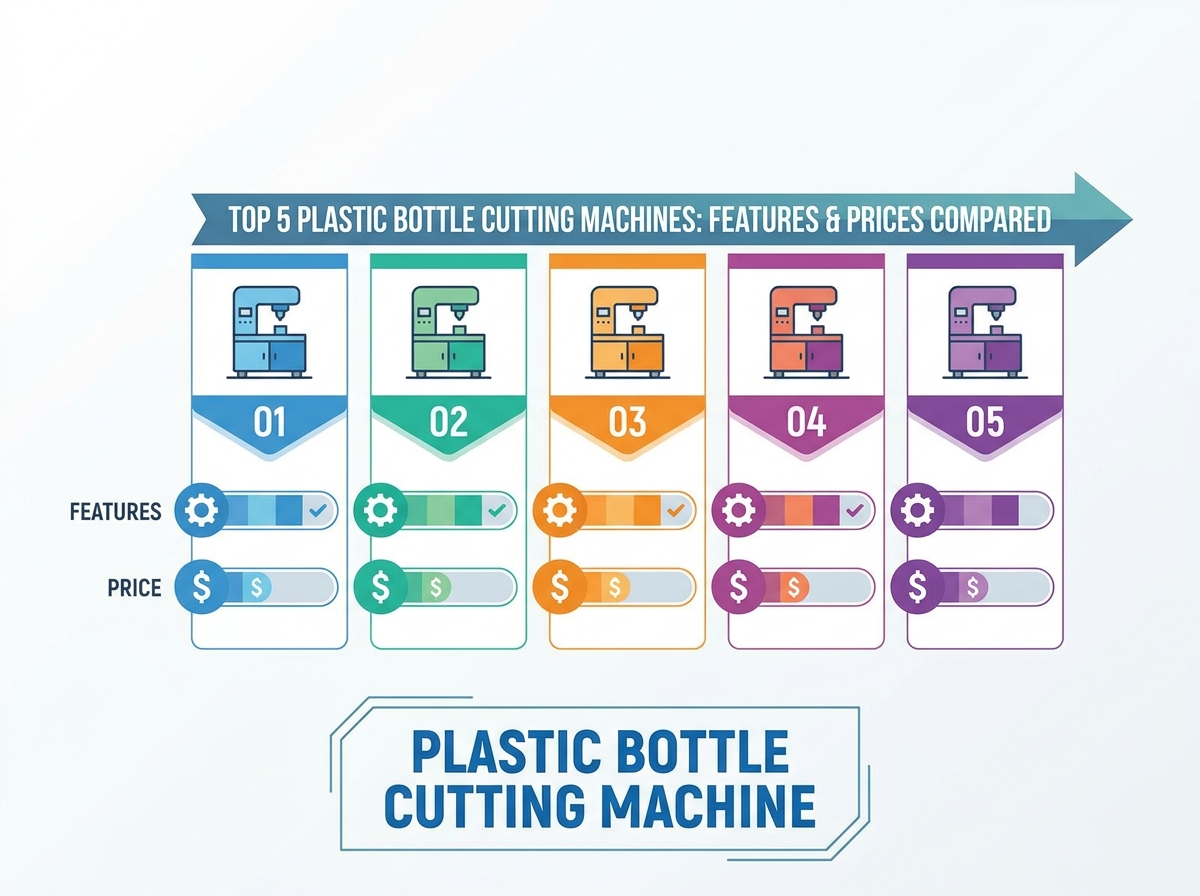
The Top 5 Plastic Bottle Cutting Machines Compared
The market offers distinct categories of machines tailored to specific operational scales. Here is a breakdown of the top five types available today, detailing their mechanical realities and operational requirements.
1. The Industrial-Grade PET Granulator and Shredder
These massive units dominate high-volume commercial recycling facilities and municipal waste management centers. They are built for continuous, aggressive operation, capable of processing tons of material per shift.
Key features include dual-shaft shredding mechanisms and continuous-duty motors exceeding 10 horsepower. They often feature integrated soundproofing to protect operators from deafening noise levels. Water-cooled cutting chambers prevent the plastic from melting due to friction. Automated feed hoppers allow operators to dump large bins of bottles directly into the machine without manual sorting.
Operating an industrial granulator requires strict adherence to standard operating procedures:
- Perform a pre-shift inspection of the cutting chamber to ensure no residual melted plastic is binding the rotor.
- Verify the sizing screen is securely bolted in place and free of obstructions.
- Engage the water-cooling system and verify flow rates before starting the main drive motor.
- Load material onto the infeed conveyor, ensuring no heavy metals or non-shreddable materials are mixed with the plastic.
- Monitor the motor amperage gauge during operation to prevent overloading and jamming.
These machines offer unmatched throughput and produce a highly uniform flake size. However, they require three-phase power and significant floor space. They also demand specialized maintenance routines to keep the heavy-duty blades sharp and aligned.
2. The Mid-Range Commercial Bottle Crusher
This category serves small to medium recycling centers, large hospitality venues, and localized circular economy hubs. They bridge the gap between industrial power and accessible operation, offering robust size reduction without the massive infrastructure requirements.
These units typically utilize single-shaft operation powered by two to five horsepower motors. They feature interchangeable sizing screens ranging from 4mm to 10mm. This allows operators to dictate the final flake dimensions based on downstream requirements. They usually maintain a compact vertical footprint, making them suitable for tighter workspaces.
They provide an excellent balance of performance and accessibility. However, they can struggle with thicker, multi-layered HDPE plastics if the operator feeds the material too quickly. Proper calibration and feed rate management are essential to prevent the single-shaft rotor from stalling.
3. The Automated Desktop PET Filament Extruder
Prosumers, makerspaces, and 3D printing farms use these specialized machines. They convert waste bottles directly into usable printer filament, bypassing the traditional flake-and-melt recycling process entirely.
These desktop units feature motorized bottle rotation and precision width-adjustment dials. The operator sets the exact width of the initial strip. Integrated heating elements then round the flat strip, converting it into standard 1.75mm filament. Auto-spooling mechanisms collect the finished filament neatly onto a standard reel.
To operate a desktop filament extruder successfully, you must follow a precise preparation workflow:
- Thoroughly wash the bottle and remove all label adhesive using a solvent.
- Inflate the bottle using a heat gun and compressed air to remove structural ridges and create a smooth, uniform cylinder.
- Manually cut the bottom off the bottle using heavy-duty shears.
- Start the initial strip by hand, feeding it through the machine's guide bearings.
- Thread the strip through the heated nozzle and attach it to the motorized take-up spool.
They are highly specialized for closed-loop upcycling. However, they are strictly limited to single-bottle processing. They also require significant manual pre-processing before the machine can take over.
4. The Motorized Upcycling String Cutter
Small craft businesses and agricultural users utilize these machines to create continuous plastic rope or string for binding applications. They are simple, effective tools for repurposing waste into functional agricultural ties.
They feature a low-torque electric pulling mechanism that draws the plastic through a stationary blade. Multi-blade slots allow for variable string widths. They maintain a compact benchtop footprint and use adjustable guide rollers to keep the plastic aligned during the pull.
These machines automate the tedious pulling process associated with manual cutters. They save significant physical effort. Like the desktop extruders, they still require manual pre-processing to remove the bottle bottoms before feeding the material into the guides. The stationary blades must be replaced frequently, as the continuous friction of the plastic will dull standard utility blades within a few hours of operation.
5. The Heavy-Duty Manual Plastic Strip Maker
Budget-conscious DIYers, survivalists, and off-grid upcyclers rely on these simple, robust tools. They require no electricity and rely entirely on mechanical advantage and operator strength.
They feature CNC-machined aluminum or steel block construction. They integrate standard utility or razor blades for the cutting edge. Most include vice-grip mounting capabilities and guide pins to keep the bottle stable during the pulling process.
They require virtually zero maintenance and are highly portable. However, they rely heavily on operator skill to maintain a consistent pull angle. If the operator pulls at an incorrect angle, the strip will snap, requiring them to restart the cut. They become physically fatiguing for batches larger than ten bottles. They are strictly for low-volume, manual operation.
Feature-to-Outcome Analysis
Understanding the internal components helps you evaluate long-term reliability. Specific features directly impact the machine's operational lifespan and maintenance requirements. You must look beyond the exterior housing and evaluate the mechanical engineering driving the cutting process.
Motor Torque vs. Continuous Operation
The motor dictates the machine's duty cycle. Cheaper machines often use brushed motors. These motors generate significant heat and are prone to overheating if run continuously. Premium models utilize brushless or industrial induction motors. These robust motors handle the continuous torque required for 24/7 operation without thermal degradation. An undersized motor will stall when encountering the thick plastic at the neck or base of a bottle, leading to frequent jams and eventual motor failure.
Blade Material and Replacement Ecosystem
Blades endure immense friction and impact. Standard steel blades lose their edge quickly and require frequent sharpening. Hardened tool steel or tungsten carbide blades maintain their edge significantly longer. You must also consider the replacement ecosystem. Proprietary blades lock you into specific suppliers, causing operational delays if parts are out of stock. Machines using standardized industrial blades offer more flexibility and easier procurement for replacement parts.
| Blade Material | Wear Resistance | Impact Toughness | Maintenance Requirement |
| Standard Carbon Steel | Low | High | Frequent sharpening (weekly) |
| D2 / SKD11 Tool Steel | High | Medium | Periodic sharpening (monthly) |
| Tungsten Carbide Insert | Extreme | Low (Brittle) | Replace inserts when dull |
Safety Enclosures and Microplastic Management
Cutting plastic generates hazardous byproducts. Integrated safety interlocks prevent the machine from operating while the cutting chamber is open, protecting operators from severe injury. Anti-jamming reverse functions protect the motor if a thick piece of plastic binds the blades. High-speed shredding also generates microplastic dust. Advanced machines feature HEPA-filtered vacuum ports to capture this airborne dust, protecting operator respiratory health and maintaining facility cleanliness.
Implementation Risks and Maintenance Realities
Operating these machines involves specific mechanical challenges. You must prepare for routine maintenance and potential operational disruptions. Ignoring these realities will result in destroyed equipment and halted production lines.
The Jamming Risk
Plastic melts when subjected to excessive friction. If you run the machine beyond its duty cycle, or if the blades become dull, the plastic will heat up rather than shear cleanly. Melted plastic fuses to the blades and the cutting chamber walls. This causes severe jamming. Clearing a fused jam requires complete machine shutdown, cooling, and difficult manual removal of the hardened polymer using pry bars and heat guns. Preventing jams requires strict adherence to feed rates and sharp blade maintenance.
Blade Sharpening Workflows
Dull blades reduce throughput and increase motor strain. You must account for the labor required to maintain the cutting edges. This involves powering down the machine, safely removing the heavy blades, sharpening them to precise angles, and re-calibrating the blade gaps upon reinstallation. Improper calibration leads to uneven cutting and accelerated wear. The gap between the rotary and stationary blades must be set using feeler gauges to ensure clean shearing without metal-on-metal contact.
Contamination and Pre-Processing
You cannot feed dirty bottles into precision cutting equipment. You must wash the bottles, remove all paper or plastic labels, and dry them thoroughly before processing. Dirt, abrasive adhesives, and sugary liquid residues will rapidly degrade machine internals. They dull blades prematurely and contaminate the final plastic output, reducing its value for recycling or extrusion. Wet bottles will also cause the shredded flakes to clump together, blinding the sizing screen and causing the cutting chamber to back up.
Conclusion
The optimal plastic bottle cutting machine depends entirely on your desired output and processing volume. Industrial granulators serve commercial flake production. Desktop extruders serve closed-loop 3D printing upcycling. Manual or low-torque cutters serve small-scale crafting. Selecting the right equipment requires matching the machine's mechanical capabilities to your specific material and throughput requirements.
Take these actionable steps before finalizing your equipment selection:
- Calculate your expected weekly bottle volume in kilograms to determine the necessary motor duty cycle and hopper size.
- Verify your facility's electrical capacity to ensure you can support single-phase or three-phase power requirements without tripping breakers.
- Request a material test or live demonstration from the manufacturer using your specific type of waste plastic to verify throughput claims.
- Establish a clear workflow for washing, de-labeling, and drying bottles prior to feeding them into the cutting mechanism.
FAQ
Q: What is the difference between a glass bottle cutter and a plastic bottle cutting machine?
A: A glass cutter uses a small wheel to score the surface, relying on thermal shock (hot and cold water) to break the glass along the score line. A plastic cutting machine uses sharp steel blades and mechanical force to physically slice or shred the polymer material.
Q: Can I use popular glass cutters like Kinkajou, Ephrem's, or Kalawen to cut plastic bottles?
A: No. Glass cutters lack the sharp edge and shearing mechanism required to cut through flexible PET or HDPE plastic. Attempting to use them on plastic will simply dent or scratch the bottle without cutting it.
Q: Is a plastic bottle cutting machine the same as a plastic bottle blow molding machine?
A: No. A blow molding machine manufactures new bottles by heating plastic preforms and injecting air. A cutting machine is downstream recycling equipment used to destroy and reduce existing bottles into flakes or strips.
Q: Can a plastic bottle cutting machine make 3D printer filament directly?
A: Specific desktop models can. These automated filament extruders cut the bottle into a continuous strip, pull it through a heated nozzle to round the edges into 1.75mm filament, and spool it automatically.
Q: How much floor space does an industrial granulator require?
A: Industrial units require significant space, often needing a dedicated room. You must account for the machine's footprint, the infeed conveyor system, the outfeed collection bins, and adequate clearance for maintenance personnel to access the cutting chamber.
Q: How often do the blades need to be replaced on a PET bottle cutter?
A: Blade lifespan depends on material volume and blade metallurgy. Standard steel blades may need sharpening weekly under heavy use. Hardened tungsten carbide blades in commercial granulators can last several months before requiring maintenance.
Q: Do I need to wash plastic bottles and remove labels before putting them in a cutting machine?
A: Yes. Dirt, sticky label adhesives, and leftover sugary liquids will gum up the cutting mechanism, dull the blades rapidly, and contaminate the final recycled plastic output.

 English