Every second of unexpected downtime costs money. Investing in packaging automation represents a high-stakes capital expenditure. It directly impacts your production bottlenecks, packaging quality, and daily labor costs. When you choose a mismatched sticker labeling machine, you invite persistent line jams into your facility. You will frequently encounter skewed labels, high changeover downtime, and wasted materials. These daily inefficiencies drain profitability. They also frustrate machine operators.
Our objective is to strip away the marketing fluff. We provide a vendor-agnostic framework to help you evaluate technical specifications. You must assess integration risks thoroughly before signing any purchase order. By following this comprehensive guide, you will learn how to confidently shortlist the exact right equipment for your specific production line.
Key Takeaways
- Production Volume Dictates Automation: Semi-automatic machines suit sub-50 bottles per minute (BPM); fully automatic lines are strictly required for high-speed, continuous scaling.
- Container and Label Material Rule Specs: Clear labels require specialized ultrasonic sensors; standard optical sensors will fail. Cylindrical vs. flat containers require fundamentally different application mechanics.
- Always Demand Factory Acceptance Testing (FAT): Never finalize a purchase without testing the machine using your exact containers and label rolls.
Defining Your Baseline: 4 Questions to Frame Your Selection
You cannot buy reliable packaging equipment based on assumptions. You must define your exact operational baseline first. Answer these four critical questions to frame your technical requirements.
1. What Are Your Throughput Requirements (BPM/CPM)?
Calculate your current required Bottles Per Minute (BPM) or Containers Per Minute (CPM). Look at your daily production targets. Divide this number by your active operating minutes per shift. Next, project your expected growth over the next three years. Do not buy extreme overcapacity. However, avoid under-specifying your needs. If your filler outputs 80 BPM, your labeler should comfortably handle 100 BPM. This buffer prevents the labeling station from becoming a system bottleneck.
2. What Are Your Container Geometry & Tolerances?
Document the exact shapes of your packaging. You must classify them as round, oval, flat, or tapered. Material choice also matters immensely. Glass bottles often have prominent seams. PET and HDPE plastics can slightly deform under pressure. These physical tolerances dictate the necessary stabilizing mechanisms on the machine. Tapered wine bottles, for example, require angled dispensing heads. Standard vertical heads will cause severe label wrinkling on tapered glass.
3. What Are Your Label Characteristics?
Identify your precise label dimensions. Measure both the width and the length. Note the materials carefully. You might use paper, BOPP, or transparent films. Consider the placement type as well. You could need wrap-around, front and back, top, or tamper-evident applications. Transparent labels on clear backing liners are notoriously difficult to detect. Standard optical sensors look for light contrast. They will fail to see clear labels. You must know your material before requesting quotes.
4. How Will You Handle Line Integration?
Determine the physical location of the machine. It might operate inline directly after an existing filler and capper. Alternatively, it might run as a standalone offline station. Inline integration requires accumulation tables. It also demands variable speed controls. The labeler must speed up or slow down based on upstream flow. Standalone offline units offer simpler setups. However, they require dedicated operators to manually load and unload the conveyor belt.

Types of Sticker Labeling Machines: Matching Mechanics to Application
Different container shapes demand entirely different mechanical handling. You cannot force a flat bottle through a standard wrap-around machine. You must match the equipment type to your primary packaging design.
Wrap-Around Labelers
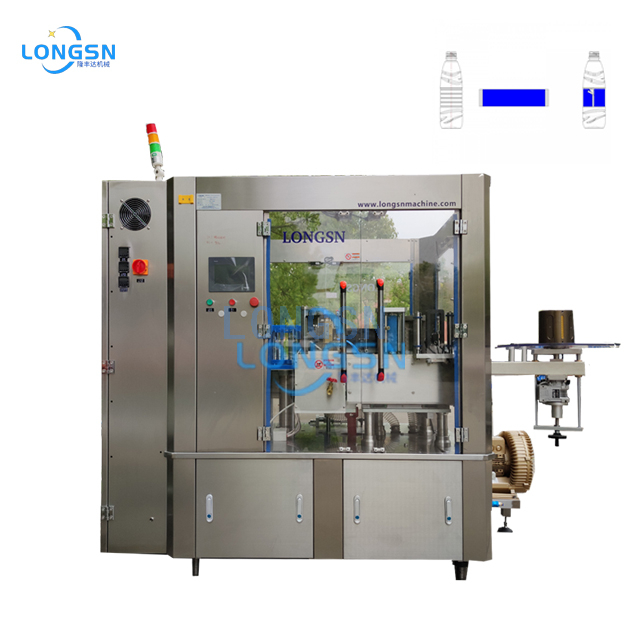
These machines are best for cylindrical containers. Common applications include bottles, vials, and round jars. The mechanics rely on spinning the container while wiping the label onto the surface.
Evaluation criteria: Look closely at roller stability. Check the alignment accuracy. Some machines use a continuous wrap belt. Others use a three-roller indexing system. Three-roller systems offer superior accuracy for long or overlapping labels. They hold the bottle perfectly straight to prevent the label from spiraling downward.
Front and Back (Double-Sided) Labelers
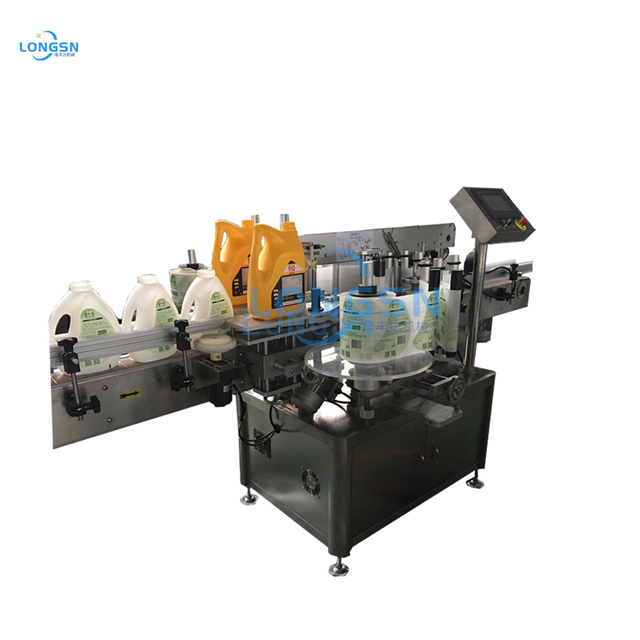
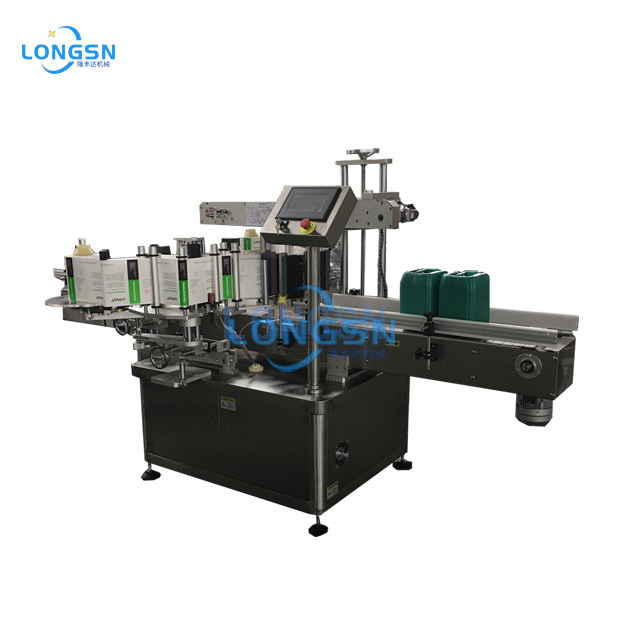
These units are best for flat, oval, or rectangular bottles. Common applications include shampoo bottles, engine oil jugs, and detergent containers. They apply two labels simultaneously as the product moves down the conveyor.
Evaluation criteria: Synchronization is the most critical factor. The dual dispensing heads must fire at the exact same microsecond. Alignment chains are also mandatory. Flat bottles tend to twist on standard conveyors. Heavy-duty alignment chains square the bottle perfectly before it reaches the dispensing heads.
Top and Bottom Labelers
These systems are best for clamshells, boxes, flat pouches, and jar caps. They feature split conveyors. The product rides over a gap where the bottom label head dispenses upward.
Evaluation criteria: Evaluate the conveyor transition smoothness. Products must not dip or stall when crossing the bottom dispensing gap. Pressure pad consistency is equally important. Overhead brushes or sponge rollers must apply even downward pressure. This ensures the labels adhere flat without trapping air bubbles.
Semi-Automatic vs. Fully Automatic
Your decision threshold here balances labor availability against capital. Semi-automatic tabletop units require an operator to load every single bottle. They typically max out around 30 to 40 BPM.
Fully automatic lines operate without manual feeding. They integrate conveyors and sorting sensors. The breakeven point usually occurs when throughput exceeds 50 BPM. At this speed, manual feeding becomes a liability. Operator fatigue leads to inconsistent label placement and repetitive strain injuries.
Comparison Chart: Labeling Machine Types
| Machine Type | Ideal Container Shape | Common Applications | Key Mechanical Requirement |
| Wrap-Around | Cylindrical (Round) | Vials, Wine Bottles, Jars | Roller alignment to prevent spiraling |
| Front and Back | Flat, Oval, Rectangular | Shampoo, Motor Oil, Detergent | Squaring chains and synchronized heads |
| Top and Bottom | Flat, Low-Profile | Clamshells, Cartons, Pouches | Split conveyors and even downward pressure |
5 Must-Check Technical Specifications on Any Vendor Quote
Marketing brochures highlight speed and sleek designs. However, the true reliability of a sticker labeling machine lives in its internal components. Review every vendor quote against these five technical pillars.
1. Motor Type (Stepper vs. Servo)
The dispensing motor drives the label web. Stepper motors move in fixed increments. They are acceptable for low-speed, budget-conscious setups. However, they lack feedback loops. If a stepper motor skips a step, it will misalign subsequent labels.
We strongly recommend Servo motors for high-speed applications. Servo motors use continuous encoder feedback. They constantly adjust their position. This guarantees high-accuracy placements within a ±1mm tolerance, even at speeds exceeding 150 BPM.
2. Sensor Technology
Sensors tell the machine when to stop dispensing. Standard photoelectric sensors measure light contrast between the label and the backing paper. They are perfectly fine for opaque paper labels.
If you run clear transparent labels, standard optical sensors will fail. You must verify the inclusion of specialized sensors. Demand ultrasonic sensors or capacitive sensors. Ultrasonic sensors use high-frequency sound waves. Capacitive sensors measure material density. Both successfully detect the physical edge of a clear label on a clear liner.
3. PLC and HMI Controls
The Programmable Logic Controller (PLC) acts as the brain. The Human Machine Interface (HMI) is the touch screen. Demand non-proprietary PLC systems. Look for globally recognized brands like Siemens, Allen-Bradley, or Panasonic.
Common Mistake: Avoid machines built on custom, proprietary circuit boards. If the vendor goes out of business, you cannot troubleshoot software issues. Furthermore, ensure the HMI features recipe-saving capabilities. You should be able to save motor speed and sensor delay settings for each specific bottle size. This makes daily changeovers significantly faster.
4. Label Dispensing Speed Alignment
The label web must exit the dispensing head at the exact same speed as the conveyor belt. If the label dispenses too slowly, it will stretch or snap. If it dispenses too quickly, it will wrinkle and bubble upon impact.
Ensure the machine features automatic speed synchronization. Advanced systems use rotary encoders on the conveyor motor. When the operator increases the conveyor speed, the dispensing head automatically matches the new velocity. This prevents operators from guessing the correct ratios.
5. Construction Material & Compliance
Industrial environments degrade cheap materials. Verify the machine frame uses SUS304 or 316 stainless steel. Avoid painted carbon steel. Paint chips off and causes contamination risks.
If you operate in food, beverage, or pharmaceutical environments, compliance is mandatory. The machine must meet FDA or GMP guidelines. Look for enclosed wiring, slanted surfaces for easy wash-down, and food-grade plastics on any contact surfaces.
Hidden Risks: Implementation, Changeovers, and Maintenance
A machine might look perfect on paper. Yet, daily operational realities often reveal hidden flaws. You must scrutinize the physical usability of the equipment.
The Changeover Trap
High-mix production requires frequent bottle size changes. Assess how long it actually takes to adjust the guide rails, sensors, and dispensing heads. Some older machines require operators to use Allen wrenches for every tiny adjustment.
Best Practice: Look for tool-less adjustment features. Modern machines use hand-crank dials with digital position counters. Operators simply turn the dial to the previously recorded number. This reduces a 30-minute changeover to just five minutes.
Web Breaks and Roll Changes
Frequent web breaks completely halt production. Assess the machine's tension control system. The web path must include dancer arms. Dancer arms are spring-loaded rollers. They absorb sudden jolts when the heavy label roll starts spinning. This prevents the thin paper backing from tearing.
Additionally, observe the roll change process. If your line runs at high speeds, stopping to change a label roll creates unacceptable downtime. Check if the vendor offers a secondary unwind station. This allows operators to splice a new roll into the web while the machine continues running.
Proprietary Parts vs. Off-the-Shelf
Custom engineering is often a trap. Warn your procurement team against machines built with obscure pneumatic cylinders or localized electronic relays. When a custom part fails, you must order it directly from the manufacturer overseas. Maintenance delays will severely damage your production schedule.
Demand machines built with off-the-shelf components. Pneumatics from SMC or Festo are universally available. Sensors from Sick or Keyence can be purchased from local distributors globally. This guarantees you can source replacement wear parts on the same day.
How to Evaluate and Shortlist Sticker Labeling Machine Manufacturers
You have defined your specs and understood the mechanical risks. Now you must vet the vendors. Do not rely solely on sales presentations.
Demand a FAT (Factory Acceptance Test)
Never authorize the final payment without a successful Factory Acceptance Test. Outline a strict FAT protocol. You must send physical product samples to the manufacturer. Include your actual bottles and actual label rolls.
Request a continuous, uninterrupted run. The machine should run hundreds of bottles without skewing, jamming, or missing a label. You can attend this test in person. If travel is impossible, demand a continuous, unedited video recording of the trial run. If the vendor refuses a FAT, walk away immediately.
Service Level Agreements (SLAs) and Support
Machines break down. You need a reliable support system when they do. Assess the timezone alignment for remote troubleshooting. If your vendor is twelve time zones away, a simple software glitch could take days to resolve.
Review the warranty length on wear parts like belts and dispensing peel plates. Ask about the availability of local technicians. Some international manufacturers partner with domestic service networks to provide on-site repairs within 48 hours.
Reference Checks
A reputable vendor will happily provide customer references. Ask for case studies from facilities running similar container and label combinations. Call these references without the vendor present.
Ask the reference specific questions. How long does a changeover really take? Does the machine hold its calibration over a 12-hour shift? How responsive is the vendor when a sensor fails? Honest feedback from an active user is your most valuable evaluation tool.
Conclusion
A high-quality automatic labeling system transforms packaging efficiency. However, a sticker labeling machine is only as good as its strict compatibility with your specific containers, label materials, and desired production speeds. You must align mechanical capabilities with your physical products.
Take action by compiling your required baseline specifications. Document your BPM targets, exact container dimensions, and label types. Combine these details into a formal Request for Quotation (RFQ). Send this RFQ only to vendors who utilize off-the-shelf components and non-proprietary PLC systems.
Finally, start gathering physical samples of your products and label rolls immediately. Keep them ready in a box. You will need to ship them to your shortlisted manufacturers for preliminary testing and final Factory Acceptance Trials.
FAQ
Q: Can one sticker labeling machine handle both round and flat bottles?
A: Yes, but it requires a specialized modular system. These machines are often significantly more expensive. They feature interchangeable wrap-around belts and adjustable alignment chains. Buying dedicated, single-purpose machines is often more reliable and efficient if your production volumes for each bottle shape are consistently high.
Q: Why is the machine failing to detect my clear labels?
A: Standard optical sensors read opacity differences between the label and the backing liner. Clear labels on a clear backing offer no visual contrast. You require a sensor upgrade. You must install capacitive or ultrasonic sensors. These specialized sensors detect the physical thickness or material density of the label edge.
Q: What is the average lead time for an automatic sticker labeling machine?
A: Standard standalone models typically take 4 to 6 weeks to build and ship. Highly customized inline systems require more engineering. Machines needing complex accumulation tables or extensive Factory Acceptance Testing (FAT) can easily take 8 to 12 weeks for final delivery.
Q: How accurate are automatic sticker labeling machines?
A: The industry standard for modern, servo-driven machines is an accuracy of ±1mm. However, real-world accuracy depends on your products. Variables like container molding inconsistencies, cheap label backing paper, or conveyor floor vibrations will negatively reduce the final application accuracy.

 English