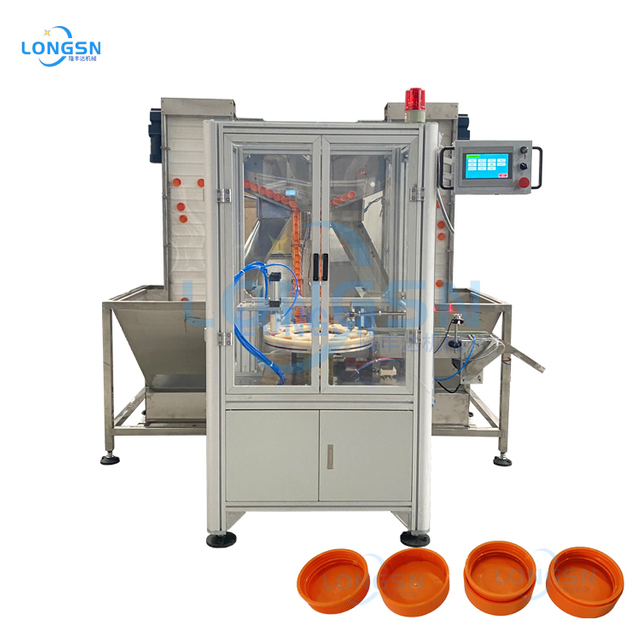
High-volume manufacturing often presents a dangerous trade-off between throughput and precision. Running a production line at 2,000 caps per minute creates immense pressure on quality control systems. In the closure industry, a single compromised seal, a missing wad, or a micro-crack can trigger massive batch recalls and reputational damage. Manufacturers historically relied on statistical probability to manage this risk, accepting a marginal error rate as the cost of doing business. However, in today’s hyper-competitive market, even a 0.1% defect rate is commercially unacceptable.
Traditional Statistical Process Control (SPC) and random sampling are no longer sufficient safeguards. These methods assume a stable error distribution, but they often miss the random, non-systemic defects that plague high-speed lines. The modern standard has shifted. Advanced assembly systems are now integrated data platforms capable of 100% inline inspection. This guide details the hardware features, vision integration strategies, and rejection logics required to transition your operations from "low defect" to true "zero defect" manufacturing.
Key Takeaways
100% Verification: Why random sampling is obsolete in cap assembly and how 100% inline inspection prevents "defect leakage."
Stability is Quality: The correlation between rotary continuous motion mechanics and defect reduction compared to indexing systems.
The "Predict-Prevent" Model: How vision sensors move beyond identifying bad parts to predicting machine drift before defects occur.
Positive Rejection Logic: The critical importance of "fail-safe" rejection mechanisms in high-speed environments.
ROI beyond Speed: Evaluating Total Cost of Ownership (TCO) based on scrap reduction and brand protection rather than just cycle time.
Moving Beyond Sampling: The Architecture of Zero-Defect Assembly
Achieving Zero-Defect Manufacturing (ZDM) in high-speed assembly requires a fundamental shift in mindset. The goal is not necessarily to make zero mistakes, as material variations and physical wear make that statistically impossible over time. The true goal is ensuring zero mistakes leave the machine. This distinction changes how you evaluate hardware. It prioritizes containment and verification over raw mechanical speed.
Rotary vs. Indexing Systems
The mechanical architecture of your assembly line dictates your ceiling for quality. When evaluating a High speed automatic plastic closure assembly machine, the choice between rotary continuous motion and indexing systems is pivotal. Indexing systems operate on a "stop-and-go" basis. They accelerate, stop for an operation (like wadding), and accelerate again. This creates continuous vibration and G-force spikes.
At lower speeds, this is manageable. At high speeds, these sudden stops cause wads to shift, O-rings to misalign, and lubricants to splatter. Physics works against precision. Conversely, rotary continuous motion systems maintain a smooth, constant velocity. The lack of abrupt deceleration allows components to settle naturally. It reduces the kinetic energy that typically leads to misalignment. Furthermore, cam-driven precision plays a massive role here. Hardened mechanical cams ensure repeatable "Golden Batch" consistency. Unlike pneumatic actuation, which can vary based on air pressure fluctuations, a mechanical cam follows the exact same path every cycle. Stability is the foundation of quality.
Single-Part Tracking (The GPS Analogy)
Modern quality control has moved from "batch control" to "individual part pedigree." Imagine navigating a city using a paper map versus a GPS. The map gives you a general idea of the route, while the GPS tracks your exact position in real-time. Old assembly lines are like paper maps; they know they produced a batch, but they don't know the history of Cap #45,002.
Advanced Programmable Logic Controllers (PLCs) now track specific tooling stations. If your machine has 24 mandrels, the system tracks the performance of Mandrel #14 independently from Mandrel #15. If defects begin to spike, the system doesn't just tell you "quality is dropping." It pinpoints that Mandrel #14 is drifting out of spec, perhaps due to a worn spring or a loose gripper. This granularity allows maintenance teams to fix the specific root cause rather than troubleshooting the entire machine.
Integrating Multi-Stage Vision for "Prevent, Predict, Validate"
Installing a camera at the end of the line is a reactive measure. To achieve zero defects, you must adopt the "Prevent, Predict, Validate" (PPV) framework. This strategy adapts Industry 4.0 concepts specifically for closure assembly, layering defenses throughout the production process.
Prevent (Incoming Inspection)
Defects often originate before the assembly process even begins. Raw plastic shells may arrive with "short shots" (incomplete molding) or excess flash. If these defective parts enter the main turret, they can jam guide rails or damage expensive tooling. Prevention starts at the in-feed.
Sophisticated machines utilize sensors at the hopper or unscrambler level. These sensors act as gatekeepers. They detect gross deformities and reject them before they enter the assembly stream. Decision criteria here should include checks for ovality and gross contamination. Does your machine utilize hopper-level sorting? If not, you are allowing bad ingredients into your recipe, guaranteeing a bad result.
Predict (Process Monitoring)
Vision systems see the surface, but process monitoring "feels" the assembly. This is where prediction happens. By monitoring torque values and insertion pressure in real-time, the machine can infer the quality of the internal assembly.
Consider wadding. If the insertion force for a specific cycle drops by 10% compared to the baseline, the system infers a fault. The liner might be missing, or it might be too thin. Conversely, a spike in pressure could indicate a double-stacked liner. This detection happens blindly but accurately through force feedback. The machine flags this specific unit for rejection before it even reaches the visual inspection station, creating a redundant layer of security.
Validate (Post-Process Inspection)
The final layer is visual confirmation. This involves integrating high-speed cameras (such as Cognex or Keyence systems) immediately after critical stations like slitting, folding, or wadding. These cameras must be configured to catch micro-defects that force sensors might miss.
Specific defect targets include:
Inverted Liners: A liner that is present but upside down.
Incomplete Slitting: Tamper-evident bands that do not break correctly upon opening.
Cap Ovality: Slight deformations that affect capping machine performance at the bottling plant.
Contamination: Grease or dust particles on the food-contact surface.
Fail-Safe Rejection Systems: The Final Firewall
A High speed automatic plastic closure assembly machine is only as safe as its rejection mechanism. There is a dangerous phenomenon known as the "False Pass." This occurs when the vision system correctly identifies a defect, sends a signal to reject it, but the mechanical rejector fails to remove the part from the stream. At 2,000 parts per minute, a rejection window is often only milliseconds wide. If the mechanism is too slow, the bad part slips through, or a good part is accidentally knocked out.
Positive Rejection Logic
The industry is moving away from simple air blasts for ultra-high-speed applications. Air is compressible and can be inconsistent. If line air pressure drops, the "blast" might not be strong enough to divert a heavy cap. Mechanical diverters offering positive displacement are far more reliable. They physically guide the part off the line rather than relying on aerodynamics.
Comparison of Rejection Mechanisms:
| Feature | Air Blast System | Mechanical Diverter |
|---|
| Speed Capability | High, but less accurate above 1,500 ppm | Excellent at 2,000+ ppm |
| Consistency | Variable (depends on air pressure) | High (cam or servo driven) |
| Maintenance | Low (no moving parts) | Medium (requires lubrication/timing) |
| Reliability | Risk of "False Pass" on heavy parts | Positive displacement ensures removal |
Crucially, you must implement "Reject Confirmation" sensors. It is not enough to signal a reject; the machine must verify that the reject actually occurred. A sensor placed in the reject bin chute confirms the bad part left the line. If the machine signals "Reject" but the verification sensor sees nothing, the system must trigger an immediate Emergency Stop. This is the only way to guarantee a zero-defect output.
Separating Waste Streams
Advanced machines also categorize waste. Instead of a single bin for all bad parts, they utilize multi-channel rejection. Bin A collects parts with missing liners (which can be re-run or recycled easily). Bin B collects parts with contamination or molding errors (which must be scrapped). This segregation improves material recovery rates and provides cleaner data for root cause analysis.
Controlling Defect Propagation with Inter-Stage Buffers
In a tightly coupled machine, a failure in one stage instantly halts the entire line. Worse, it can cause defects to propagate. This is the "Domino Effect." For example, if the liner punching station jams, the caps currently in the turret might stop under a heater or adhesive applicator, ruining them due to over-exposure.
Buffer Strategy
Effective machine architecture uses accumulation zones and vertical integration to decouple processes. You must evaluate if the machine allows for independent deceleration of sub-modules. If the liner feed experiences a micro-stop, does the cap feed pause instantly? Or does it continue to run, creating a stream of "dry" caps without liners?
Smart buffering allows the upstream module to slow down while the downstream module clears its queue. This prevents the "start-stop" shock that often knocks components out of alignment. It ensures that when the machine ramps back up, it does so smoothly, maintaining the integrity of the assembly process.
Defect Mitigation Layer
Hardware logic can also save raw materials. Implementing "No Cap, No Liner" logic is essential. Mechanical probes or sensors detect the presence of a cap before the liner is punched or inserted. If a cap is missing from a pocket, the liner station skips a cycle. This prevents loose liners from floating around the machine interior, where they can jam gears or contaminate good caps. Additionally, look for "Manual Recovery" features. When the machine E-Stops, operators should be able to jog the system and recover good components from the safe zones without needing to purge the entire line into the scrap bin.
TCO Analysis: The Cost of Quality vs. The Cost of Speed
Decision-makers often fixate on "Cap-Ex per Output." They calculate the machine price divided by its maximum speed. This is a flawed metric for high-precision manufacturing. The better metric is "Cost per Good Part." A fast machine that produces 2% scrap is effectively slower and far more expensive than a slightly slower machine with 0.01% scrap.
The Cost of Poor Quality (CoPQ)
The hidden costs of defects are massive. Consider the scrap rate. Reducing scrap by just 0.5% on a line running 24/7 can save enough raw material to fund a significant machine upgrade within two years. Then, consider downtime costs. Stopping a 2,000 ppm line for 15 minutes to clear a jam caused by a defective part results in 30,000 lost units. If this happens twice a shift, the losses compound rapidly.
Evaluation Checklist for Buyers
When vetting vendors, demand data on the following:
Repeatability: Ask for specific CpK (Process Capability Index) and CmK (Machine Capability Index) values. A vendor confident in their stability will guarantee these numbers.
Changeover (SMED): Can the machine maintain zero-defect calibration after a format change? Look for tool-less changeover features that physically lock into place, eliminating the need for operator "fine-tuning."
Compliance: For food, beverage, or pharmaceutical applications, ensure the software supports traceability standards (like FDA 21 CFR Part 11). The machine should log every reject, every stop, and every parameter change.
Conclusion
Achieving zero defects in high-speed cap assembly is no longer just an operational ideal; it is a practical necessity driven by hardware and software synthesis. It requires moving away from the assumption that speed necessitates waste. By leveraging rotary continuous motion for mechanical stability, implementing the "Prevent, Predict, Validate" vision framework, and utilizing fail-safe rejection logic, manufacturers can break the high-speed paradox.
When selecting your next assembly platform, resist the urge to prioritize maximum parts-per-minute over verification capabilities. The fastest machine on the market is useless if it produces waste faster than it produces product. Your next step should be to audit your current "Defect Slippage Rate." Determine how many bad parts are reaching your customers, and then request a demonstration from vendors that focuses specifically on their vision system's ability to catch these errors at full speed.
FAQ
Q: What is the realistic defect rate for a modern high speed automatic plastic closure assembly machine?
A: Ideally, you should aim for less than 50 PPM (Parts Per Million) reaching the external customer. However, the internal machine rejection rate might be higher as the system actively filters out non-conforming parts. The goal is for the machine's internal systems to catch 100% of the defects so that the external defect rate is effectively zero.
Q: Can existing assembly machines be retrofitted for zero-defect production?
A: You can add vision systems to existing lines, but mechanical stability often limits their effectiveness. If the base machine uses indexing motion or vibrates excessively at high speeds, cameras will trigger false rejects due to image blurring. True zero-defect performance usually requires a machine architecture designed for stability from the ground up, such as rotary continuous motion systems.
Q: How does machine vision impact the speed of assembly?
A: Modern processing power ensures that vision inspection happens within milliseconds. It does not throttle the mechanical speed of the machine. The image capture and processing occur during the natural dwell time or transport time of the cap, allowing the machine to maintain full throughput (e.g., 2,000+ ppm) without slowing down for inspection.
Q: What is the difference between SPC and 100% inline inspection?
A: Statistical Process Control (SPC) relies on testing a small sample (e.g., 10 caps every hour) to infer the quality of the whole batch. It assumes errors are systemic and predictable. 100% inline inspection validates every single unit produced. This is required for high-speed assembly because defects are often random—such as a single damaged liner in a box of thousands—which sampling would likely miss.

 English