Bagging empty plastic bottles essentially means packaging and shipping "air" across long distances. Inefficient material choices directly erode your profit margins. They waste plastic and increase shipping footprints. Facility managers frequently over-specify bag thickness to prevent pallet collapses. They also rely on standard bag dimensions. This practice leaves excessive slack around the product. Guesswork creates unstable loads and compromises logistics efficiency.
This guide provides the mathematical formulas needed to streamline your operations. It covers essential material science and crucial equipment evaluation criteria. You will learn how to optimize your bottle bagging strategy entirely. We outline everything required to improve your process. These principles apply whether you run a manual packing line or integrate fully automated machinery.
Key Takeaways
Right-Sizing Saves Margins: Applying exact mathematical formulas to pallet and container sizes prevents "dog ears" and excess weight, reducing overall logistics costs.
Thicker Isn't Always Better: Transitioning from traditional LDPE to multi-layer coextruded films allows for downgauging—cutting film thickness without sacrificing burst strength or tear resistance.
Machinery Dictates Film Format: The choice between pre-made bags and rollstock film depends entirely on your operational throughput and whether you implement an automated bottle bagger.
Sustainability is Measurable: Integrating Post-Consumer Recycled (PCR) materials and optimizing micron thickness directly supports ESG compliance while maintaining structural integrity.
1. The Economics of Bottle Bagging: Framing the Success Criteria
High production volume combined with exceptionally low product weight defines this industry. Empty bottles naturally shift during transit. This movement creates uneven stress points inside the packaging. These concentrated points can easily puncture bags. They can also destabilize entire pallets during warehouse storage.
Over-Specifying vs. Under-Specifying
Facility managers often guess the required material strength. They either choose films too thick or too thin. Both extremes carry significant business risks.
Risk of Over-specifying: You introduce unnecessary cost bloat to your packaging budget. Overly thick materials are stiff. They become difficult for operators to tie off manually. Heavy films also generate a larger environmental footprint.
Risk of Under-specifying: Thin films compromise crucial barrier properties. Dust and moisture can infiltrate the packaging. Seams often burst during vertical pallet stacking. This leads to high product rejection rates at the receiving facility.
The Evaluation Lens
A successful packaging strategy requires a delicate balance. You must achieve precise dimensional accuracy for a tight fit. You also need mechanical strength to resist punctures from sharp bottle necks. Finally, you must maintain high throughput velocity on the production floor. Every decision must support these three pillars. Balancing these factors prevents costly shipping damage.
2. Precision Right-Sizing: Calculating Film and Bag Dimensions
Standardized bag sizes rarely map perfectly to custom bulk bottle quantities. Relying on "rules of thumb" or guesswork creates obvious problems. It always leads to excess material overhang. This overhang forms "dog ears" on pallets. These loose corners catch on warehouse equipment and tear.
You must calculate exact dimensions based on your specific container or pallet size. Use the following formulas to establish your baseline requirements.
For Square or Rectangular Bulk Bins
Bag Width: Bin Width + 1 to 2 inches (allows clearance for insertion).
Bag Depth: Bin Depth + 1 inch.
Bag Length: Bin Depth + Bin Height + 7 to 12 inches. The extra length is critical. It provides enough slack for operators to twist and tie off the seal area securely.
For Gusseted Pallet Covers
Cover Width: Pallet Width + 2 inches.
Cover Depth: Pallet Depth + 2 inches.
Cover Length: (1/2 Pallet Depth) + Pallet Height.
Implementation Reality
Automated processes require a different calculation method entirely. Machines typically form bags from continuous plastic tubing. You must calculate the required lay-flat tubing size accurately.
First, measure the widest circumference of your complete bottle load. Add a 5% to 10% slack allowance to this measurement. Next, divide this total number by two. The resulting figure represents your ideal lay-flat tubing width. This formula ensures your machine forms a perfectly snug enclosure.
Dimension Calculation Reference Table
Application Type | Width Formula | Depth Formula | Length Formula |
|---|
Square Bulk Bin | Bin Width + 1-2" | Bin Depth + 1" | Bin Depth + Bin Height + 7-12" |
Gusseted Pallet | Pallet Width + 2" | Pallet Depth + 2" | (1/2 Pallet Depth) + Pallet Height |
Lay-Flat Tubing | (Circumference + 10%) / 2 | N/A (Tubing) | Determined by machine cut length |
3. Material Science: Mil vs. Micron and the Downgauging Advantage
Packaging professionals often confuse measurement units across different global regions. Understanding these metrics is vital for vendor communication. You must know exactly what you are ordering.
Understanding the Units in Production
North American suppliers predominantly use Mil. European and Asian suppliers use Micron. You will also hear the term Gauge used casually as an industry standard. One Mil equals one-thousandth of an inch. One Mil roughly equals 25.4 microns.
Historically, a 2 Mil (approx. 50 microns) thickness served as the standard baseline for empty containers. However, modern polymers render these historical gauge requirements obsolete. You no longer need thick plastics to achieve load stability.
HDPE vs. LDPE for Empty Bottles
Your choice of resin determines how the film behaves under stress. Low-Density Polyethylene (LDPE) and High-Density Polyethylene (HDPE) offer distinct operational profiles.
LDPE Characteristics: LDPE offers excellent stretch capabilities. It provides high optical clarity. Clarity is important for visual quality control checks. However, LDPE requires thicker gauges to support very heavy bottle loads.
HDPE Characteristics: HDPE provides superior tensile strength. It achieves this strength at a much thinner gauge. It is stiffer than LDPE. However, it is more prone to tearing once a bottle neck punctures the surface.
The Downgauging Strategy
Downgauging represents the most effective way to reduce material expenses. This strategy relies on multi-layer coextrusion technology. Manufacturers combine different proprietary resin blends into a single thin film.
By utilizing these advanced blends, operations can drop their specifications significantly. You can transition from a traditional 3.0 mil bag to a 2.0 mil bag safely. This simple switch yields up to an 18% reduction in plastic usage. You achieve this reduction without losing load stability or puncture resistance.
Film Property Comparison Chart
Resin Type | Puncture Resistance | Stretch Capacity | Clarity | Downgauge Potential |
|---|
Standard LDPE | Moderate | High | Excellent | Low |
Standard HDPE | High (Tensile) | Low | Poor | Moderate |
Coextruded Blends | Very High | Moderate | Good | Maximum |
4. Evaluating Equipment: Manual vs. Automated Bottle Bagging Machines
Your production volume dictates your equipment strategy. At a certain threshold, manual labor becomes a severe bottleneck. You must identify the exact volume trigger where manual tie-offs slow down upstream blow molding machines. This indicates a strict necessity for equipment upgrades.
Categorizing the Approaches
Packaging approaches generally fall into two distinct operational categories. Each category handles plastic film differently.
Manual and Semi-Auto: This method relies heavily on pre-made, perforated roll bags or loose bags. It incurs high labor costs. It also produces varying consistency in pack density. One operator might pack bottles tightly. Another might leave them loose.
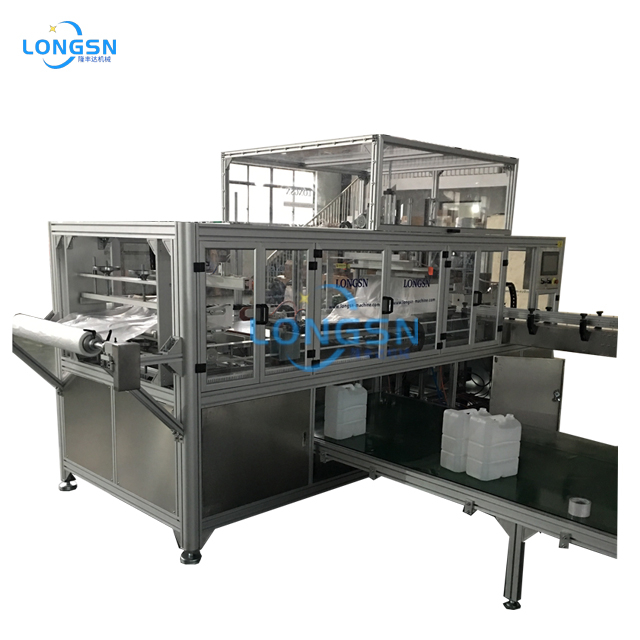
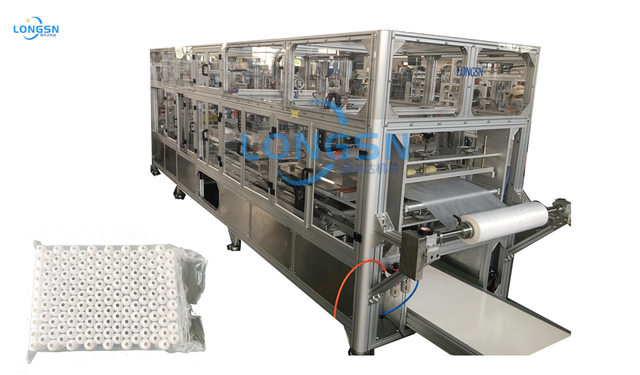
Automated Equipment: An automated bottle bagging machine uses continuous rollstock. It utilizes flat film or tubing. The machine forms, fills, and seals bags seamlessly around a precise matrix of bottles. This eliminates human error completely.
Shortlisting Your Machinery
You must evaluate potential equipment against strict operational criteria. Look closely at how the machine handles rapid production changes.
First, evaluate versatility. Can the machine handle fast changeovers between different bottle sizes? Switching from 500ml PET bottles to 1-gallon HDPE jugs must be seamless. Extended downtime kills daily output targets.
Second, check film format compatibility. Ensure it accepts lower-gauge, coreless rolls. Coreless rolls minimize waste. They also reduce roll changeover downtime significantly. This keeps your line moving efficiently.
Finally, inspect the sealing technology. Look for consistent heat-seal integrity. The seal jaws must match the exact micron thickness of your chosen film. Proper calibration prevents burn-throughs. It also prevents weak seams from splitting open during transport. Consider discussing these specifications directly with a reliable bottle bagger supplier to match equipment to your film.
5. Implementation Risks: Quality Control and Compliance
Procuring materials and installing machinery is only half the battle. You must implement rigorous quality control measures. You also need to anticipate changing environmental regulations.
Verifying Supplier Claims
Gauge is not always a standardized metric across every regional supplier. Some vendors run their extruders on the lighter side to save money. Always request exact mil or micron specifications in writing. Confirm acceptable industry tolerances. A standard variance is usually +/- 10%.
In-House Quality Control
Implement strict standardization checks upon receiving new film rolls. Do not assume every delivery matches your order perfectly.
Use digital or mechanical thickness gauges. Micrometers provide exact thickness readings upon roll receipt.
Conduct visual and physical stress tests regularly. Evaluate seal strength forcefully. Check stretch limits under extreme tension.
Document these findings to hold your suppliers accountable over time.
Regulatory and ESG Compliance
Sustainability regulations affect packaging specifications directly. You must anticipate global extended producer responsibility (EPR) laws. These laws will mandate greener practices.
Evaluate the integration of recycled materials immediately. Look into #2 (HDPE) or #4 (LDPE) films containing Post-Consumer Recycled (PCR) content. Aim for 10% to 50% PCR inclusion. However, exercise caution. Ensure the addition of PCR does not introduce physical impurities. Impurities can weaken the automated heat-sealing process on your bagging line. Test small sample rolls before rolling out PCR films entirely.
Conclusion
Choosing the right film size and bagging method is a multifaceted decision. It requires aligning your mathematical dimensions accurately. You must understand material chemistry to enable smart downgauging. Finally, you must match these material choices strictly to your machinery capabilities.
Take actionable steps today. First, audit your current pallet rejection rates to identify failure points. Second, measure your actual load dimensions against the mathematical formulas provided above. Third, request downgauged sample rolls from your supplier immediately. Run these lighter rolls through your existing machines. Testing verifies seal integrity before you commit to large material orders. These adjustments reduce material waste and stabilize your shipping logistics permanently.
FAQ
Q: What is the standard film thickness for bagging empty PET bottles?
A: Standard thickness usually ranges between 1.5 to 2.5 mil (38–63 microns). The exact requirement depends heavily on the individual bottle weight and overall pallet height. It also depends on whether the film utilizes multi-layer coextruded technology to enhance strength.
Q: Can I run thinner films on my older bottle bagging machine?
A: It depends on your machine's seal-jaw temperature controls and tension rollers. Older machines often lack precise calibration. They may stretch the material aggressively or burn through downgraded films completely. You might need hardware adjustments before running thinner gauges.
Q: Is thicker plastic easier to recycle?
A: No. Recyclability depends on the specific resin identification code (like #4 LDPE). It also depends on the strict absence of contaminants, such as paper labels or trapped moisture. Thinner, pure resin films are highly recyclable and less resource-intensive to process.

 English