Procuring industrial plastics machinery requires balancing upfront capital expenditure against long-term production efficiency. Manufacturers face complex equipment choices when launching beverage or custom packaging lines. You must navigate overlapping industry terminology carefully. For instance, preform injection molding, stretch blow molding, and single-step injection blow molding often cause confusion during procurement. Understanding these differences matters deeply for your capital allocation and factory layout. Choosing the wrong equipment type can severely limit your output capacity. We structured this guide to provide a transparent framework for estimating base machinery investments. You will learn how to calculate custom mold and tooling expenses accurately. We also help you forecast the long-term operational expenses for a commercial production line. This knowledge ensures you invest strategically for sustainable manufacturing growth and operational stability.
Key Takeaways
- Base Price Variability: Equipment ranges from $10,000 for entry-level, semi-automatic blow molders to $500,000+ for high-speed, fully integrated automated lines.
- The 1-Step vs. 2-Step Factor: Integrating preform injection and bottle blowing into a single machine (ISBM) carries a different cost structure and footprint than separating the processes.
- Tooling is a Major Cost Center: Custom mold design and fabrication often represent 15% to 30% of the initial capital outlay.
- Auxiliary Requirements: True project costs must account for high-pressure air compressors, chillers, and dehumidifiers, which are mandatory for PET processing.
Clarifying the Equipment: Injection vs. PET Bottle Blow Moulding Machines
You must understand exact machinery functions before allocating your budget. Buyers often request quotes for the wrong equipment type. This leads to frustrating procurement delays. The industry primarily uses two distinct manufacturing methodologies.
Two-Step Process (Standard for High Volume)
High-volume beverage producers rely almost exclusively on the two-step process. It splits manufacturing into two dedicated systems. This separation maximizes output speeds. It also provides supply chain flexibility.
First, the injection molding machine takes center stage. It melts raw plastic resin pellets. A heavy-duty screw injects this molten plastic into a highly precise mold. This creates the "preform." A preform looks exactly like a thick plastic test tube with threaded neck finishes. You can manufacture preforms in bulk. You can store them for months. You can even ship them efficiently because they consume minimal space.
Next, the PET Bottle Blow Moulding Machine takes over the process. An operator or an automated hopper feeds the preforms into the machine. Infrared lamps reheat the preforms until the plastic softens. A mechanical stretching rod descends into the preform. Simultaneously, high-pressure air injects into the cavity. This forces the soft plastic against the chilled mold walls. The plastic solidifies instantly. The machine ejects the final bottle.
One-Step Process (ISBM)
Single-step injection stretch blow molding combines both actions. One machine performs injection and blow molding continuously. It melts the resin, injects the preform, and blows the bottle in one uninterrupted cycle.
This method excels at producing specialty shapes. Cosmetics brands use it for square bottles. Food packaging companies use it for wide-mouth peanut butter jars. The plastic retains its core heat from the injection phase. This allows for highly detailed bottle geometry. However, it typically yields a lower bottles-per-hour (BPH) rate than two-step systems.
Impact on Budgeting
Your supply chain strategy dictates your equipment needs. You must define this early. Are you purchasing finished preforms from a third-party supplier? If so, you only require a standalone blowing unit. Are you manufacturing everything from raw resin pellets? You will require both machines or an integrated ISBM system.
| Feature | Two-Step Process | One-Step Process (ISBM) |
| Production Speed | Extremely high (Up to 45,000+ BPH) | Moderate to Low |
| Equipment Footprint | Requires two separate large machines | Compact, single-machine setup |
| Best Application | Standard water and beverage bottles | Custom cosmetics and wide-mouth jars |
| Supply Chain Flexibility | Can purchase or store preforms easily | Must process raw resin immediately |
Base Investment Tiers and Production Capabilities
Machinery budgets align directly with your required production volume. Evaluating equipment based purely on capital outlay is a common mistake. You must map the machine's capabilities to your business success criteria. Different production scales require entirely different engineering architectures.
Entry-Level & Semi-Automatic
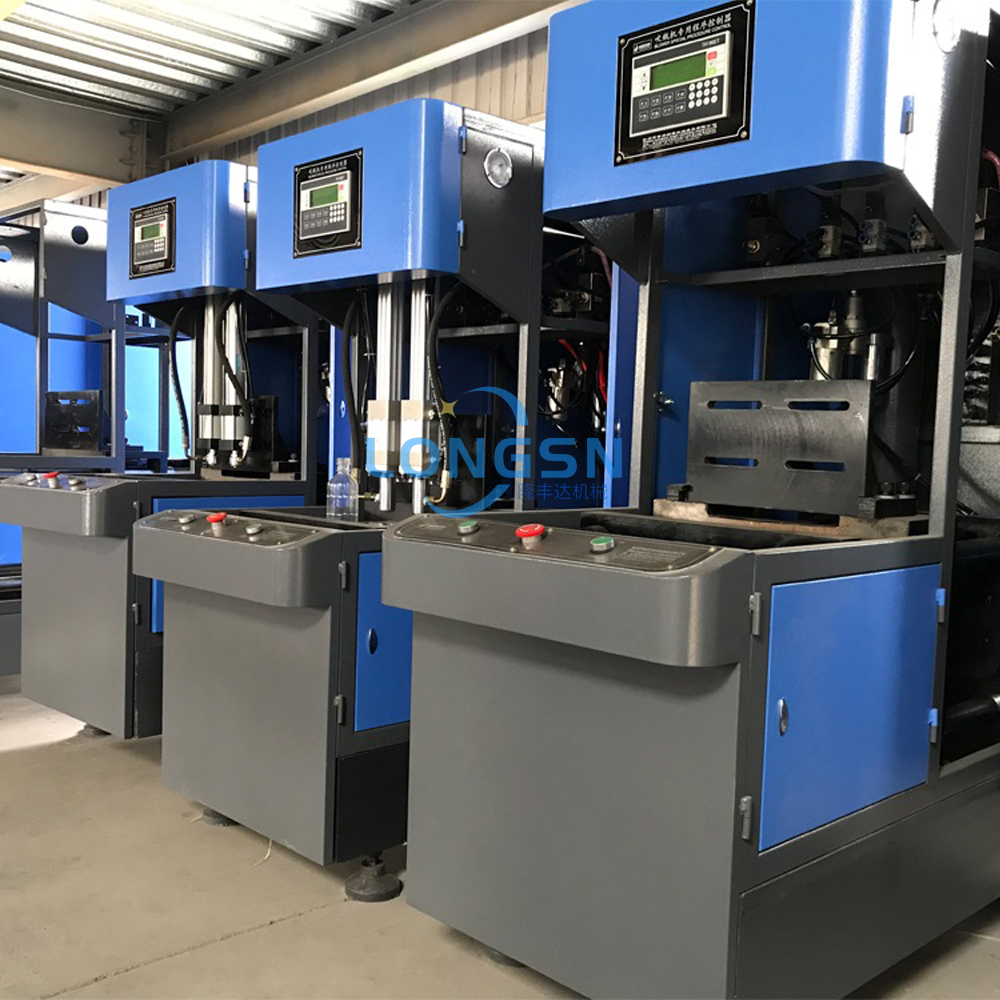
Semi-automatic machines require manual intervention. An operator must physically load preforms into the heating oven. After heating, the operator moves them into the blowing station. Finally, the operator removes the finished bottles. These units deliver output typically under 2,000 BPH.
They are best suited for startups. They work perfectly for low-volume seasonal runs. Packaging engineers also use them to test new bottle designs. They demand a highly labor-dependent workflow. However, they represent the most accessible entry point into plastic manufacturing.
Standard Fully Automatic Systems
Standard fully automatic machines dominate the mid-tier market. They employ standardized linear movement systems. Preforms travel in a straight line through the heating ovens. Automated clamps transfer them into the mold. Production speeds range comfortably from 2,000 to 8,000 BPH.
These units serve mid-sized water and beverage operations perfectly. They eliminate manual loading. They ensure consistent heating profiles. They maintain stable cycle times. Their straightforward mechanical design makes maintenance relatively simple.
High-Speed Rotary & Multi-Cavity Lines
Enterprise-scale beverage manufacturers require relentless output. High-speed rotary lines handle this demand. These machines move preforms in a continuous circular motion. They never stop moving during the heating or blowing phases. This continuous kinematic flow allows them to achieve massive outputs.
Features include advanced servo-motors for precise motion control. They utilize rapid cooling technologies. They achieve minimal reject rates. A typical rotary system can exceed 45,000 BPH. They require significant capital. They also demand highly trained technicians for maintenance.
Specialty/Heavy-Duty Systems
Large volume containers demand specialized equipment. Producing 5-gallon water jugs is entirely different from blowing small soda bottles. Thick-walled preforms require specialized heating profiles. Standard ovens cannot penetrate the thick plastic evenly.
Furthermore, blowing a 5-gallon jug requires significantly higher clamping force. High tonnage prevents the mold from bursting open under pressure. Automated heavy-duty units feature reinforced steel frames. They represent a substantial standalone investment.
The Cost of Tooling: Molds and Cavitation
Tooling represents the most variable expense in plastic manufacturing. Your product design dictates the complexity of the mold. Molds require precision engineering. You cannot compromise on mold quality without sacrificing bottle integrity.
Cavitation Scaling
Cavitation refers to the number of individual bottle shapes cut into a single mold block. A 2-cavity mold produces two bottles per cycle. An 8-cavity mold produces eight bottles per cycle. Increasing cavitation boosts your production speed dramatically.
However, cavitation scaling alters your upfront tooling investment. A 2-cavity mold requires less material and less machining time. It is drastically cheaper. An 8-cavity mold requires a massive block of premium steel. It also requires a larger PET Bottle Blow Moulding Machine with enough clamping force to hold it shut. You must weigh the upfront tooling investment against the per-unit production savings.
Material Quality & Lifespan
Mold material determines longevity. Manufacturers generally choose between aluminum and stainless steel. Each offers distinct advantages.
- Aluminum Molds: They are easier to machine. They cool down rapidly during production. They require a smaller upfront investment. However, aluminum is soft. The mold edges wear out faster. They have a shorter lifespan.
- Hardened Stainless Steel Molds: They resist wear exceptionally well. They handle high-pressure clamping without deforming. They offer a multi-million cycle lifespan. They demand a higher initial investment. High-volume producers rely on steel exclusively.
Prototyping & Design Fees
Custom bottle shapes incur engineering expenses. You cannot simply draw a bottle and machine it. Engineers must calculate the stretch ratios. They must design complex cooling channels inside the mold metal. Water flows through these channels to cool the plastic instantly.
Neck finishes also influence design fees. Standard necks like PCO 1881 are straightforward. Custom thread designs require extensive prototyping. Testing these prototypes ensures the cap seals perfectly. You must factor these engineering hours into your tooling budget.
Hidden Implementation Costs and Auxiliary Equipment
Many buyers focus solely on the primary machine. This causes severe budget overruns. You cannot operate a blow molder without mandatory infrastructure. Auxiliary equipment ensures the core machine functions correctly.
High-Pressure Air Compressors
Standard factory air lines usually deliver 8 to 10 bar of pressure. This is insufficient. Stretching thick plastic requires 30 to 40 bar of air pressure. You must install a specialized high-pressure air compressor. Often, facilities use a booster system. This infrastructure represents a separate, significant capital expense.
Cooling and Thermal Management
Blowing hot plastic creates immense heat. If you eject a bottle too hot, it deforms instantly. Industrial water chillers are mandatory. They pump cold water through the mold's internal channels. Rapid cooling maintains strict cycle times. Sizing your chiller correctly prevents production bottlenecks.
Resin Handling
Plastic resin absorbs moisture from the air. If you melt wet resin, the plastic degrades. The final bottles become brittle. You must use dehumidifying dryers. They strip moisture from the raw pellets before injection. Additionally, auto-loaders pull the dried resin into the machine hoppers automatically. This prevents contamination.
Logistics & Commissioning
Implementing heavy machinery involves logistical expenses. Consider these critical site preparation tasks:
- Freight Forwarding: Shipping heavy steel machinery requires specialized rigging and transport.
- Factory Site Preparation: High-speed machines vibrate intensely. You may need reinforced concrete flooring.
- Electrical Infrastructure: Heating ovens draw massive amperage. Dedicated power drops are essential.
- Vendor Installation: Technicians must travel to your site. They handle leveling, calibration, and operator training.
Evaluating Long-Term Operational Expenses and Vendor Shortlisting
Providing a decision framework helps evaluate vendor quotes beyond the sticker tag. The cheapest machine often becomes the most expensive asset to run. You must analyze ongoing operational variables.
Energy Consumption
Heating preforms and compressing air consume immense electricity. Energy bills will dominate your monthly operating expenses. You must compare power efficiency between vendors. Older hydraulic models consume power continuously. Modern servo-driven electrical systems only draw power when moving. Project your utility expenses over a five-year horizon. Servo systems usually justify their higher initial investment rapidly.
Scrap Rate and Material Waste
Material waste destroys profit margins. A cheaper machine might struggle with consistent heating. It might yield a 3% higher reject rate. Over a single year of high-volume production, that 3% represents millions of wasted preforms. Investing in precise oven controls minimizes scrap. Reliable machinery keeps your material yield high.
Used vs. New Equipment
Refurbished machinery offers an alternative path. It works well for secondary lines. However, you must assess the risks carefully. Avoid machines with unsupported legacy software. If the PLC controller breaks, you cannot source replacement parts. Inspect the tie-bars meticulously. Worn tie-bars cause uneven clamping. This leads to visible seam lines on your bottles. Ensure any used purchase includes verifiable maintenance logs.
Next-Step Actions for Buyers
You must prepare a precise Request for Quote (RFQ). Vague requests generate inaccurate estimates. Follow these best practices when contacting vendors:
- Provide exact physical bottle samples or 3D CAD files.
- State your target bottles-per-hour (BPH) clearly.
- Specify the exact neck size and thread standard.
- Detail your factory's electrical voltage and hertz ratings.
This detailed approach forces vendors to quote the correct machine size. It prevents them from under-sizing the equipment just to win the bid.
Conclusion
The machine's sticker tag represents only one component of your production line investment. You must evaluate tooling, auxiliary infrastructure, and ongoing energy consumption. Proper planning prevents unexpected financial strains during installation. Always align your machine capacity directly with your actual market demand. Over-capitalizing on a massive rotary system for low-volume sales drains resources. Conversely, under-sizing your equipment limits growth. We encourage you to consult with a dedicated tooling engineer. Draft a comprehensive RFQ. Request a customized, itemized quote based strictly on your specific bottle design and volume requirements. Strategic procurement ensures your packaging line runs profitably for years.
FAQ
Q: How much does a custom PET bottle mold cost?
A: Custom mold investments range significantly based on complexity and materials. Simple one-cavity blow molds require accessible, minimal investment. Conversely, multi-cavity hardened steel injection molds demand substantial capital. Complex thread designs and custom cooling channels increase the engineering hours required.
Q: Can one machine make both small bottles and 5-gallon jugs?
A: No. The physical requirements differ entirely. Five-gallon jugs require massive clamping force to hold the mold closed. Their thick preform necks demand specialized heating oven configurations. You must purchase separate, dedicated machines for standard bottles and heavy-duty jugs.
Q: Is it worth buying a used PET blow molding machine?
A: Yes, it works well for secondary lines or startups. However, you must verify the machine's maintenance logs. Ensure it uses standard, modern PLCs so you can source replacement parts. Always inspect the platen parallelism to avoid uneven clamping and bottle defects.
Q: What is the difference between a linear and rotary blow molding machine?
A: Linear machines move preforms in a straight, stop-and-go line. They are highly cost-effective but max out around 10,000 BPH. Rotary machines move preforms continuously in a spinning circle. They handle ultra-high speeds exceeding 40,000 BPH, making them ideal for enterprise operations.

 English