Manufacturing PET bottles goes far beyond simple mechanical movements. It represents a critical business variable where machine efficiency ultimately dictates cost-per-bottle and overall production yield. Maximizing output while minimizing material waste directly impacts your operational success. The right process transforms raw plastic into highly profitable packaging.
Stretch blow moulding stands as the undisputed industry standard for creating PET packaging today. Manufacturers across the globe rely on this highly refined method. It produces containers featuring exceptional clarity, lightweight properties, and robust structural integrity. It enables rapid scaling without sacrificing container quality.
Understanding the underlying physics of this process serves as an absolute prerequisite before making equipment decisions. You will discover exactly how thermal conditioning and biaxial stretching work together to shape resilient containers. This comprehensive guide prepares you to properly evaluate and invest in the right PET Bottle Blow Moulding Machine for your specific production line.
Key Takeaways
- PET bottle production relies on Stretch Blow Moulding (SBM), involving precise thermal conditioning and high-pressure biaxial stretching.
- The choice between single-stage (integrated) and two-stage (preform-to-bottle) machines dictates facility footprint, flexibility, and production scaling limits.
- Evaluating a PET bottle blow moulding machine requires analyzing cavity count, energy consumption (specifically infrared heating and high-pressure air recovery), and changeover times.
- Implementation risks often center on auxiliary equipment mismatches (e.g., inadequate high-pressure air compressors) and operator training requirements.
The Core Process: How a PET Bottle Blow Moulding Machine Works
Creating a flawless plastic container requires perfect synchronization of heat, motion, and pressurized air. A modern PET Bottle Blow Moulding Machine executes these complex physical transformations in fractions of a second. We can break this sophisticated operation down into three distinct phases.
Phase 1: Preform Feeding and Thermal Conditioning
The journey begins with injection-moulded preforms. These look like small plastic test tubes featuring fully threaded necks. Automated unscramblers organize these preforms and feed them onto internal carrier rails. They travel in a continuous line through a specialized infrared (IR) heating oven.
Thermal conditioning requires extreme precision. The body of the preform must absorb enough IR energy to reach its specific glass transition temperature. This target usually sits between 75°C and 85°C. At this exact point, the rigid plastic softens into a highly malleable state. However, one crucial detail dictates success: the neck must remain perfectly cool. Equipment utilizes internal cooling mandrels or chilled water shields to protect the threaded finish. If the neck absorbs heat, the threads distort. Warped threads ruin the container's ability to hold a secure cap.
Phase 2: Biaxial Stretch Blow Moulding (SBM)
Once properly heated, mechanical grippers transfer the softened preform into the open blow mold. The heavy steel mold clamps shut. Now, the machine initiates biaxial stretching. A mechanical stretching rod descends rapidly into the center of the preform. It physically pushes the hot plastic downward toward the mold base. This vertical motion orients the polymer molecules in a linear fashion, giving the final bottle exceptional top-load strength.
Simultaneously, a highly coordinated dual-stage blowing process occurs. First, a low-pressure pre-blow introduces gentle air into the cavity. This expands the plastic outward, preventing it from sticking to the descending rod. It forms a rough balloon shape inside the mold. Immediately after, a high-pressure main blow activates. This blast forces the expanding plastic violently against the chilled walls of the mold cavity, capturing every intricate design detail.
Phase 3: Cooling and Ejection
The plastic must cure instantly upon touching the mold. Industrial water chillers circulate frigid fluid through channels hidden inside the mold walls. This chilled environment rapidly drops the temperature of the PET material. Fast cooling locks in the required shape. It also stabilizes the crystalline structure of the polymer. Slow cooling would cause the plastic to turn cloudy or shrink out of tolerance.
Once the material sets, the internal air pressure exhausts. The mold opens, and automated arms eject the finished bottles onto an outgoing conveyor belt. The entire three-phase cycle often completes in just one or two seconds per cavity.
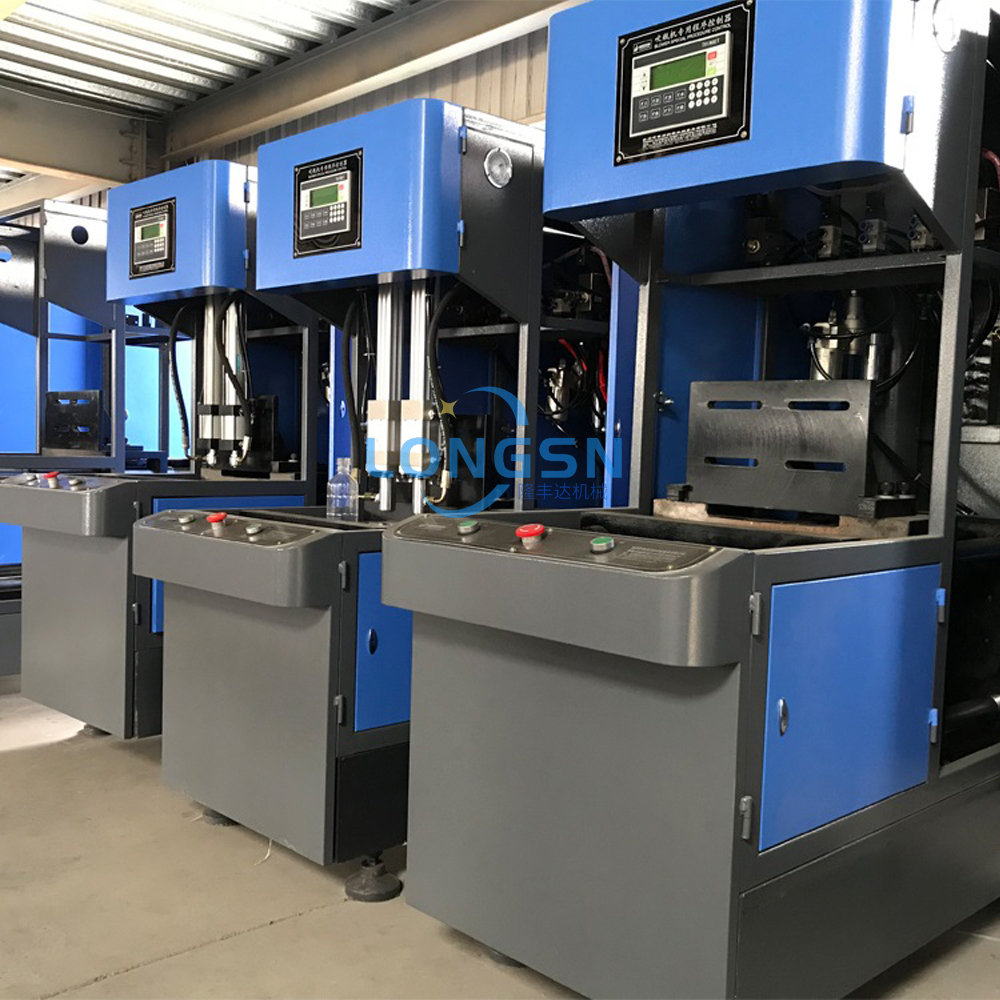
Single-Stage vs. Two-Stage Machines: Which Fits Your Production?
Your first major procurement decision involves choosing the correct process architecture. Manufacturers must frame this as a fundamental business problem. You must base this choice directly on your expected production volume, product variety, and available facility space.
Single-Stage (Injection Stretch Blow Moulding)
Single-stage systems consolidate everything into one continuous cycle. The machine melts raw PET resin pellets, injects the liquid into a preform mold, conditions its temperature, and immediately blows the final bottle. The preform never leaves the machine.
This architecture is best for producing custom, completely blemish-free containers. High-end cosmetic brands and medical companies heavily favor single-stage systems. Because the preforms never drop into a storage bin, they avoid surface scratches entirely. It also requires highly restricted floor space since you need zero preform storage. The primary limitations include noticeably lower output speeds and significantly higher initial tooling costs for the complex injection molds.
Two-Stage (Reheat Stretch Blow Moulding)
Two-stage systems separate the process entirely. You use pre-manufactured preforms fed into a dedicated blow moulding machine. You can either manufacture these preforms yourself on separate injection machines or buy them in bulk from external suppliers.
This setup is best for high-speed, high-volume production lines. The beverage industry relies almost exclusively on two-stage machines to produce water and carbonated soft drink containers. It offers maximum scalability. You can swap preform suppliers easily to keep materials flowing. The main limitations include complex storage logistics. Storing millions of preforms requires vast warehouse space. Additionally, transporting preforms creates friction, introducing risks of minor surface scratching.
Chart: Single-Stage vs. Two-Stage Architecture Comparison | Feature | Single-Stage Architecture | Two-Stage Architecture |
| Core Mechanism | Melts resin, injects, and blows in one continuous loop | Reheats and blows cold, pre-manufactured preforms |
| Best Application | Cosmetic, pharmaceutical, premium custom designs | High-volume beverages, bottled water, mass production |
| Surface Quality | Flawless; zero transport scratching | Good, but vulnerable to minor scuffs during transit |
| Floor Space Needs | Minimal (no preform warehousing required) | Extensive (requires bulk storage for preform inventory) |
| Tooling Complexity | High (requires both injection and blow molds) | Moderate (blow molds only) |
Key Evaluation Criteria for a PET Bottle Blow Moulding Machine
Not all equipment delivers equal value. Assessing a machine requires looking past basic marketing claims. You must evaluate internal mechanics, efficiency metrics, and changeover capabilities to ensure long-term profitability.
Production Output to Cavity Ratio
Buyers must calculate required Bottles Per Hour (BPH) versus the number of machine cavities. A cavity represents one physical mold space. A four-cavity machine blowing 1,500 bottles per cavity yields a theoretical maximum of 6,000 BPH. However, you must always frame this calculation against expected Overall Equipment Effectiveness (OEE).
An OEE of 85% means your real-world output drops to 5,100 BPH. Never buy a machine based purely on its theoretical maximum speed. Always pad your cavity requirements to account for routine maintenance stops, mold changes, and brief operator delays.
Energy Efficiency & Resource Recovery
Focus aggressively on operating expenses. Air generation and thermal heating consume massive amounts of electricity. Evaluate machines that offer high-pressure air recycling systems. These smart setups capture the exhausting 40-bar air from the main blow phase. They route it backward into the low-pressure pneumatic cylinders operating the machine's moving parts. This cuts compressor energy usage drastically.
Similarly, prioritize closed-loop IR heating controls. Older ovens blast heat continuously. Modern intelligent ovens monitor ambient temperatures and preform heat absorption. They dial the lamps up or down dynamically, saving substantial energy while preventing melted preforms.
Automation & Servo-Motor Integration
Compare traditional pneumatic-driven machines against all-electric servo-driven models. Traditional machines use compressed air to drive the stretching rods and mold clamps. They work well but suffer from micro-inconsistencies as air pressure fluctuates.
Servo-driven machines represent a major upgrade. Evidence shows they offer tighter production tolerances, lower ambient noise, and significantly less mechanical wear. A servo motor drives the stretch rod to the exact millimeter every single cycle. This absolute positioning guarantees every bottle features perfectly uniform wall thickness.
Mold Changeover Speed
Assess exactly how quickly the equipment allows for switching bottle designs. A complicated changeover requires operators to unbolt heavy steel blocks, re-route water cooling lines, and recalibrate sensors. This can stall a production line for half a shift.
Fast-change mold systems are highly critical for contract manufacturers handling multiple SKUs. Look for equipment featuring quick-release toggles and snap-in water fittings. An experienced crew should complete a standard mold swap in under forty-five minutes.
Implementation Realities: Hidden Costs and Operational Risks
Acquiring the blow moulding unit only represents step one. Facility managers frequently underestimate the operational infrastructure required to keep these systems running smoothly. You must prepare for specific implementation realities.
The Auxiliary Equipment Trap
We must warn buyers: the primary machine is only part of your overall investment footprint. Many facilities overlook the immense demand for specialized utility support. Without the correct auxiliary setup, the finest equipment becomes useless.
You face an absolute necessity for high-pressure air compressors. Standard factory air lines max out around 8 to 10 bar. Blowing complex shapes or carbonated beverage containers requires a dedicated compressor generating 30 to 40 bar of oil-free air. You also need heavy-duty industrial water chillers to support the rapid cooling phase. Upgrading your factory's utility infrastructure heavily impacts your initial capital requirements.
Scrap Rates During Setup
Address the reality of material waste during daily operations. Whenever operators change a mold or introduce a new batch of preforms, they must dial in the heating profile. This trial-and-error period naturally produces scrap bottles. Necks warp, walls thin out, and bases burst.
Machines equipped with intelligent thermal feedback loops reduce this risk significantly. These systems save specific heating recipes inside the primary logic controller. Operators load the saved profile, and the machine calibrates itself instantly. This reduces setup scrap from hundreds of ruined preforms down to merely a handful.
Environmental & Compliance Factors
Sustainability mandates shift how we process plastics. Lightweighting involves running thinner preforms to reduce plastic usage per bottle. Thinner walls leave virtually zero margin for heating errors. The stretch rod must hit its target perfectly, or the bottle ruptures.
Processing 100% recycled PET (rPET) introduces another major variable. Recycled material typically carries a slightly darker tint than virgin plastic. Darker resins absorb infrared heat at a highly accelerated rate. Your equipment must feature intensely precise oven controls. If the IR lamps lack micro-adjustability, the rPET preforms will overheat, crystallize, and snap inside the mold.
Shortlisting Equipment & Next-Step Procurement Actions
Moving from technical research to active procurement requires a structured approach. You must define your exact needs before engaging equipment vendors. Ambiguity leads to purchasing incorrect machinery.
Defining the User Requirement Specification (URS)
Advise your engineering team to map out precise specifications before contacting any supplier. A strong URS prevents miscommunication. You should strictly document the following criteria:
- Exact bottle volume sizes and complex geometry details.
- Required neck finishes (e.g., 28mm PCO, 38mm wide mouth).
- Target BPH metrics and expected shift durations.
- Maximum available facility power limits and compressor capacities.
Presenting this data ensures vendors only quote machinery capable of surviving your real-world factory environment.
Factory Acceptance Testing (FAT)
We strongly recommend mandating a Factory Acceptance Test. This acts as your ultimate performance guarantee. Do not authorize final equipment payments until the vendor proves the machine works on their own assembly floor.
Crucially, the vendor must run your specific preforms and custom molds during this test. Never accept trials run with generic vendor materials. Demand continuous hour-long test runs to verify guaranteed cycle times. Document every fault, jam, or heating error during the FAT.
Assessing Vendor Support
Mechanical parts inevitably fail. When they do, the speed of recovery dictates your profitability. Emphasize the importance of local spare parts availability. Sourcing a replacement valve from overseas can shut your line down for weeks.
Demand clear technical support Service Level Agreements (SLAs). Ensure the vendor provides comprehensive operator training packages. Your internal mechanics need deep knowledge of the pneumatic logic and servo controls to minimize costly downtime.
Conclusion
Understanding exactly how a PET bottle is blow moulded directly informs much smarter equipment purchasing. The complex interaction between infrared heating, mechanical stretching, and high-pressure blowing demands precision machinery. By mastering these principles, you protect your production line from catastrophic inefficiencies.
The optimal machine choice requires balancing initial capital expenditure against long-term energy efficiency, scrap reduction, and operational flexibility. Look beyond the physical steel and evaluate the software controls, servo integrations, and air recovery systems. These elements transform a standard machine into a highly profitable asset.
Before requesting your first set of equipment quotes, take immediate action internally. Conduct a rigorous audit of your current utility infrastructure. Map your exact limits for electrical draw, high-pressure air availability, and chilled water capacity. This foundational step guarantees a smooth, successful installation.
FAQ
Q: What is the difference between injection blow moulding and stretch blow moulding?
A: Injection blow moulding lacks a mechanical stretching rod. It inflates the plastic freely inside a mold. This works fine for small, basic medical bottles. However, it lacks biaxial stretching. Stretch blow moulding forces the molecules to align vertically and horizontally. This creates the extreme strength and glass-like clarity required for carbonated beverage PET bottles.
Q: How much air pressure does a PET bottle blow moulding machine need?
A: It requires two distinct pressure stages. The initial pre-blow stage typically uses 10 to 15 bar of pressure to form the rough shape. The main blow requires significantly more power. For complex bottle shapes or high-pressure carbonated containers, the machine demands 30 to 40 bar of clean, oil-free, high-pressure air.
Q: Can these machines run 100% recycled PET (rPET)?
A: Yes, modern machines can successfully process 100% rPET. However, recycled materials naturally possess a darker tint. Darker plastics absorb infrared heat much faster than virgin clear resins. The equipment must feature highly adjustable, closed-loop IR oven controls to prevent the preforms from instantly overheating or distributing material unevenly.
Q: How do you control the wall thickness of a blow-moulded PET bottle?
A: Final wall thickness depends primarily on the original preform's weight and design. Once inside the machine, thickness is controlled through precise oven tuning. Operators adjust individual heating zones to warm specific bands of the preform more or less. This targeted heating, combined with exact pre-blow timing, forces plastic into specific areas of the mold.

 English