Investing in a new PET Bottle Blow Moulding Machine requires significant capital and careful strategic planning. The wrong equipment choice often drains operational budgets rapidly. You need a system balancing high performance and manageable running expenses.
Manufacturers regularly struggle balancing upfront equipment expenses against long-term unit economics. Your primary goal remains minimizing the cost per bottle while maintaining structural integrity and consistent production output. A slight miscalculation in capacity or power consumption heavily impacts your profit margins over a decade of operation.
This guide helps you navigate complex technical specifications and avoid costly over-specification. You will learn how to evaluate machine architecture, assess hidden operational expenses, and match equipment capabilities to your actual facility constraints. We break down exactly what matters most when selecting production machinery.
Key Takeaways
- Capacity matching is critical: Target sustained Overall Equipment Effectiveness (OEE) rather than theoretical maximum Bottles Per Hour (BPH).
- Architecture dictates scalability: Rotary machines suit high-volume, continuous runs; linear machines offer flexibility for diverse SKU profiles.
- Hidden operational costs: High-pressure air consumption and electrical heating account for the majority of lifetime running costs.
- Auxiliary dependency: A blow moulding machine is only as reliable as its supporting compressors, chillers, and preform supply chain.
Defining Production Requirements and Success Criteria
Selecting the correct machinery starts by defining your exact production parameters. Many operators buy equipment based on theoretical maximums. This approach frequently leads to underutilized assets. You must audit your actual needs before engaging vendors.
Output Capacity vs. Actual Yield
First, calculate your required Bottles Per Hour (BPH). Base this calculation on seasonal demand peaks rather than your average annual demand. Beverage consumption typically spikes during summer months. If your machine cannot handle peak July volumes, you will lose market share.
Next, you must differentiate between theoretical machine speeds and realistic yields. A machine rated for 20,000 BPH rarely produces 20,000 usable bottles every hour. You need to account for Overall Equipment Effectiveness (OEE). OEE factors in planned maintenance, mould changeovers, and minor stops. A well-optimized facility usually targets an OEE of 85% to 90%. Always base your ROI models on these realistic numbers.
Bottle Specifications and Versatility
Your bottle design directly influences machine selection. Define the exact range of bottle volumes your facility plans to produce. Running 500ml water bottles requires vastly different stroke lengths and heating profiles compared to 5L cooking oil containers. Most standard machines handle a specific volume bracket efficiently.
Design complexity also dictates technical requirements. Assess your portfolio for asymmetrical shapes, deep grips, or heavy-wall cosmetic bottles. Complex designs demand higher blowing pressure to force the PET material into intricate mould corners. They often require specialized stretch rod configurations. Simple cylindrical water bottles require lower pressure, saving significant compressed air energy.
Facility Constraints
A high-performance machine needs adequate physical infrastructure. Map out your available floor footprint. Ensure your concrete floor load capacity supports heavy rotary machinery. Pay special attention to ceiling height. Preform tippers and automatic loaders often require substantial vertical clearance.
Audit your current utility availability. Modern blow moulding systems consume immense amounts of power and chilled water. Calculate the exact electrical load required. Verify your cooling tower or chiller system can handle the heat dissipation from the machine's infrared ovens and hydraulic systems.
Core PET Bottle Blow Moulding Machine Categories
Understanding equipment architecture helps you align machinery capabilities to your business model. Every configuration offers distinct advantages depending on your production scale and product variety.
Linear vs. Rotary Architecture
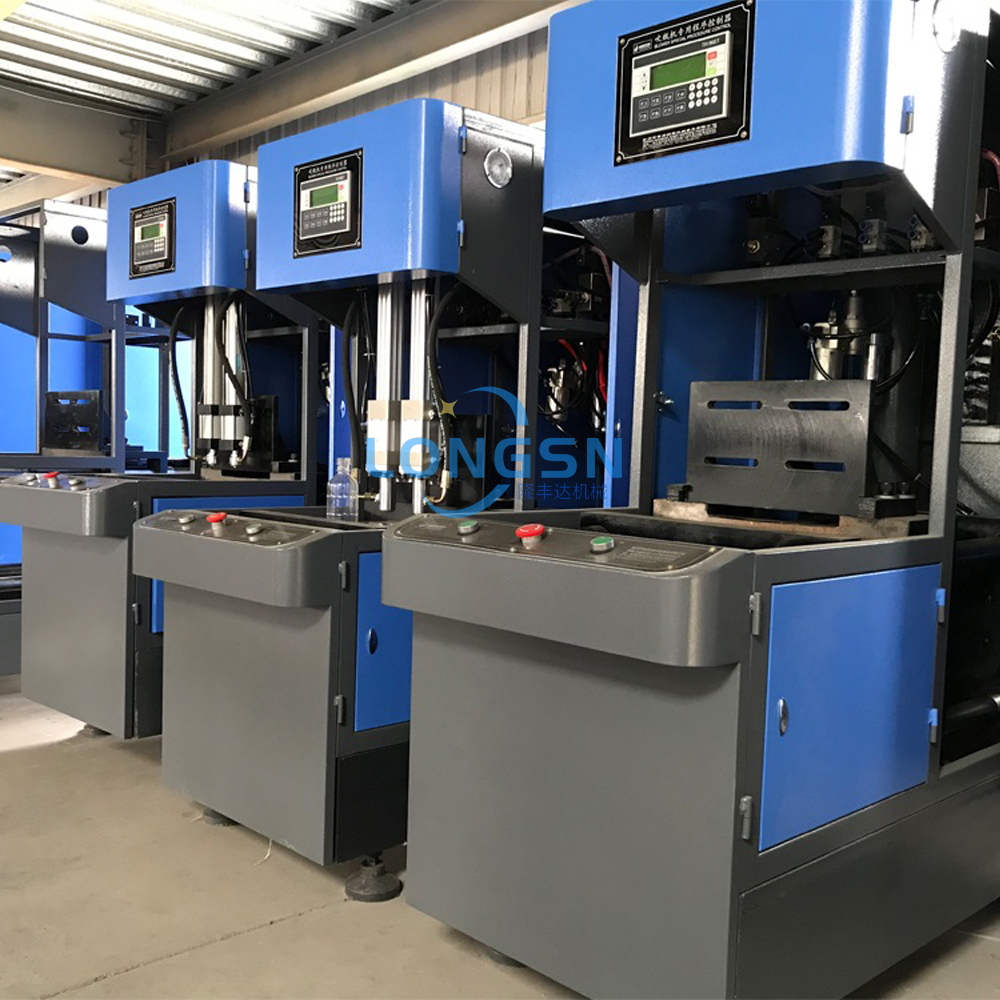
Linear machines transport preforms in a straight line through the heating and blowing stations. They serve best for low-to-medium output, typically topping out around 10,000 BPH. Linear architecture simplifies mould changes. This makes them ideal for co-packers handling frequent SKU swaps. They also require significantly lower initial capital investment.
Rotary machines move preforms continuously around a large carousel. Facilities choose rotary systems for high-speed, high-volume production. They easily exceed 80,000 BPH. Rotary designs offer superior consistency because the continuous motion eliminates the stop-and-go jerking found in linear systems. However, they demand a substantial upfront investment and require longer downtimes for mould changeovers.
Linear vs. Rotary Architecture Comparison | Feature | Linear Architecture | Rotary Architecture |
| Maximum Output | Up to 10,000 BPH | 80,000+ BPH |
| Ideal Application | Frequent SKU changes, diverse products | High-volume, single SKU continuous runs |
| Changeover Time | Fast (1-2 hours) | Slow (4-8 hours) |
| Footprint Required | Moderate | Large |
Fully Automatic vs. Semi-Automatic
Fully automatic systems remain essential for standard beverage lines. They load preforms, heat them, blow the bottles, and eject them onto air conveyors without human intervention. This automation heavily reduces labor dependency. It also eliminates contamination risks, keeping your production sanitary and compliant.
Semi-automatic setups are viable only for highly specific niches. Operators manually load heated preforms into the blowing station. You might use these for large 5-gallon water jugs or highly customized cosmetic runs. Their slow speed and high labor requirements make them unsuitable for standard consumer packaging.
Single-Stage vs. Two-Stage Processes
The two-stage process—known as reheat stretch blow moulding—dominates the beverage industry. In this setup, you purchase or inject preforms separately. Later, the PET Bottle Blow Moulding Machine reheats and blows them. This method separates injection and blowing, allowing you to maximize the speed of both distinct processes.
Single-stage systems combine preform injection and bottle blowing into one machine. The molten plastic goes directly from injection to blowing. This eliminates preform scratching during transport. Facilities utilize single-stage machines primarily for flawless cosmetic containers, pharmaceutical bottles, or specialized custom shapes where visual perfection matters most.
Key Evaluation Dimensions for a PET Bottle Blow Moulding Machine
Once you select an architecture, you must evaluate the specific internal technologies. The right internal systems guarantee long-term reliability and minimal waste.
Energy and High-Pressure Air Efficiency
Compressed air consumption dictates your daily operational expenses. Evaluate the air recovery systems on prospective machines. Modern designs recycle high-pressure exhaust air from the blowing phase. They redirect this air to power low-pressure mechanical pneumatic movements or use it for the initial pre-blowing stage. A robust air recovery system significantly drops your compressor's workload.
Compare infrared heating oven efficiencies. Closed-loop temperature control systems constantly monitor and adjust lamp output based on ambient conditions. Open systems simply run at set voltages. Closed-loop systems drastically reduce electricity waste and maintain stable preform temperatures despite factory temperature fluctuations.
Heating System Precision and Material Distribution
Your machine must profile preform temperatures with exacting precision. Different sections of a preform require different heat intensities to stretch correctly. Assess the oven's capability to adjust individual heating zones independently.
Precise heating directly impacts product outcomes. Correct temperature profiles prevent thick bottoms, thin walls, and pearlescence (the cloudy white appearance caused by over-stretching cold PET). Good material distribution allows you to lightweight your bottles, directly reducing the amount of PET resin wasted per unit.
Mechanical Reliability and Component Sourcing
A machine's reliability mirrors the quality of its internal components. Verify the manufacturer uses industry-standard, locally serviceable parts. Check for recognized brands like Festo or SMC for pneumatics, and Siemens or Allen-Bradley for PLCs. Utilizing standard parts means you can source spares locally during a breakdown.
Evaluate the stretching mechanism carefully. Opt for servo-driven stretch rods over pneumatic ones. Servo motors offer superior control over the stretch rod's speed and final position. This granular control leads to perfect material distribution, especially for difficult bottle shapes.
Changeover and Maintenance Accessibility
Downtime destroys profitability. Calculate the exact time required to swap moulds, change neck personalized parts, and adjust heating oven profiles. Quick-change mould systems represent a mandatory feature for multi-SKU facilities. These systems utilize slide-in mould carriers and quick-release water connections, cutting changeover times from hours to minutes.
Operational Expenses and ROI Modeling
When modeling your return on investment, you must analyze long-term operational economics. Over-focusing on the initial purchase invoice often leads to disastrous financial outcomes.
Initial CapEx vs. Lifetime OpEx
Equipment buyers sometimes select machines based solely on the lowest initial capital expenditure (CapEx). This strategy proves flawed. Over a standard 5 to 7-year lifespan, the electricity and compressed air consumed will vastly exceed the machine's original purchase price.
A highly efficient machine requiring a larger upfront investment often pays for itself rapidly through energy savings. When drafting your ROI models, project the daily kilowatts per hour and the exact volume of high-pressure air required. Compare these ongoing operational expenses (OpEx) against the initial sticker price.
Scrap Rates and Material Yield
Even minor increases in reject rates severely damage profitability. Calculate the financial impact of a 1% increase in scrap. Multiply your hourly BPH by your run hours, then determine the resin weight lost to rejected bottles.
When you multiply that lost resin by current commodity prices, the cost of an imprecise machine becomes obvious. You need equipment delivering steady, predictable material yield. High scrap rates also generate secondary costs, including waste removal and wasted electricity used to blow the defective bottles.
Maintenance and Consumables
Do not ignore the cost of routine wear parts in your ROI calculations. High-speed moving machinery consumes components regularly.
- Seals and O-Rings: High-pressure blowing blocks destroy seals over time. You must replace them to prevent air leaks.
- Infrared Lamps: Heating ovens require lamp replacements to maintain consistent thermal output.
- Pneumatic Valves: Rapid cycling wears out internal valve spools.
Account for planned downtime required to swap these consumables. Accurate ROI modeling includes the lost production hours during scheduled preventative maintenance.
Implementation Risks and Facility Preparation
Installing complex packaging machinery introduces significant facility risks. Proper preparation prevents extended commissioning delays.
Auxiliary Equipment Matching
A common mistake involves upgrading the blow moulder without upgrading the facility's auxiliary equipment. A modern high-speed machine requires massive volumes of 40-bar oil-free compressed air. If your existing high-pressure compressor lacks capacity, your new machine will sit idle waiting for air pressure to recover.
Similarly, blowing moulds require constant chilled water to solidify the hot PET instantly. Undersized chillers lead to distorted bottles and frequent machine alarms. You must size your auxiliary equipment to match the peak demand of your new production line.
Preform Supply Chain Variability
Your machine is highly dependent on your preform supply chain. Inconsistent preform quality causes high scrap rates regardless of machine quality. Two variables matter most:
- Moisture Content: Preforms absorbing humidity before blowing will exhibit structural weaknesses and visual defects.
- Intrinsic Viscosity (IV): Variations in the PET resin's IV alter how the material stretches. Your heating ovens must be recalibrated if the IV fluctuates wildly between batches.
Establish strict quality control agreements with your preform suppliers to protect your operational efficiency.
Operator Competency
Operating a modern servo-driven blow moulder requires advanced technical skills. Yesterday's mechanics managed basic pneumatic logic and simple relays. Today's machines feature complex human-machine interfaces (HMIs) and multi-axis servo synchronization.
Your facility needs technicians possessing PLC troubleshooting capabilities and strong automation backgrounds. Before the machine arrives, invest heavily in training your maintenance team. Without competent operators, your equipment will never hit its target OEE.
Shortlisting Vendors and Next Steps
The final phase involves vetting suppliers and securing technical guarantees. Structured procurement ensures you receive exactly what you expect.
Drafting the Technical RFQ
Your Request for Quotation (RFQ) must leave no room for interpretation. Include your required BPH and attach exact 3D bottle drawings. Specify your preform weights and neck finish dimensions.
List mandatory component brands in the RFQ. Specify the exact make of PLCs, pneumatic cylinders, and servo drives you accept. This prevents vendors from quoting cheap, proprietary components that become impossible to replace later.
Evaluating Vendor Support
Even the best machines experience breakdowns. Assess the vendor's post-installation support infrastructure. Ask for the location of their nearest field service engineer. Confirm they operate a local spare parts depot.
A vendor located across the globe offering cheap equipment becomes very expensive when your line stops and you wait three weeks for a proprietary circuit board. Prioritize partners demonstrating strong regional technical support.
The Factory Acceptance Test (FAT)
Never authorize final payment or shipment without conducting a rigorous Factory Acceptance Test (FAT). Travel to the vendor's manufacturing facility. Demand they run the machine at full speed for a sustained period.
You must mandate they use your specific preforms and your custom moulds during the test. Verify the bottle dimensions, test the drop-impact strength, and check the actual power consumption. Only sign the FAT document once the equipment meets every performance metric outlined in your initial RFQ.
Conclusion
Buying a PET Bottle Blow Moulding Machine represents a major infrastructure decision, extending far beyond a simple equipment purchase. Your choice dictates your facility's energy consumption, labor requirements, and ultimate unit profitability for years to come.
Always base your selection on verifiable OEE rather than theoretical output limits. Prioritize energy recovery systems and servo-driven precision to keep your lifetime running expenses low. Focus intensely on matching your auxiliary equipment, like compressors and chillers, to your new production targets.
Finally, demand complete vendor transparency. Partner with manufacturers willing to prove their machine's performance during a rigorous FAT. By focusing on operational efficiency over the lowest initial sticker price, you build a resilient, highly profitable production line.
FAQ
Q: What is the typical lifespan of a commercial PET blow moulding machine?
A: A commercial machine generally operates reliably for 10 to 15 years. This lifespan depends entirely on proactive maintenance. Regularly replacing wear parts like pneumatic seals, stretch rods, and infrared lamps prevents catastrophic mechanical failures. Operating the machine within its designed speed limits also extends the structural integrity of the frame.
Q: Can one machine blow different sizes of bottles?
A: Yes, machines process various sizes, but physical limits apply. The machine's stroke length dictates the maximum bottle height and volume it can accommodate. Additionally, you must stay within a specific neck size range unless you purchase costly, interchangeable neck handling parts for the entire transfer system.
Q: Why is the high-pressure air compressor sometimes as expensive as the blow moulding machine?
A: Stretch blow moulding requires immense pneumatic force. You need 40-bar, completely oil-free compressed air to force the heavy PET material tightly against the cold mould walls. Generating, filtering, and drying this massive volume of high-pressure air demands highly specialized, robust compressor technology.
Q: What is the difference between hot-fill and cold-fill blow moulding?
A: Cold-fill moulding produces standard bottles for water or carbonated drinks. Hot-fill moulding creates bottles for juices or teas pasteurized at high temperatures. Hot-fill requires specialized heat-resistant moulds and crystallized PET neck finishes to prevent the bottle from shrinking or melting when filled with hot liquid.

 English