Choosing the wrong manufacturing process at the project outset creates heavy burdens. It locks your business into unfavorable unit economics, compromised part performance, or excessive upfront capital expenditures. The decision between extrusion blow molding and injection molding isn't just a simple technical preference. It dictates your tooling budgets, your time-to-market speed, and your long-term scalability.
You must get this decision right before cutting any tool steel. This guide bypasses surface-level definitions to provide a pragmatic, decision-stage evaluation framework. We compare both processes across tooling costs, energy consumption, and overall production viability.
You will learn exactly how to align your product's geometry and market goals with the most efficient manufacturing strategy available. By understanding the distinct mechanical boundaries of each process, you can confidently allocate capital and accelerate your production timeline.
Key Takeaways
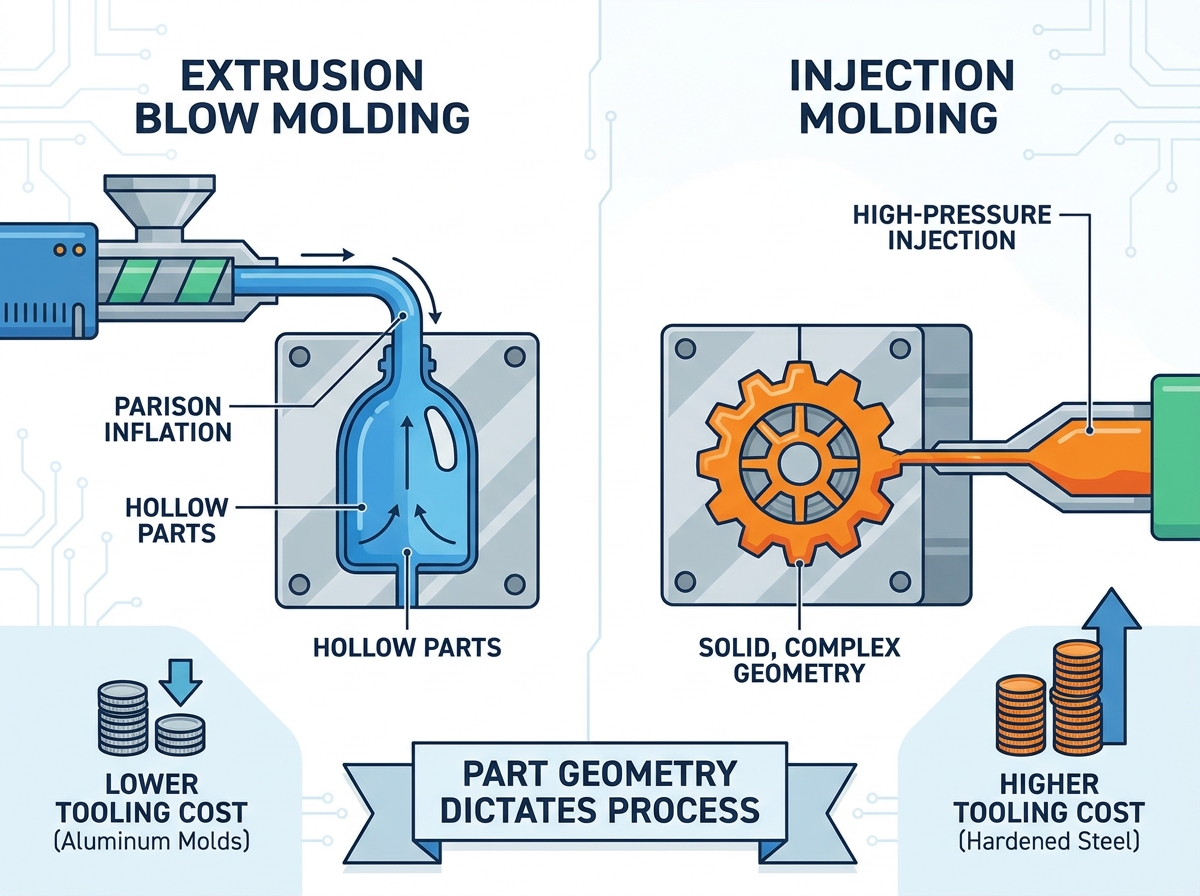
- Part Geometry is the Ultimate Filter: Injection molding is mandatory for complex, solid, high-tolerance parts; extrusion blow molding is the industry standard for hollow, continuous-volume containers.
- Tooling CapEx Discrepancy: Injection molds require hardened steel and handle immense pressure, driving up initial costs and lead times. Blow molding molds often utilize aluminum, drastically lowering the barrier to entry.
- Operational Expense (OpEx): Energy consumption profiles differ significantly; evaluating the power draw of an extrusion blow molding machine versus the high-pressure hydraulic/electric demands of an injection press is critical for ESG and margin goals.
- Tolerance Trade-offs: Injection molding guarantees identical, precise wall thicknesses. Extrusion blow molding requires acceptable tolerance bands for wall thickness variations due to the parison inflation process.
Process Fundamentals and Design Boundaries
Understanding the physics behind each molding technique reveals why certain part geometries succeed while others fail. Both processes start with melted polymer, but they manipulate it in entirely different ways.
Extrusion Blow Molding (EBM) Mechanics
The extrusion blow molding process begins by melting plastic resin and pushing it through a die. This creates a hollow, continuous tube of molten plastic called a parison. Two halves of a mold then close around this parison, pinching it at the top and bottom. A blow pin drops into the mold, injecting compressed air. The air forces the plastic outward against the chilled mold walls.
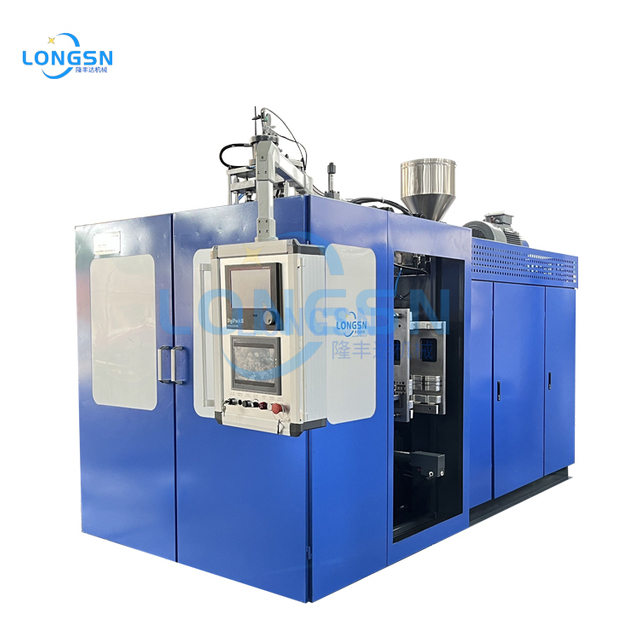
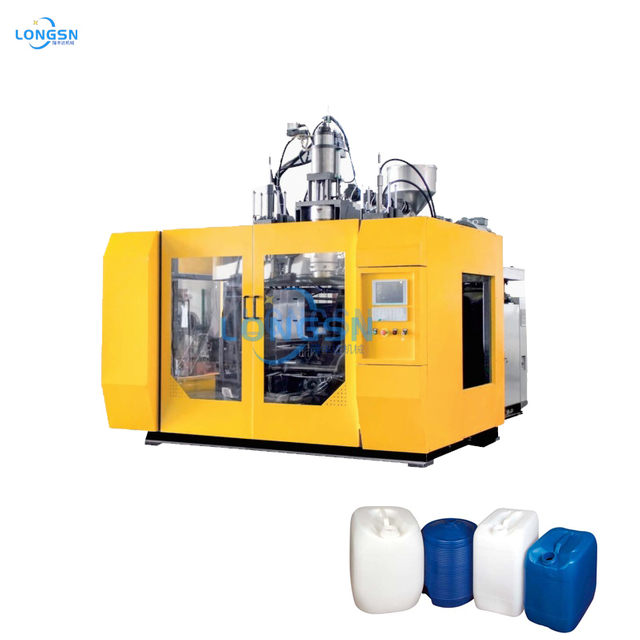
Operating a modern Extrusion Blow Molding Machine requires balancing extrusion speed, air pressure, and cooling times. Process engineers use either continuous extrusion for smaller bottles or accumulator heads for heavy, large-volume parts.
Design Sweet Spot:
- Consumer packaging bottles and jerrycans.
- Automotive air ducts and fluid reservoirs.
- Large industrial holding tanks and drums.
Limitation: You cannot create highly complex internal features. The process also struggles to maintain uniform wall thicknesses across sharp corners. As the plastic inflates, it stretches thinner in corners and areas furthest from the parison center.
Injection Molding Mechanics
Injection molding uses immense force. An injection unit melts the resin and uses a reciprocating screw to ram the material into a closed, highly machined metal mold. The machine holds the mold shut under massive clamping pressure (often thousands of tons). The plastic cools, solidifies, and ejects as a finished part.
Design Sweet Spot:
- Threaded caps and complex closures.
- Tight-tolerance medical device housings.
- Internal structural brackets and gears.
Limitation: You cannot effectively or economically produce hollow parts in a single step. Creating a hollow void requires secondary ultrasonic welding, adhesives, or highly complex overmolding processes.
Mold Tooling and Capital Costs
Your upfront capital allocation depends heavily on mold construction. The environmental pressures inside the molding machines dictate the metals you must use.
Tooling Material and Engineering
Injection molds operate in a high-pressure environment. Molten plastic enters the cavity at pressures frequently exceeding 20,000 PSI. To resist deflection and wear, tooling engineers must cut these molds from hardened metals like P20, H13, or specialized stainless steel. Machining these hardened metals requires extensive CNC time, electrical discharge machining (EDM), and complex polishing. Furthermore, engineers must design intricate cooling channels to remove heat efficiently. Due to these complexities, injection mold lead times often span 8 to 16 weeks.
Blow molds operate differently. Low-pressure inflation (usually under 150 PSI) allows engineers to use aircraft-grade aluminum or softer beryllium copper. Aluminum is significantly easier and faster to machine. This yields lower tooling costs. In fact, blow molds frequently cost 50% to 70% less than equivalent injection molds. You also benefit from much faster prototyping-to-production cycles, enabling quicker market entry.
Maintenance and Lifecycle Risks
Both tooling types experience distinct wear patterns over their operational lifecycles.
- Injection Molds: Wear and tear typically concentrate around gates, runners, and moving ejector pins. High-glass-fill resins act like sandpaper, eroding the steel over hundreds of thousands of cycles. Maintaining these tools requires specialized welding and re-machining.
- Blow Molds: The primary failure point lies at the pinch-offs. The mold must physical crush the molten parison to seal it. Over time, these pinch edges dull. Cheaper aluminum blow molds may require more frequent maintenance on these pinch areas. If you neglect this maintenance, the machine will produce excessive flashing, requiring expensive manual trimming.
Production Volume, Speed, and Material Yield
Once you commit to a tooling strategy, daily production economics take over. The speed at which you produce parts directly impacts your margins.
Cycle Times and Output
Injection molding provides rapid, multi-cavity cycle times. A single mold can hold 32, 64, or even 128 cavities. The machine fills them all in seconds. You can eject hundreds of small parts per minute.
Blow molding cycle times depend heavily on cooling. A thick parison takes longer to freeze against the mold wall. However, modern manufacturing narrows this output gap. Rotary wheel setups or multi-head machine configurations allow manufacturers to produce high-volume consumer packaging at staggering speeds. Multiple molds rotate continuously, capturing parisons in a seamless loop.
Manufacturing Metrics Comparison
| Feature | Injection Molding | Extrusion Blow Molding |
| Standard Tooling Material | P20, H13 Steel | Aluminum, Beryllium Copper |
| Internal Pressure | Very High (>10,000 PSI) | Low (<150 PSI) |
| Scrap Generation | Near Zero (with Hot Runners) | Requires Flash Trimming |
| Typical Cycle Dictator | Injection Speed & Wall Thickness | Cooling Time & Parison Drop |
Scrap and Flash Management
Material waste erodes profitability. You must handle scrap efficiently.
Injection molding systems utilize advanced runnerless designs. Hot runner manifolds keep the plastic molten right up to the part cavity. This technology achieves near-zero scrap, as the machine only injects material directly into the final part. Any cold runners produced can usually go straight into a grinder.
Extrusion blow molding inherently produces flash. When the mold halves clamp shut, they pinch off the top and bottom of the parison, leaving excess material. Facilities manage this waste using in-line granulators. Automated trimmers snap the flash off the bottle and drop it onto a conveyor. A grinder chops it up, and a closed-loop vacuum system feeds it directly back into the extruder hopper. This mitigates material waste efficiently.
Energy Efficiency and Sustainability
Manufacturing facilities face intense pressure to reduce their carbon footprints. The power requirements for each process differ fundamentally.
Power Consumption Profiles
When you evaluate energy consumption, look at the mechanical movements. An extrusion process carries a continuous thermal and mechanical load. The extruder screw turns constantly, melting and pushing resin to form the parison. Heater bands draw steady power.
In contrast, an injection press draws spike-heavy energy. The machine uses massive hydraulic or electric force to clamp the mold shut. It then spikes power again to fire the injection ram. While all-electric injection presses reduce this draw, the intermittent, high-pressure demands create different peak-load profiles on a facility's electrical grid.
Cooling Demands
Both processes require dedicated industrial chillers to remove heat. However, cooling a solid, thick-walled injection molded part demands aggressive thermal management. Plastic acts as an insulator, so heat traps easily in the center of thick sections.
Cooling a thin-walled blow molded container works differently. The chilled mold cools the outside skin quickly, while the inflation air inside can be continuously flushed (using internal cooling technology) to extract heat from the inner wall. This dual-action cooling helps speed up the cycle time for larger hollow parts.
Sustainability Metrics
Handling Post-Consumer Recycled (PCR) resins is critical for modern brands. Extrusion blow molding adapts exceptionally well to PCR. It allows for multi-layer co-extrusion. Manufacturers can set up an A-B-A layer structure. They sandwich dark, inconsistent PCR resin in the middle layer. They then coat the inside and outside with pristine virgin plastic. This ensures virgin material contacts the product inside, while maintaining brand aesthetics outside.
Standard injection molding struggles to achieve this economically. Coinjection exists, but it requires highly complex, expensive specialty presses. Generally, injection molded parts mix PCR directly with virgin resin, which can degrade structural integrity or surface finish.
Decision Framework: Shortlisting Your Manufacturing Strategy
Navigating these two distinct technologies requires matching your product requirements to the physical realities of the machinery. Use this framework to finalize your direction.
When to Choose Injection Molding
Select injection molding when your part demands precision and structural rigidity. It remains the gold standard for dense, complex components.
- Precision Requirements: You require sub-millimeter precision and strict dimensional stability. If parts must snap together perfectly every time, injection presses deliver.
- Solid Complexity: The part is solid, requires complex internal ribbing, or needs a Class-A surface finish straight out of the mold.
- Capital Allocation: You have the budget to absorb high upfront tooling costs in exchange for incredibly low piece-prices at scale.
When to Invest in an Extrusion Blow Molding Machine (or Partner)
This process dominates the packaging and fluid-handling sectors. It offers an unbeatable path for hollow geometries.
- Hollow Geometry: The primary product is a hollow vessel, bottle, tank, or continuous container.
- Budget Constraints: You need to minimize initial tooling capital to test a market quickly or achieve a faster return on investment.
- Flexible Tolerances: The part design can tolerate slight variations in wall thickness and minor flash-trimming marks along the parting line.
Conclusion
Neither manufacturing process is objectively superior. Their utility remains strictly dictated by your part geometry, your tolerance demands, and your capital allocation strategies. Choosing correctly ensures efficient production, minimizes scrap, and keeps energy costs predictable.
Take these actionable next steps to secure your project:
- Lock Your Geometry: Finalize a robust 3D CAD model that clearly defines whether your part is structurally solid or fundamentally hollow.
- Execute a DFM Analysis: Consult with tooling engineers to conduct a Design for Manufacturability (DFM) review. This identifies potential pinch-off failures or cooling constraints early.
- Map Your Volumes: Calculate your expected annual volumes to justify either the heavy steel investment of injection tooling or the rapid aluminum deployment of blow molding.
- Audit Energy Needs: Review your facility's power infrastructure to accommodate either steady continuous extrusion loads or intermittent high-tonnage spikes.
FAQ
Q: Can injection molding be used to make hollow parts?
A: Yes, through specialized sub-processes like gas-assist injection molding or two-part assembly. However, it is highly inefficient and expensive for standard containers compared to blow molding. Producing a basic bottle via injection molding usually requires secondary welding steps, significantly increasing cycle times and labor.
Q: Which process has a faster time-to-market?
A: Extrusion blow molding typically wins due to its reliance on aluminum tooling. Aluminum is significantly faster to CNC machine, polish, and validate than the hardened steel required for high-pressure injection molds. This shorter tooling phase shaves critical weeks off your launch schedule.
Q: Is an extrusion blow molding machine cheaper to operate than an injection press?
A: It depends heavily on the tonnage and configuration. Blow molding machines operate at lower pressures, reducing mechanical stress and clamping costs. However, continuous extrusion requires steady thermal energy. In-line flash trimming also adds secondary pneumatic or mechanical energy costs. Evaluate your specific local power rates.
Q: Which process handles recycled plastics (PCR) better?
A: Extrusion blow molding is highly adaptable to PCR. Through advanced co-extrusion capabilities, manufacturers can hide recycled content in the middle layer of the container wall. This A-B-A structure ensures virgin material contacts the internal product and maintains exterior aesthetics, which is much harder to do in injection molding.

 English