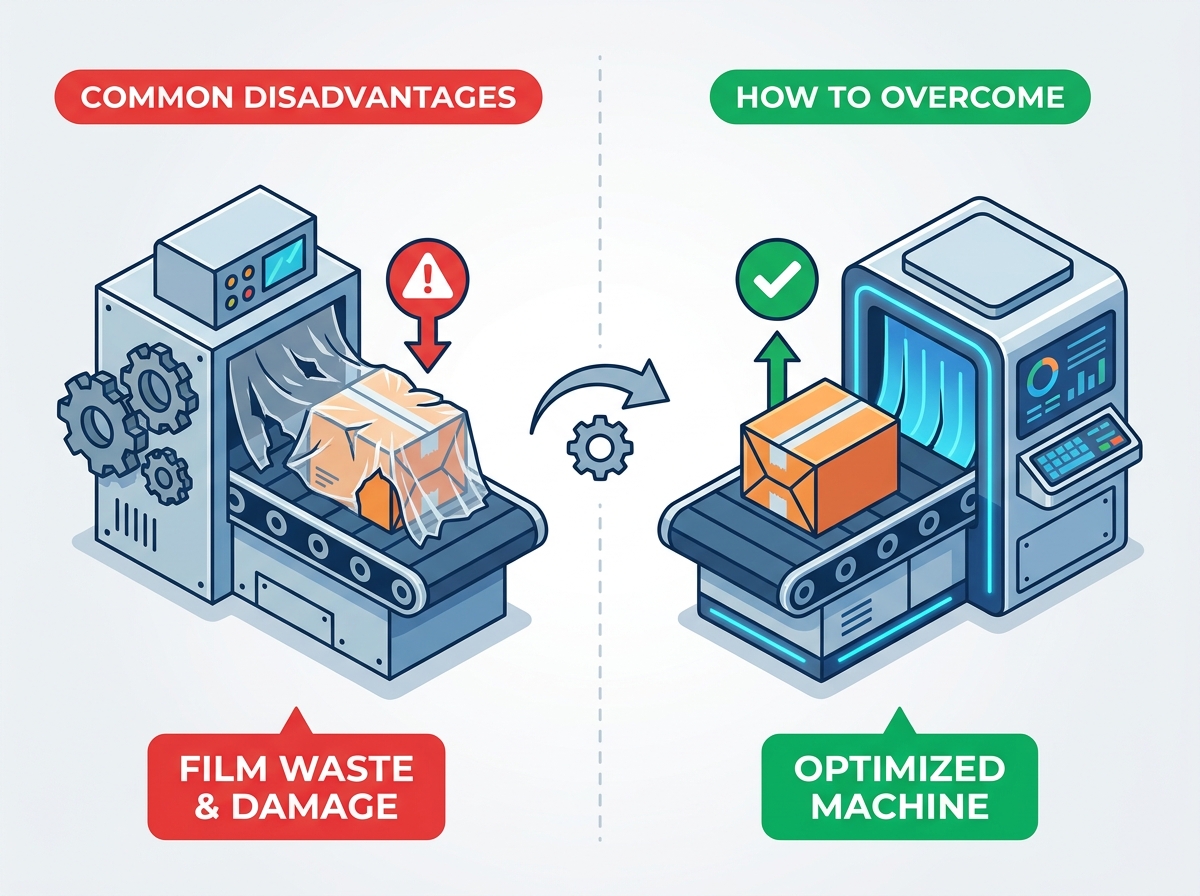
Shrink wrapping is a global standard for product unitization and retail display. However, inherent process limitations and operational inefficiencies cost packaging facilities thousands annually in wasted material and energy. Facility managers often struggle to determine if packaging bottlenecks, product damage, and high utility bills are caused by fundamental flaws in the shrink wrapping process, incorrect film selection, or outdated equipment. You might look at a pallet of poorly wrapped goods and wonder if the machinery is failing or if the materials are simply wrong for the application. Most perceived disadvantages of shrink wrapping can be engineered out of the process. We will dissect common shrink wrapping failures, evaluate material limitations, and provide a technical framework for calibrating, upgrading, or replacing your equipment to eliminate waste and protect your products.
- Defects are Symptoms, Not Inevitabilities: Visual flaws like "dog ears," "fish eyes," and "angel hair" are rarely inherent flaws of the method; they are direct indicators of poor machine calibration, incorrect heat tunnel settings, or mismatched film gauge.
- Material and Application Mismatches: Shrink wrapping is not universally applicable. Sharp-edged, highly heat-sensitive, or highly compressible products require specialized cross-linked films or entirely different packaging methodologies.
- Sustainability and Energy Trade-offs: The environmental impact of plastic use and the high energy consumption of traditional heat tunnels can be heavily mitigated by upgrading to energy-efficient shrink wrapping machines and utilizing modern, recyclable polyolefin (POF) films.
- Equipment ROI: Upgrading from manual or legacy semi-automatic wrappers to modern automated systems reduces film waste by up to 30% and significantly lowers overall expenses through precise temperature and conveyor speed controls.
Evaluating the Inherent Disadvantages of Shrink Wrapping
High Energy Consumption in Heat Tunnels
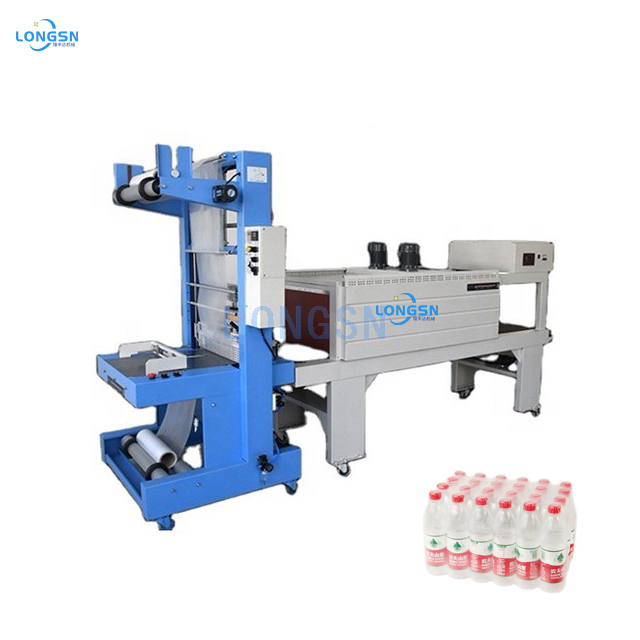
Maintaining consistent temperatures in shrink tunnels requires massive energy input. Legacy systems rely on continuous-run heating elements. These elements draw maximum power regardless of actual product throughput. This constant energy draw inflates utility bills and puts a heavy load on facility power grids. Modern operations must evaluate the operational trade-offs of continuous-run heating elements versus on-demand systems. Comparing the kilowatt-hour costs of legacy tunnels against modern, insulated, recirculating-air heat tunnels reveals massive efficiency gaps. Upgrading your Shrink Wrapping Machine to a model with advanced thermal management drastically reduces baseline energy consumption. Heat loss through poorly insulated tunnel curtains also forces heating banks to overwork. You need to measure the ambient temperature around the tunnel. If the surrounding air is hot, you are paying to heat the warehouse, not the shrink film.
| Tunnel Type | Heating Mechanism | Energy Efficiency | Heat Loss Mitigation |
| Legacy Single-Zone | Continuous radiant heat | Low | Basic silicone curtains |
| Modern Dual-Zone | Recirculating forced air | High | Double-insulated walls, heavy-duty curtains |
| On-Demand Infrared | Sensor-activated IR banks | Very High | Targeted heating, minimal ambient loss |
Environmental Impact and Material Waste
The reliance on single-use plastics presents environmental challenges. Facilities face increasing regulatory pressures regarding plastic waste. Improper machine settings exacerbate this issue by causing high scrap rates, film web breaks, and excessive trim waste. When operators fail to optimize film feed and tension, material consumption spikes. Utilizing non-recyclable PVC films poses compliance risks in certain global markets. Transitioning to recyclable materials and fine-tuning equipment settings are necessary steps to mitigate environmental impact. You must track your scrap rate daily. A poorly calibrated Shrink Wrapping Machine will generate miles of wasted trim over a single shift. Adjusting the scrap take-up wheel tension prevents web breaks and keeps the line moving.
Limitations with Specific Product Types
Shrink wrapping is not suitable for every product. Heat-sensitive goods like chocolates, cosmetics, or sensitive electronics risk thermal damage during the tunnel phase. Sharp-edged products with rigid corners or protruding metal parts easily puncture standard-gauge films during the shrinking process. High film tension causes small punctures to instantly propagate, compromising the entire package's structural integrity. Facilities must assess product characteristics carefully before committing to a shrink wrapping process. You often need specialized films or alternative packaging methods for challenging items. If you wrap heavy metal parts, standard polyolefin will tear. You must switch to a cross-linked film or a heavy-duty polyethylene blend.
The Transparency, Thickness, and Security Trade-Off
Packaging engineers face a constant compromise between high-clarity transparent films and the increased gauge thickness required to maintain load stability. Retail displays demand aesthetic clarity. Heavy or irregular loads require thicker, often cloudier films for durability. High-transparency film presents security disadvantages for high-value retail goods during transit. It exposes contents to potential theft. Facilities should consider opaque or tinted films to obscure valuable products. This balances security needs with structural requirements. You cannot use a 45-gauge display film to secure a 20-pound bundle of industrial components. The film will fail during transit.
Post-Packaging Shipping Risks: Secondary Shrinkage and Fusion
High temperatures inside cargo trucks or shipping containers trigger secondary shrinkage. This warps products post-production. Packaged products can also fuse or stick together inside shipping boxes due to residual heat or high-tack film properties. This is known as blocking. You must allow products to cool adequately before case packing. Installing cooling fans at the exit of the heat tunnel drops the film temperature rapidly. This sets the shrink memory and prevents blocking. If your operators pack hot products directly into corrugated boxes, the film will stick to the cardboard and ruin the retail presentation.
Diagnosing Common Visual and Structural Defects
"Dog Ears" and "Crow's Feet" (Corner Wrinkling)
"Dog ears" appear as triangular protrusions of un-shrunk film at the corners of a package. "Crow's feet" are fine wrinkles radiating from the edges. These defects stem from insufficient heat, a conveyor speed moving too fast, or oversized film bags. To resolve this, operators must adjust the heat tunnel temperature and conveyor speed ratios. Ensuring the film bag size closely matches the product dimensions minimizes excess material.
- Measure the product dimensions and verify the film width is correct.
- Reduce the conveyor speed by 10% to increase dwell time inside the tunnel.
- Increase the tunnel temperature in 5-degree increments until the corners pull tight.
- Check the airflow baffles inside the tunnel to ensure hot air is directed at the corners of the package.
"Fish Eyes" and "Ballooning" (Air Evacuation Failures)
"Fish eyes" are round, un-shrunk patterns on the flat surfaces of the package. "Ballooning" occurs when the package inflates and pops inside the tunnel. Both defects indicate a lack of air evacuation before sealing or inadequate vent holes in the film. Adjusting the pin perforator wheel on the Shrink Wrapping Machine ensures proper air escape during the shrinking process. Proper perforation allows trapped air to vent smoothly.
- Inspect the pin perforator wheel for dull or broken pins.
- Adjust the depth of the perforator wheel so it fully pierces both layers of the centerfold film.
- Add a second perforator wheel if the product is large and traps excessive air.
- Ensure the film is not slipping away from the perforator during the feed cycle.
"Angel Hair" and Weak Seals
"Angel hair" consists of thin, stringy strands of plastic stretching from the seal seam. This is often accompanied by seals that easily pop open. This issue is caused by uneven pressure on the sealing head, a dirty sealing wire, or an incorrect sealing temperature. Regular maintenance is required. Operators should clean sealing blades with non-abrasive tools and replace worn PTFE tape promptly. Maintaining optimal sealing temperatures prevents the film from melting unevenly.
- Turn off the machine and allow the sealing jaw to cool completely.
- Remove the old PTFE tape and clean the sealing wire with a brass brush.
- Apply new PTFE tape smoothly, ensuring there are no air bubbles or wrinkles.
- Check the sealing pad for deep grooves or burns and replace the silicone rubber if damaged.
- Calibrate the jaw pressure to ensure even contact across the entire length of the seal.
Strategic Solutions: Overcoming Limitations with Modern Equipment
Upgrading Your Shrink Wrapping Machine
Moving from a manual L-sealer to a fully automatic side sealer or continuous motion wrapper is justified when production volumes exceed manual capacity. Modern PLCs allow operators to save specific recipes for different product SKUs. This ensures repeatable, defect-free wrapping by automatically adjusting seal times, temperatures, and conveyor speeds. An upgraded Shrink Wrapping Machine eliminates the guesswork from changeovers. It increases throughput and reduces material waste. Manual machines rely entirely on operator skill. If the operator presses the sealing jaw too hard or too soft, the seal fails. Automated systems apply exact pressure for an exact duration every single cycle.
Optimizing Film Selection
Selecting the correct film is as important as calibrating the machine. Polyolefin is ideal for retail display due to its clarity and strength. Polyethylene is suited for heavy-duty transit and bullseye wrapping. PVC is largely being phased out due to environmental concerns. For sharp-edged products, cross-linked POF provides higher puncture resistance and stronger seals. Matching the film type and gauge to both the product and the machine capabilities ensures optimal performance. You cannot run heavy polyethylene film on a machine designed for light-gauge polyolefin. The sealing jaws will not get hot enough to cut and seal the thicker material.
| Film Type | Primary Application | Clarity | Puncture Resistance |
| Standard Polyolefin (POF) | Retail boxes, food packaging | Excellent | Moderate |
| Cross-Linked POF | Sharp-edged items, irregular shapes | Very Good | High |
| Polyethylene (PE) | Heavy multipacks, water bottles | Poor (Cloudy) | Very High |
Implementing Preventative Maintenance Protocols
Consistent maintenance prevents downtime and defect recurrence. A realistic schedule includes weekly and monthly tasks. You must lubricate chains, inspect silicone pads, and verify thermocouple accuracy. Keeping the sealing mechanisms clean and ensuring the heat tunnel airflow remains unobstructed are critical for consistent operation. A well-maintained Shrink Wrapping Machine operates efficiently and extends the lifespan of wear parts. Neglecting the conveyor belt inside the heat tunnel leads to tracking issues. If the belt drifts, products jam inside the tunnel and catch fire.
- Blow out dust and debris from the electrical cabinet weekly to prevent overheating.
- Inspect the hot hole punch mechanism and clear any melted plastic buildup.
- Check the tension on the film unwind rollers to prevent the film from wandering.
- Verify the accuracy of the tunnel temperature controller using an external infrared thermometer.
Alternative Packaging Methods: When to Pivot Away from Shrink Wrapping
Shrink Wrapping vs. Stretch Wrapping
Shrink wrapping uses heat for unitization. Stretch wrapping relies on tension for palletization. When bundling heat-sensitive multipacks, stretch banding often serves as a better alternative. Stretch banding secures products without exposing them to the thermal stress of a heat tunnel. This makes it ideal for items that might melt or warp under high temperatures. Stretch banding machines use a mechanical arm to wrap a band of stretch film tightly around a bundle. There is no heat involved. This saves energy and protects the product.
Shrink Wrapping vs. Automated Cartoning or Flow Wrapping
Flow wrapping is a superior alternative for high-speed, individual food items where a tight shrink is unnecessary and heat is detrimental. For fragile or highly irregular items, transitioning to corrugated cardboard cartoning provides premium protection. Cartoning eliminates the thermal damage risk entirely and offers superior structural defense during transit. Flow wrappers form a loose bag around the product and seal the ends. This is much faster than shrink wrapping and uses less energy because there is no heat tunnel required.
Calculating the True Cost of Inefficiency
You must calculate the hidden costs of legacy shrink wrapping. This includes the cost of film waste, rework labor, and excess energy consumption. When a package fails inspection due to a weak seal or a massive dog ear, an operator must manually cut the film off, discard it, and run the product through the machine again. This doubles the material cost and halves the production speed for that unit. Investing in a modern, energy-efficient system with precise film-feed mechanisms yields a rapid return on investment through material savings and reduced utility overhead. You stop paying for wasted film and you stop paying to heat empty air.
Conclusion
Audit your current defect rates and energy bills. If defects are high, calibration and maintenance are step one. If throughput is bottlenecked or energy costs are prohibitive, an equipment upgrade is required. If the product is highly heat-sensitive or sharp, alternative methods must be evaluated.
- Schedule a comprehensive packaging audit to identify specific defect rates and energy consumption levels on your current line.
- Implement a strict preventative maintenance schedule focusing on sealing blade cleaning and heat tunnel airflow calibration.
- Test alternative film materials, such as cross-linked POF, to resolve ongoing puncture and seal strength issues.
- Request a sample run of your product on a modern automated system to verify potential speed and quality improvements.
FAQ
Q: What causes "dog ears" on shrink-wrapped products?
A: "Dog ears" are caused by insufficient heat in the shrink tunnel, the conveyor moving too quickly, or using a film bag that is too large for the product. Adjusting tunnel temperature and slowing the conveyor speed usually resolves this defect.
Q: Why are there holes or "fish eyes" in my shrink wrap?
A: "Fish eyes" occur when air cannot escape the package during the shrinking process. This is fixed by adjusting the pin perforator wheel on the machine to ensure adequate vent holes are created in the film before sealing.
Q: How can I prevent "angel hair" on my seals?
A: "Angel hair" is caused by incorrect sealing temperatures, dirty sealing blades, or uneven jaw pressure. Clean the sealing mechanism, replace worn PTFE tape, and adjust the temperature settings to ensure a clean, sharp cut.
Q: Is shrink wrapping safe for heat-sensitive products?
A: Standard shrink wrapping can damage heat-sensitive goods like chocolate or electronics. For these items, consider alternative methods like stretch banding or flow wrapping, which secure the product without requiring a high-temperature heat tunnel.
Q: When should I upgrade from a manual to an automatic shrink wrapper?
A: Upgrade to an automatic system when manual labor cannot keep up with production volume, when defect rates increase due to operator inconsistency, or when you need programmable controls for repeatable, fast SKU changeovers.
Q: Why do my shrink-wrapped packages stick together in the shipping box?
A: Packages stick together, or block, when they are packed into boxes before the film has fully cooled. Install cooling fans at the exit of the heat tunnel to drop the film temperature rapidly and set the shrink memory.

 English